
They saw a dip and they bought it


Credit those who anticipated that major stock indexes would enter May 2026 at record highs. And kudos especially to those who based that forecast on nothing more than the rock-ribbed conviction that, when it comes to stock prices, the line goes up. Doubters may fret about geopolitics, industrial supply chains, and food and fuel availability, but whose brokerage account balance has profited from listening to them over the past decade?
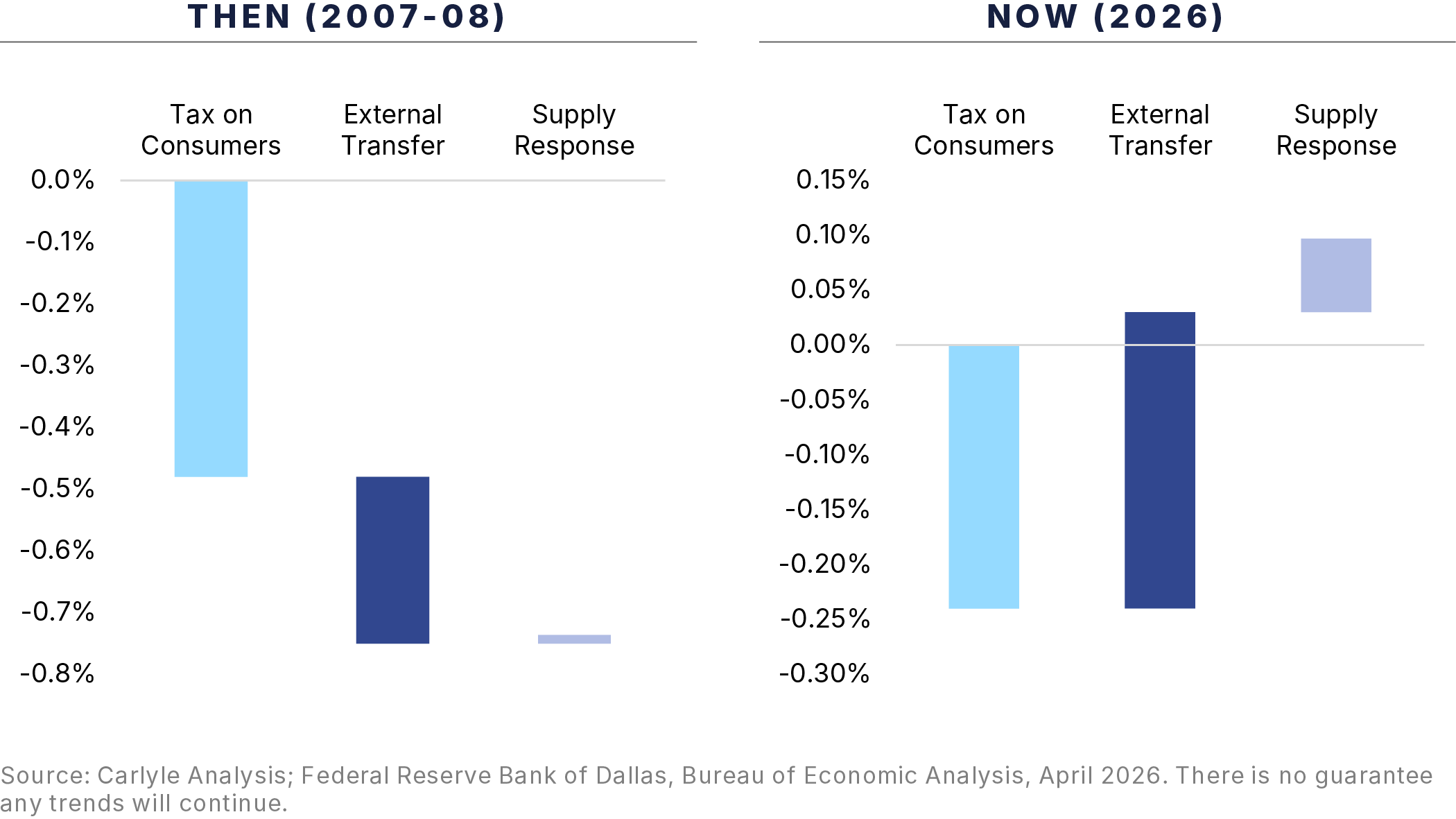
There are “fundamental” reasons that stock prices have risen even as the Strait of Hormuz remains closed. Advanced economies are far less hydrocarbon-dependent than 20 years ago. Since 2006-07, nominal income in the US has doubled even as oil prices have oscillated in the same range; over the same period, real GDP is 50% larger but the economy consumes roughly the same amount of oil. When you add in the dramatic reversal in the net energy trade balance from deficit to surplus (“The risk is time”) and the capex stimulated by higher energy prices, the first $20 of the increase in oil prices since the start of the conflict probably added to US GDP on net (Figure 1).
Figure 1: High oil prices, where is thy sting?
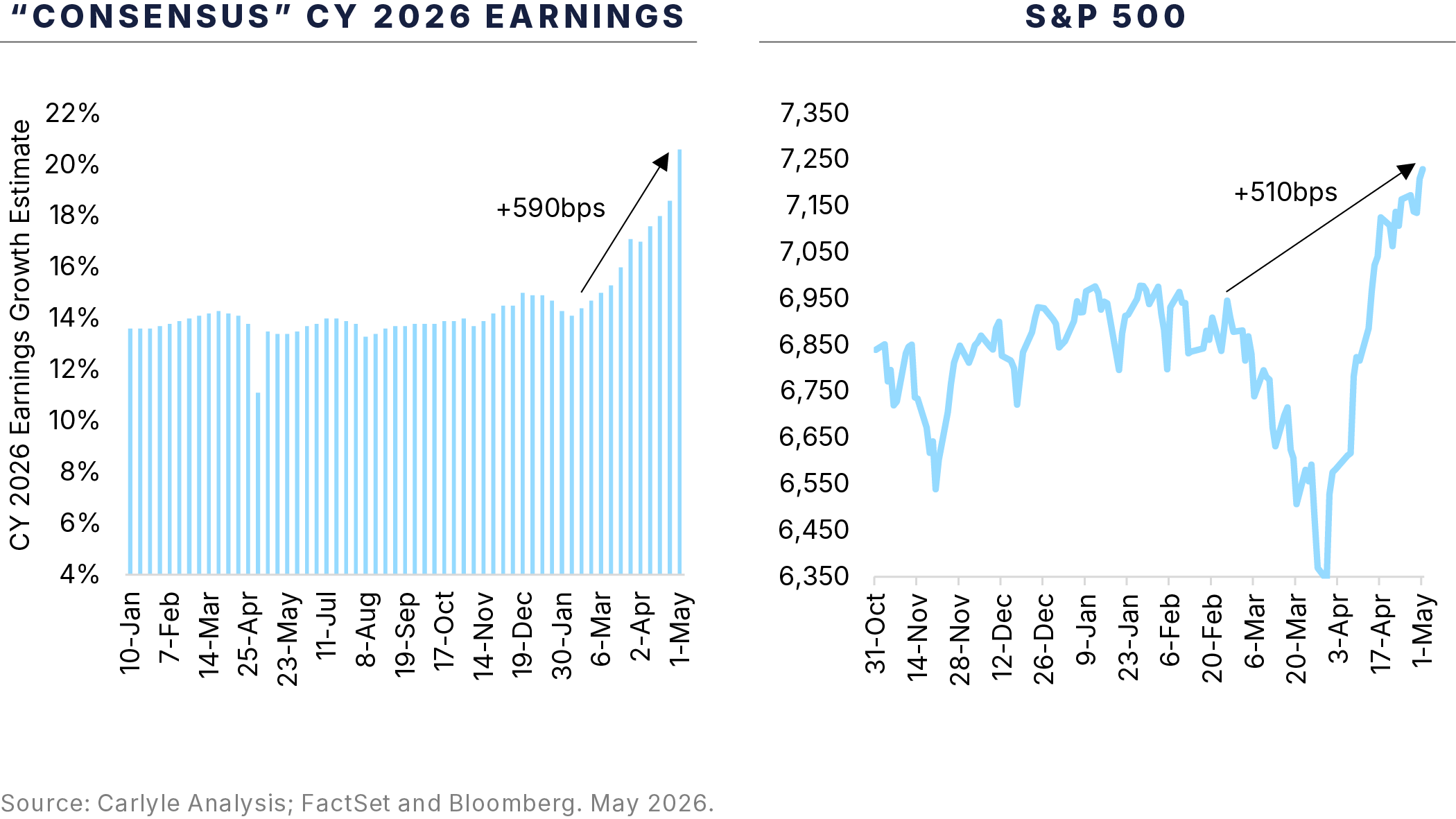
Besides, it’s not the conflict but AI that explains most of the April gains in the S&P 500 (+10.4%) and Nasdaq (+15.3%). When adding the sharp increase in enterprise IT budgets (“Resilient growth, growing divergence”) to the ongoing surge in data center investment, AI-related spending added ~150bps to Q1-2026 US GDP.1 And this spending translates directly to upwardly-revised earnings estimates. Strange as the stock market rebound may seem to many, NTM price-to-earnings ratios haven’t really budged since the start of the conflict (Figure 2).
Figure 2: Stocks rise in proportion to the increase in forecasted earnings
To say that the rebound is explicable is not to suggest it’s “rational.” Stock prices are thought to represent a ratio between the expected stream of future earnings in the numerator and the appropriate rate at which they’re to be discounted in the denominator. Even if one accepts that the expected value of future earnings has increased over the past two months, it seems impossible to believe that the range of outcomes for those earnings hasn’t widened at least as much. The mystery here is why the Hormuz-inflected increase in variance has not generated a proportionate rise in the risk premium.
Perhaps that’s explained, in part, by the entry of a new class of market participants. It’s common to think of equities as the residual, or riskiest, tranche of an investment opportunity set also consisting of corporate bonds, loans, sovereign securities, cash and commodities. In this framework, stocks have to offer higher expected returns as compensation for the fact that their payoff can fall far below those of other financial claims in certain states of the world. But how does the relative return assessment shift when the alternative to stocks is not BBB corporate bonds or a metals ETF but prediction markets, meme coins, and the outcome of Thursday’s Lakers game?
Americans are marrying and buying homes later than prior cohorts. Due in part to the decline in housing affordability, young adults who once would have devoted savings to down payments and mortgage amortization have increasingly routed surplus cash into app-based brokerage accounts, crypto exchanges, prediction markets, and sports-betting platforms (Figure 3). Liquidity once devoted to the slow accumulation of home equity now gets channeled to wagers and speculation.
Figure 3: The new face of finance

The share of 25-year-olds moving money into retail investment accounts rose 6x over the past decade and that increase has been attributed to the decline in first-time homeownership. Retail traders may own a modest share of total financial assets, but they account for roughly 18% of stock turnover and the bulk of the growth in options trading, including the staggering 318% increase in short-dated options volume since 2018. Options convert small premiums into large delta exposure (dealers’ hedging demand for stocks), which helps to explain why market makers have been willing to pay over $4 billion annually for the order flow from retail trading platforms.
These trades don’t seem so risky when the menu consists of paying sports gambling’s “vig,” buying digital assets with zero intrinsic value, or accepting the non-probabilistic pricing of prediction markets. No surprise that these traders have been happy to step in when shocks like “Liberation Day” led institutional investors to cut market exposure. And their presence and influence spill over onto the expectations and positioning of other market participants, especially algorithmic platforms trained on retail fund flows in past downturns.
As Keynes warned: “When the capital development of a country becomes a by-product of a casino, the job is likely to be ill-done.” As this seems less metaphor than literal descriptor for stock markets today, expect more long-term, patient capital to find its way to private markets.
Economic and market views and forecasts reflect our judgment as of the date of this presentation and are subject to change without notice. In particular, forecasts are estimated, based on assumptions, and may change materially as economic and market conditions change. Pacharbor Capital Group has no obligation to provide updates or changes to these forecasts. Certain information contained herein has been obtained from sources prepared by other parties, which in certain cases have not been updated through the date hereof. While such information is believed to be reliable for the purpose used herein, Pacharbor Capital Group and its affiliates assume no responsibility for the accuracy, completeness or fairness of such information. This material should not be construed as an offer to sell or the solicitation of an offer to buy any security in any jurisdiction where such an offer or solicitation would be illegal. We are not soliciting any action based on this material. It is for the general information of investors of Pacharbor Capital Group. It does not constitute a personal recommendation or take into account the particular investment objectives, financial situations, or needs of individual investors.