
The risk is time


Finance has been described as “the economics of risk and time.” In the current moment, the risk is time, with the adjustment in asset prices rising nonlinearly the longer the disruption to energy supplies lasts.
Over the past year, investors have been conditioned to expect that if a policy creates sufficient stress in markets, then that policy will change. One could imagine an algorithmic trading strategy that’s learned from this experience to buy Brent Crude futures until they rise above some price threshold, at which point they’re sold and converted into call options on equity indexes. The “AI,” in this case, maximizes expected profits by estimating the point at which the economic and financial pain from higher energy prices precipitates the inevitable course correction.
But the prior data on which this algorithm was trained may not capture the current reality. As a seasoned foreign policy hand emphasized to us last week, one state can start a war, but its conclusion typically requires the assent of multiple parties.
Last week’s employment report further complicates the outlook. In a different geopolitical environment, markets might have even welcomed the “bad news” for increasing the odds of rate cuts. Instead, investors were forced to consider the possibility that labor markets are weakening at the same time an inflation shock incapacitates the Fed. The spike in energy prices may not only fail to generate the expected course correction but could also constrain policymakers’ natural response to unrelated developments.
Before spiraling into anxiety, three points to consider:
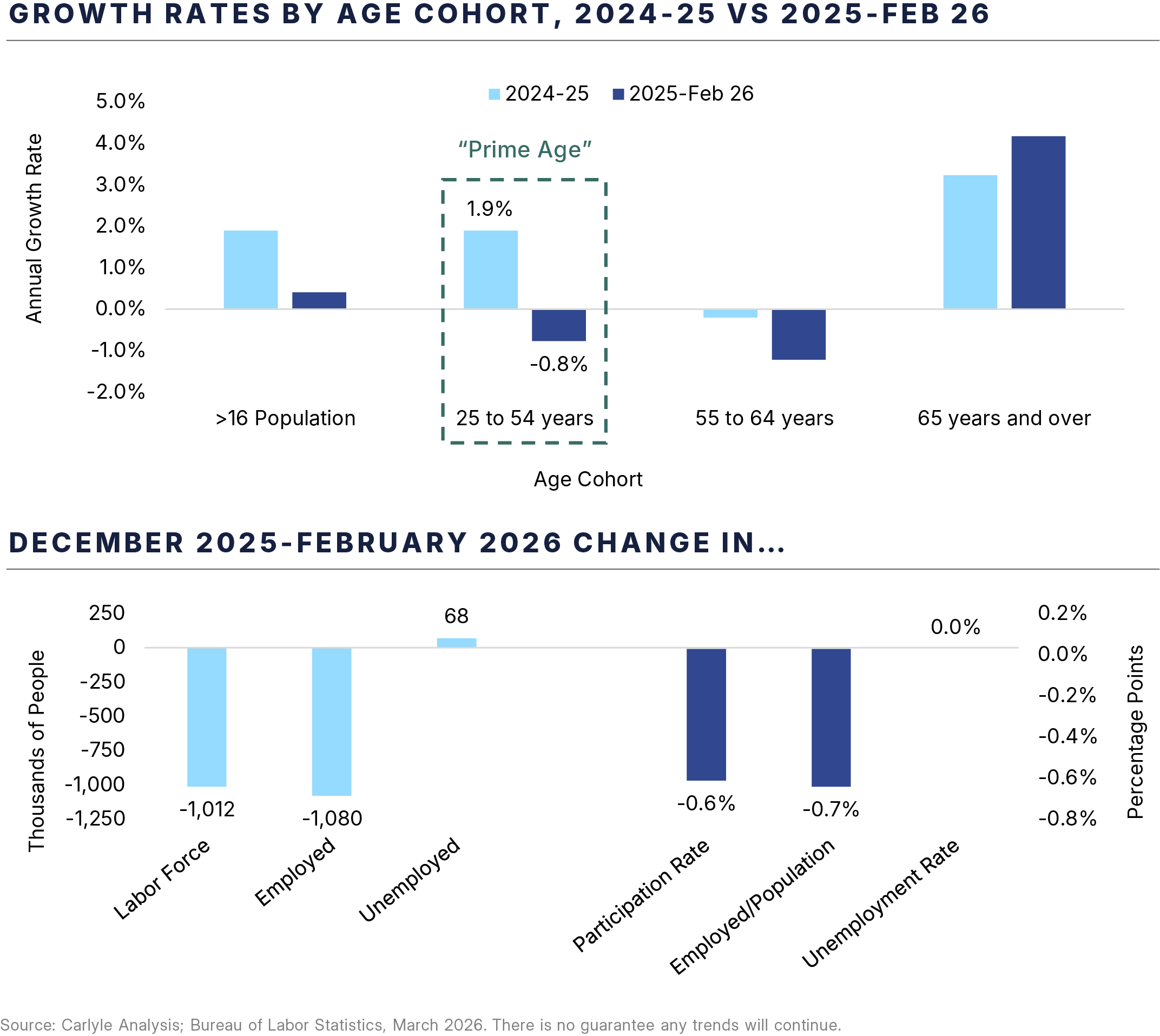
The past two months of official data have been dominated by benchmark revisions, which sharply reduced the number of people estimated to be working and seeking work inside the US. Since September 2025, it’s been virtually impossible to separate signal from noise in labor market data because the effects of immigration enforcement loom so large.
Last month, payrolls (establishment survey) were revised down by over 1 million; last Friday total employment was revised down proportionally (household survey). This has had virtually no impact on the unemployment rate because the labor force contracted by the same proportion. When segmenting the labor force by age cohort, the number of “prime age” workers in February fell by 0.8% relative to its 2025 level. The residual labor force is not only smaller but also older and therefore somewhat less likely to be seeking work, potentially reducing slack in the labor market (Figure 1).
Figure 1: Data revisions reveal smaller, older population
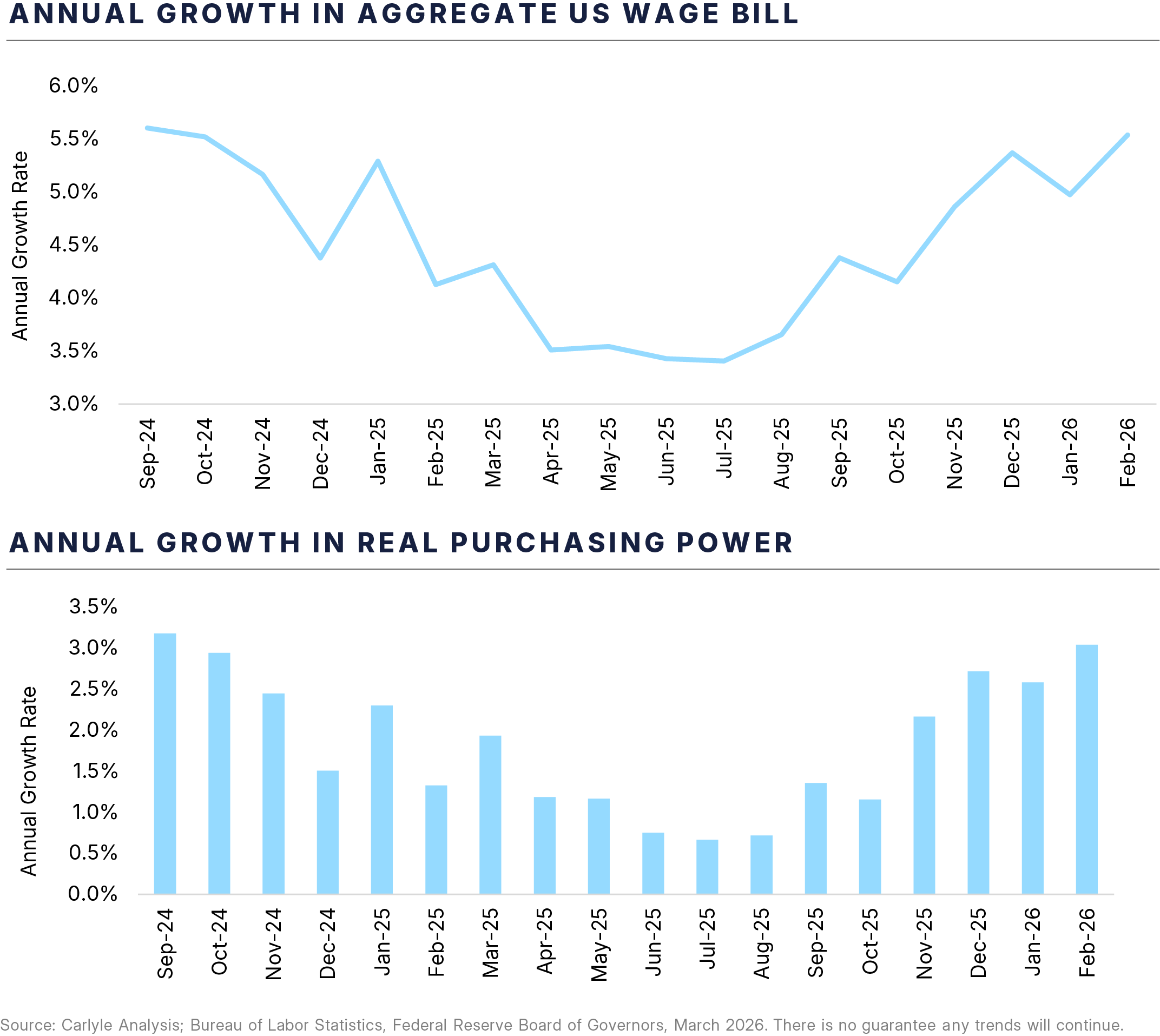
The aggregate wage bill of private employers surveyed in the report rose 5.5% relative to year-ago levels, its largest increase in 16 months. This translates to 3% annual growth in workers’ real purchasing power, an increase of 230 basis points since June 2025 (Figure 2). These are not the results we’d expect if the weakness in payrolls was mainly due to softening labor demand. In this “low-hiring, low-firing” regime, most of the adjustment occurs on what economists refer to as the “intensive margin,” which means the hours and wages of existing employees.
Figure 2: Impressive growth in labor income & real purchasing power
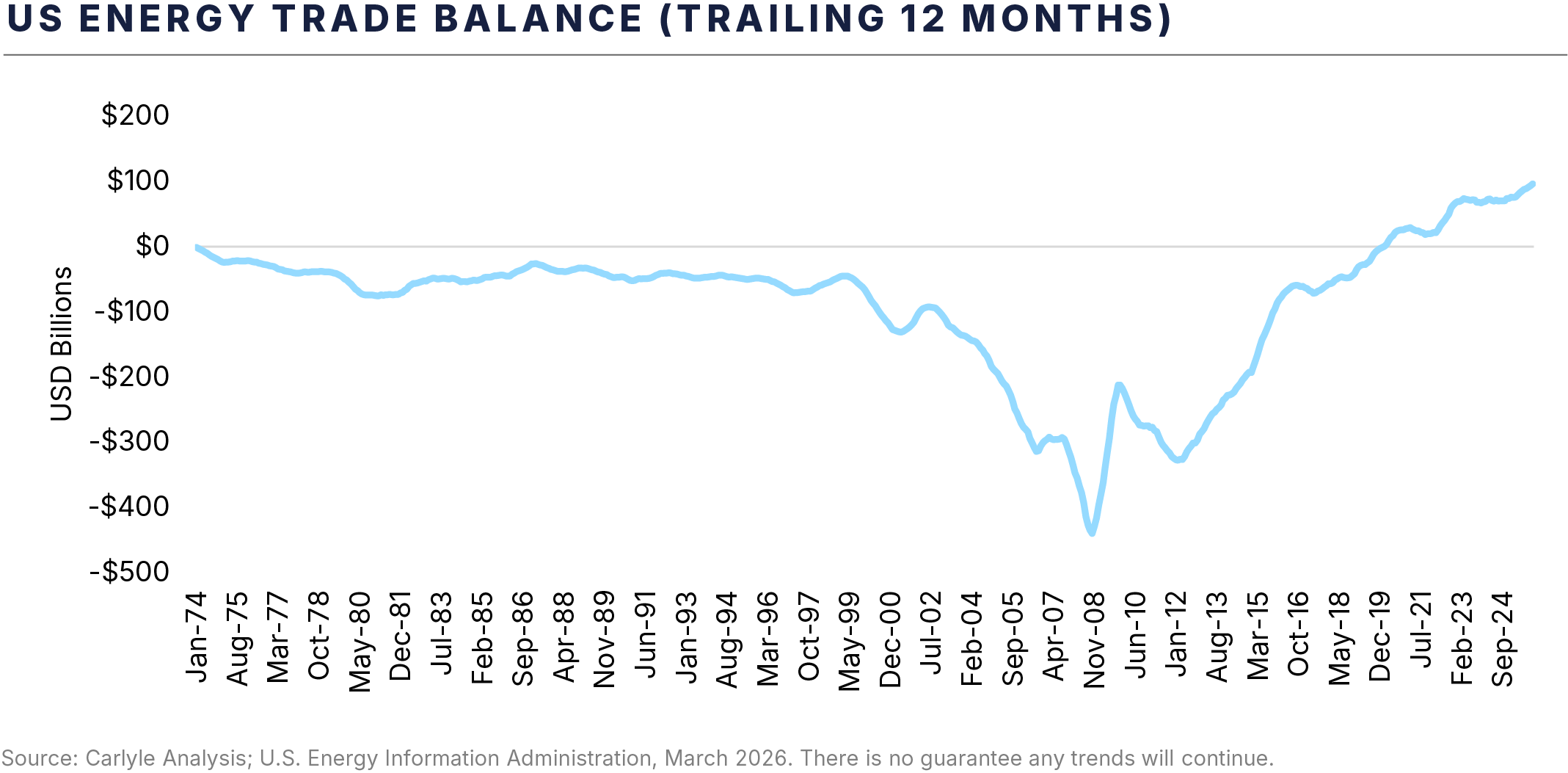
If supply disruptions persist, conditions may prove extraordinarily challenging for net energy importing economies. But with an annualized energy trade surplus of nearly $100 billion in the last 12 months, the US doesn’t find itself in that category. And increases in the prices of and demand for US LNG will almost certainly cause this surplus to increase substantially in the weeks ahead. Higher gasoline prices still could be conceived of as a “tax” on US consumers, but that’s offset today by an increase in domestic revenues that didn’t exist when the energy price shock of 2007-08 shaved over 1% from US GDP (Figure 3).
Figure 3: Net impact of energy price shocks nothing like 2007-08
Since Bernanke et al., it’s become conventional wisdom in monetary policy circles that policymakers should ignore the effects of an energy supply shock. Inflation arising from the effective closure of the Strait of Hormuz is ephemeral while the demand destruction that results from it could prove longer lasting. If “core” inflation and longer-dated inflation breakevens remain well-behaved, the Fed won’t feel constrained by an exogenous spike in energy prices that’s expected to resolve itself over time. The Fed may retain more scope to respond to signs of real economic weakness than many suppose, and their willingness to cut rates over the past two years with inflation persistently above target strengthens that view.
Economic and market views and forecasts reflect our judgment as of the date of this presentation and are subject to change without notice. In particular, forecasts are estimated, based on assumptions, and may change materially as economic and market conditions change. Pacharbor Capital Group has no obligation to provide updates or changes to these forecasts. Certain information contained herein has been obtained from sources prepared by other parties, which in certain cases have not been updated through the date hereof. While such information is believed to be reliable for the purpose used herein, Pacharbor Capital Group and its affiliates assume no responsibility for the accuracy, completeness or fairness of such information. This material should not be construed as an offer to sell or the solicitation of an offer to buy any security in any jurisdiction where such an offer or solicitation would be illegal. We are not soliciting any action based on this material. It is for the general information of investors of Pacharbor Capital Group. It does not constitute a personal recommendation or take into account the particular investment objectives, financial situations, or needs of individual investors.