
A light at the end of the liquidity tunnel



Our latest Global Private Markets Quarterly summarizes the current state of the private markets, highlighting strong deal activity in 2025 and resilient credit markets in the face of macroeconomic and geopolitical uncertainty.
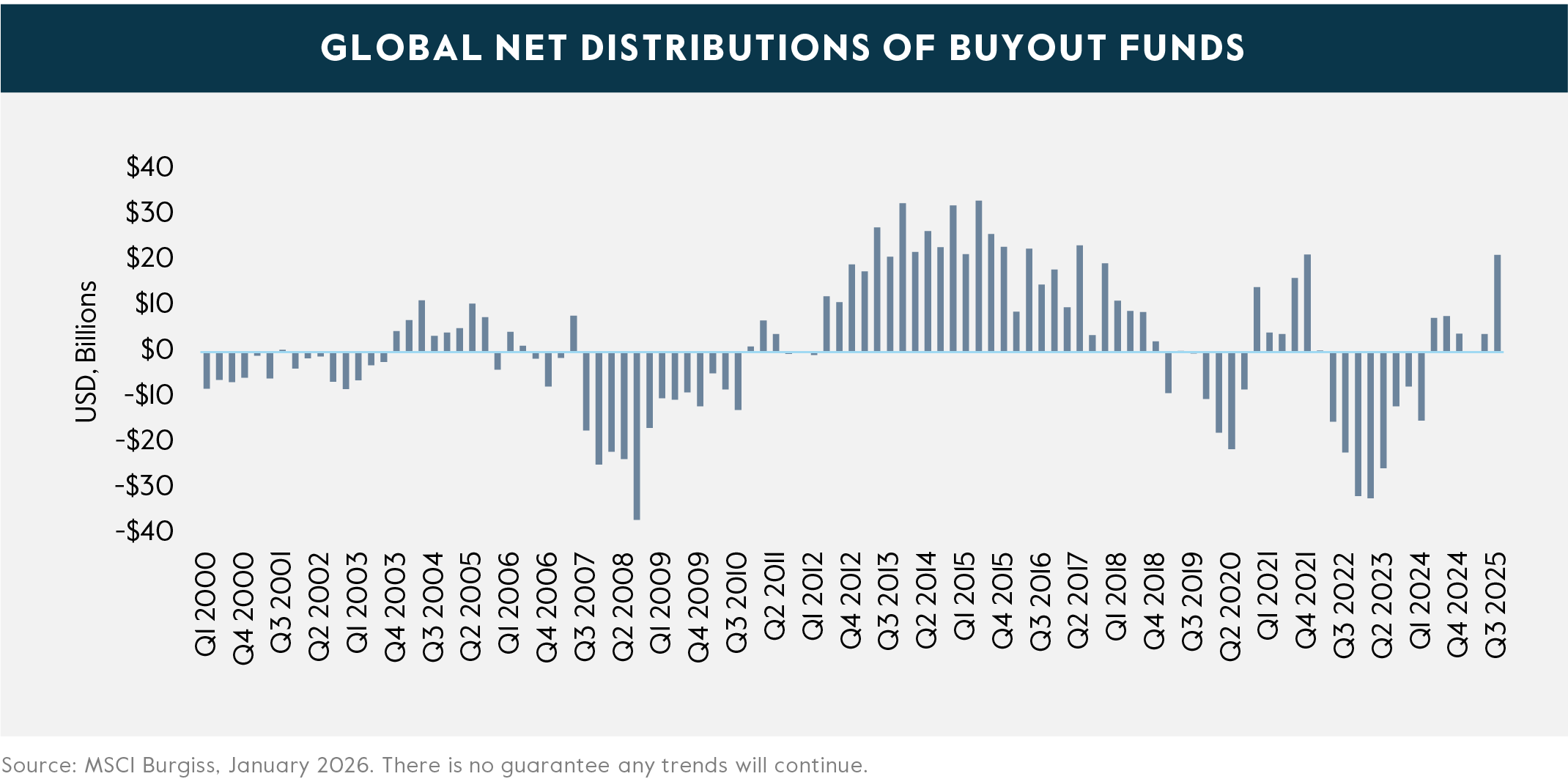
After several years of constrained distributions, private equity investors may be starting to see a light at the end of the liquidity tunnel. Net distributions from global buyout funds surged in Q3 2025 to $21.5 billion, more than five times the amount of the prior quarter and the strongest quarter since Q4 2021 (Figure 1). While full exits continued to lag in 2025, strong activity in dividend recapitalizations and Continuation Vehicles enabled GPs to return capital to LPs. However, the market still has some way to travel, with contributions exceeding distributions by a cumulative $117bn since the start of 2022, following a decade of positive net distribution activity in the 2010s. Looking ahead, conditions seem supportive for further distributions, with robust credit markets and buyout exit EBITDA multiples once again exceeding holding multiples—a return to the traditional dynamic after three years of exit multiples falling behind where assets were kept on the books.
Transaction activity ended the year strongly. Global M&A activity increased 44% from 2024 to $5.1 trillion, representing the highest annual volume since 2021. Overall totals were boosted by an uptick in larger deals, particularly in the US, with the average deal size increasing nearly 50% year-over-year. Leveraged buyout activity saw a similar increase and similar drivers, ending the year 48% higher than 2024 with the 10 largest deals representing more than 30% of the total volume—all of them involving US targets.
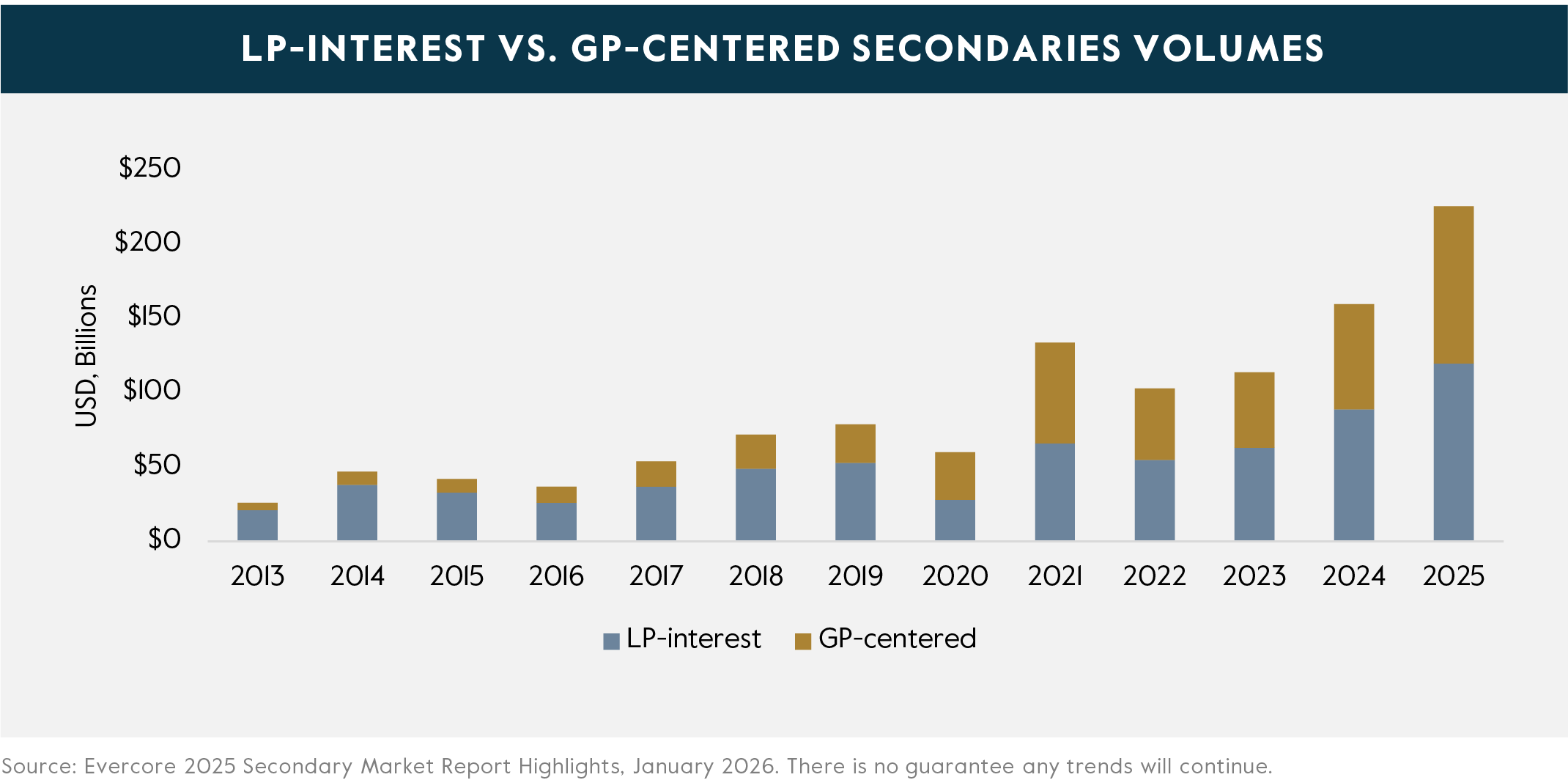
The secondary market notched another record year, completing $226 billion in transactions (Figure 2), a 41% increase over 2024’s record volume of $160 billion. Driven by an increase in both LP-interest volume as well as GP-centered transactions, this activity has left the market with only $215 billion in dry powder—less than a year’s supply at current investment pacing—which should support continued strength in secondary fundraising over the next year. Indeed, secondaries were the lone bright spot in private equity fundraising in 2025, as venture capital, growth equity, and buyout strategies all took in lower totals. However, the robust deal environment has helped reduce dry powder across the private equity industry, which has fallen by more than 30% from its 2023 peak.
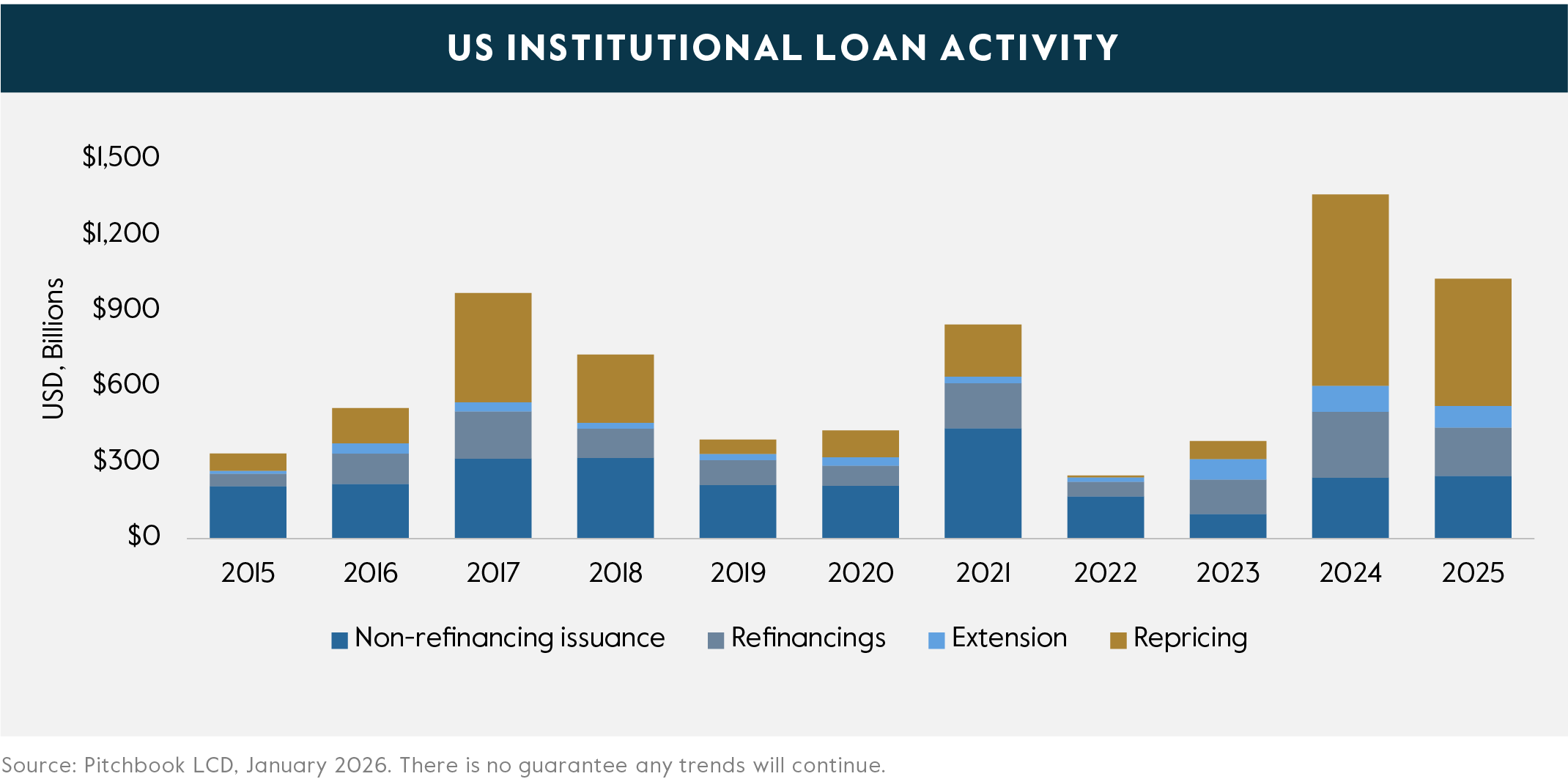
Credit markets remained resilient in 2025, with demand supported by record fundraising in the CLO market, and an uptick in new supply from robust M&A activity, dividend recaps, and refinancing. While US institutional loan activity fell in the fourth quarter, 2025 was still the second-busiest year on record with total activity over $1 trillion (Figure 3). European leveraged loan volume increased 21% over 2024, driven by a wave of repricing on the back of more favorable financing conditions. Spreads continued to compress, with direct lending deals pricing at 510bps and 521bps in the US and Europe, respectively, and syndicated markets pricing well below 400bps (and, even close to 300bps in some instances) in both regions. Risk continues to remain muted, as defaults plus distressed exchanges in the leveraged loan market fell by more than a percentage point to 3.35% in the final quarter of the year, and private credit defaults remained below 2%.
Economic and market views and forecasts reflect our judgment as of the date of this presentation and are subject to change without notice. In particular, forecasts are estimated, based on assumptions, and may change materially as economic and market conditions change. Pacharbor Capital Group has no obligation to provide updates or changes to these forecasts. Certain information contained herein has been obtained from sources prepared by other parties, which in certain cases have not been updated through the date hereof. While such information is believed to be reliable for the purpose used herein, Pacharbor Capital Group and its affiliates assume no responsibility for the accuracy, completeness or fairness of such information. This material should not be construed as an offer to sell or the solicitation of an offer to buy any security in any jurisdiction where such an offer or solicitation would be illegal. We are not soliciting any action based on this material. It is for the general information of investors of Pacharbor Capital Group. It does not constitute a personal recommendation or take into account the particular investment objectives, financial situations, or needs of individual investors.