
Three Themes Shaped the 2025 Macro Environment


European rearmament, Chinese self-reliance, and stubbornly high bond yields all demanded investors’ attention in 2025, but these were the leitmotifs that molded this year’s macro storyline.
Those worried about a recession in 2025 probably didn’t appreciate how much wind the economy had at its back:
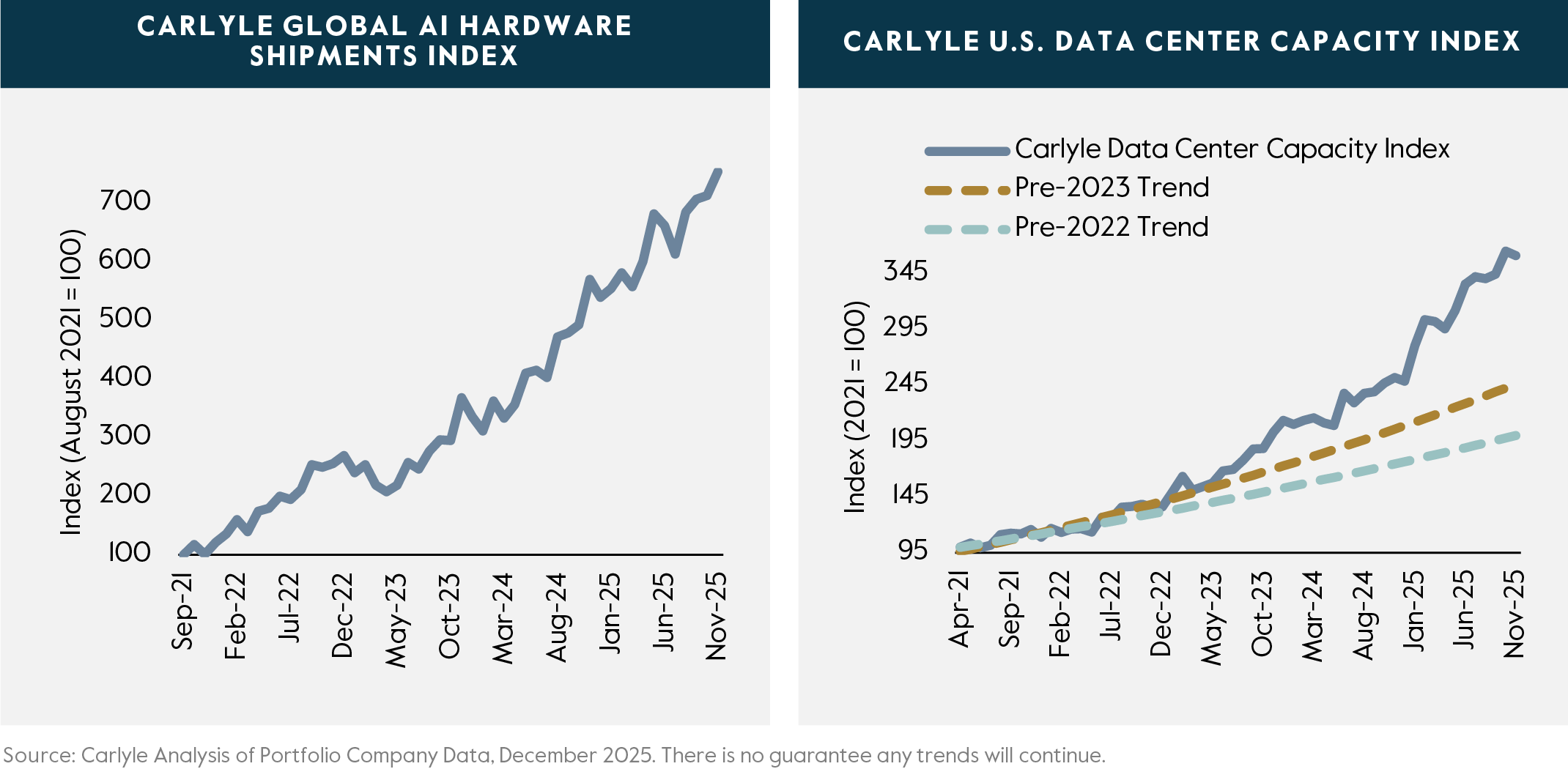
“Since the advent of ChatGPT in November 2022, U.S. GDP growth has exceeded prior years’ ‘consensus’ expectations by an average of 1.5%--one of the largest and most sustained periods of outperformance in recent history. Enthusiasm for the technology and its downstream applications set off a staggering capex boom that allowed the economy to shrug off an interest rate shock that many expected to trigger recession” (Jevons or Dixit? (February 4)). The absolute contribution of AI-related capex grew over the course of 2025, offsetting the drag from tariffs and other cyclical fluctuations (Figure 1).
As 2025 comes to a close, there are signs that market enthusiasm for AI has been displaced by greater discernment. Deals that markets once celebrated (Oracular Warning (September 30)) have come under greater scrutiny. Portfolios once thought to be positioned on the right side of the technological divide now seem imprudently concentrated. And analysts who once marveled at AI-related capex’s enormous boost to GDP growth have grown more conscious of signs that some of this growth may be “crowding out” investment in other sectors (Let Them Eat Compute (August 19)).
Expect this healthy transition to continue in 2026, as the sober assessments of financial analysts gain ground relative to the dreams of technologists in shaping AI’s market reality.
We had a good laugh in April when discussing the market narrative that the Fed was “in a box” and couldn’t cut if the job market faltered because of above-target inflation. Of course, the Fed would cut by September if the labor market weakened no matter where inflation was at the time! The market caught onto this by August (A Whiff of Stagflation (August 5)), and the rest of the year played out more or less as expected.
As the result of Fed dovishness, the “hard landing” hypothesis of 2022-23 was never really tested: “Economics deals in ‘if…then’ statements; not prophecy, but conditional likelihoods. ‘Hard landers’ weren’t necessarily predicting an outright contraction in economic activity. They were simply saying that IF 2% inflation were to be achieved, THEN a recession would be necessary” (Soft Landing’s Illusory Victory (February 25)). As it happened, there was neither a recession nor a return to the 2% inflation target, i.e. “no landing.”
This hasn’t gone unnoticed by households, who’ve been asked to accept 100 basis points of excess inflation today on top of the 22% rise in consumer prices since the start of 2021. That hasn’t gone down well, as public opinion surveys attest. The Fed can credibly claim to have been caught off guard by the “supply chain” inflation of 2021-23, but “it’s time to stop pretending that prices were supposed to continue rising at these rates thereafter” (No Easy Way Out (November 11)).
The Fed thinks that rate cuts may catalyze wage growth that more than compensates for ongoing price pressures. There are reasons to suspect that won’t happen – GDP already expanded at a brisk pace in Q3-2025 when overnight interest rates were 75bps higher than they are today – and increasingly price-conscious consumers might not care where wages go if prices remain on their current trajectory.
How are policymakers to address “affordability” while the Fed pivots to more accommodative monetary policy? Wage and price controls? Prosecution of price gougers? Subsidization of key businesses to operate unprofitably? These methods have all been tried in the past and proved so counterproductive that monetary economists became convinced that price stability was not just a policy goal in its own right, but also a means to achieve other goals like maximum employment. These old lessons may be relearned in 2026.
We knew, “with a high degree of certainty, that tariffs (were) coming.” But it wasn’t possible to estimate their economic impact until we knew “the purpose they intend to serve” (What is the Purpose of Tariffs? (January 7)).
At first, it seemed the goal was to narrow the U.S. goods trade deficit. But because U.S. businesses play such a large role in its creation, “near-term reductions” would “require that U.S. consumers cut back on buying so much U.S.-branded merchandise,” with “every $1 of the exporting economy’s GDP lost to tariffs translat(ing) to between $2 to $4 in foregone U.S. earnings” (Tariff Paradoxes (May 6)). In other words, the biggest loser from the initial April 2 tariff schedule was the U.S. corporate sector, which imports much of the goods it sells domestically.
As time elapsed, tariffs came to be seen as a mechanism to raise revenue. “Recent trade ‘deals’ signal the Administration’s willingness to accept lower sector- and-product specific duties to maximize the baseline rate. Implicitly, they define success in terms of revenue, not the bilateral trade balance or scale of onshoring. That makes it more likely the tax sticks, not just for the next year but in perpetuity as the U.S. Treasury comes to depend on the associated revenue and exporters adjust to new realities” (Taking the W (July 29)).
Tariffs’ $350 billion in annualized revenue helped to narrow the U.S. fiscal deficit, which came in about 0.5% of GDP below expectations for FY2025. More importantly, these deals kept effective tariff rates in a range that felt to management teams more like a sudden shift in FX rates: not helpful, but something they had to plan for in the normal course of business.
A firming of final demand may encourage management teams to recoup more tariff costs from their customers than they had in 2025. But why would anyone assume that they stop pushing on price at precisely the point that gross margins return to 2024 levels?
Economic and market views and forecasts reflect our judgment as of the date of this presentation and are subject to change without notice. In particular, forecasts are estimated, based on assumptions, and may change materially as economic and market conditions change. The Pacharbor Capital Group has no obligation to provide updates or changes to these forecasts. Certain information contained herein has been obtained from sources prepared by other parties, which in certain cases have not been updated through the date hereof. While such information is believed to be reliable for the purpose used herein, The Pacharbor Capital Group and its affiliates assume no responsibility for the accuracy, completeness or fairness of such information. References to particular portfolio companies are not intended as, and should not be construed as, recommendations for any particular company, investment, or security. The investments described herein were not made by a single investment fund or other product and do not represent all of the investments purchased or sold by any fund or product. This material should not be construed as an offer to sell or the solicitation of an offer to buy any security in any jurisdiction where such an offer or solicitation would be illegal. We are not soliciting any action based on this material. It is for the general information of clients of The Pacharbor Capital Group. It does not constitute a personal recommendation or take into account the particular investment objectives, financial situations, or needs of individual investors.