
No Easy Way Out


New York is an expensive place. No surprise that the cost-of-living was voters’ top issue in last week’s mayoral election. But the same is true of voters nationally (p.16). When looking at the President’s approval ratings, inflation stands out (Figure 1). Consumer sentiment may have dipped because of the government shutdown, but most of the weakness seems attributable to the rise in year-ahead inflation expectations to 4.7%.
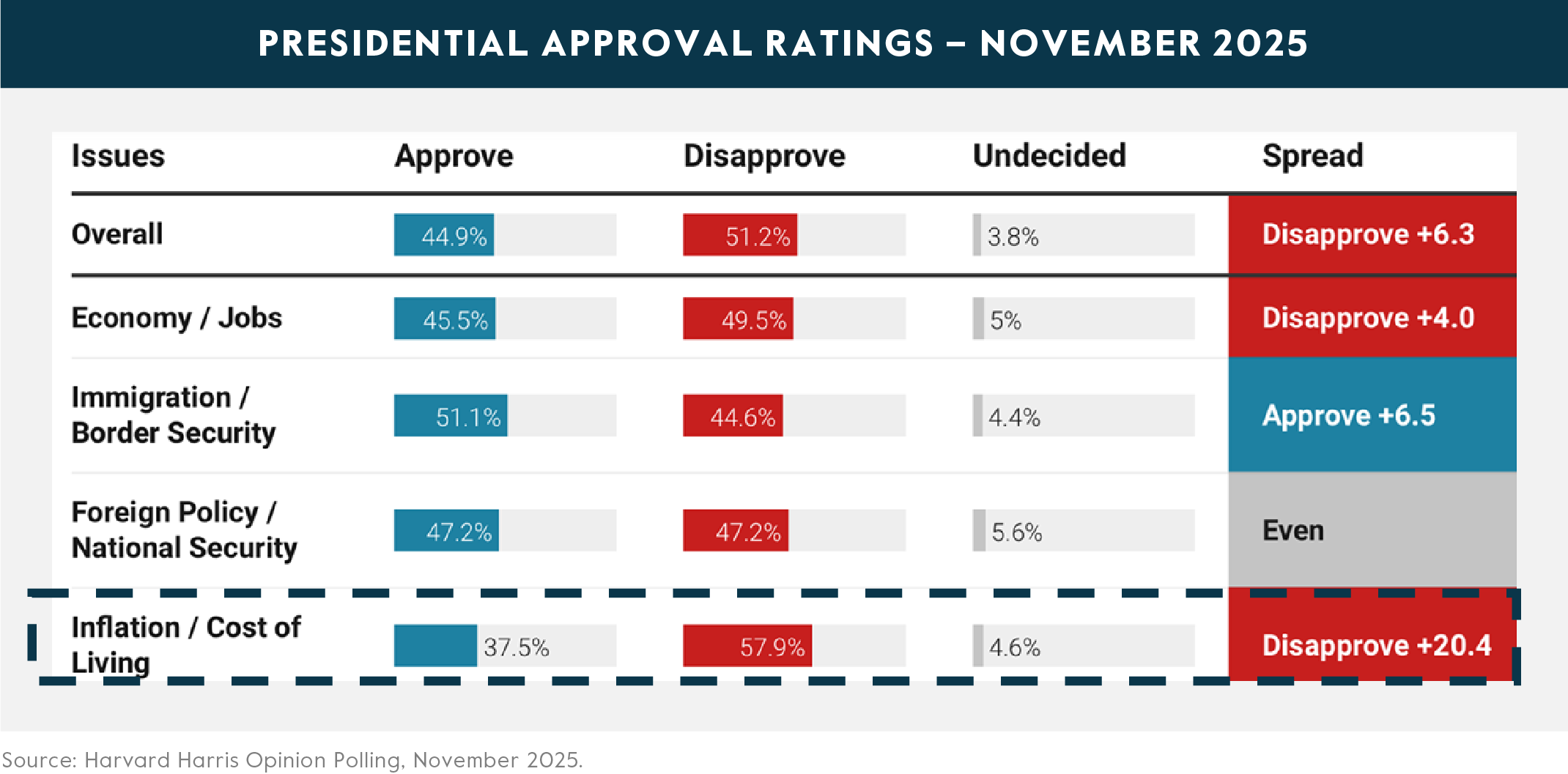
The electorate is angry about the cost of living, but no one seems willing to countenance the obvious solution. The current situation, while far less acute, bears similarities with that of November 2021, when Fed Chair Powell testified before feisty Members of Congress demanding to know why he hadn’t done more to contain the explosive growth in consumer prices.
Those Committee hearings were a remarkable spectacle. The Fed exists as an “independent” agency so that it has the freedom to make unpopular decisions—like raising interest rates—that a more politically sensitized body wouldn’t. But on that day, incentives seemed to have been reversed. The elected officials most exposed to the pressures of the electorate berated the technocrat insulated from them for failing to take unpopular steps.
The news coverage was all about the Fed “pivot.” Powell acknowledged that the Fed should take inflation more seriously than it had to-date. It was as though a light bulb had gone on. From that point forward, the Fed would do what it could to bring inflation under control. Base interest rates rose by 400 basis points over the next 12 months.
Professional forecasters expected the economy to fall into recession as a result. That was a reasonable assumption; historical data suggested that it would be difficult to bring inflation down without significant losses in employment and output. But that didn’t happen. Instead, inflation drifted down to more normal levels in the context of robust growth.
That anomaly helps to explain voter dissatisfaction today. As NBER-affiliated researchers document, inflation came down without recession, in part, because the price level had already risen so much. After a 20% average increase in final sales prices, businesses didn’t need to shed labor or cut back on investment; their operating margins had expanded meaningfully from pre-pandemic levels (Figure 2). No one had to “give back” on price, they just had to recalibrate their go-forward price increases.
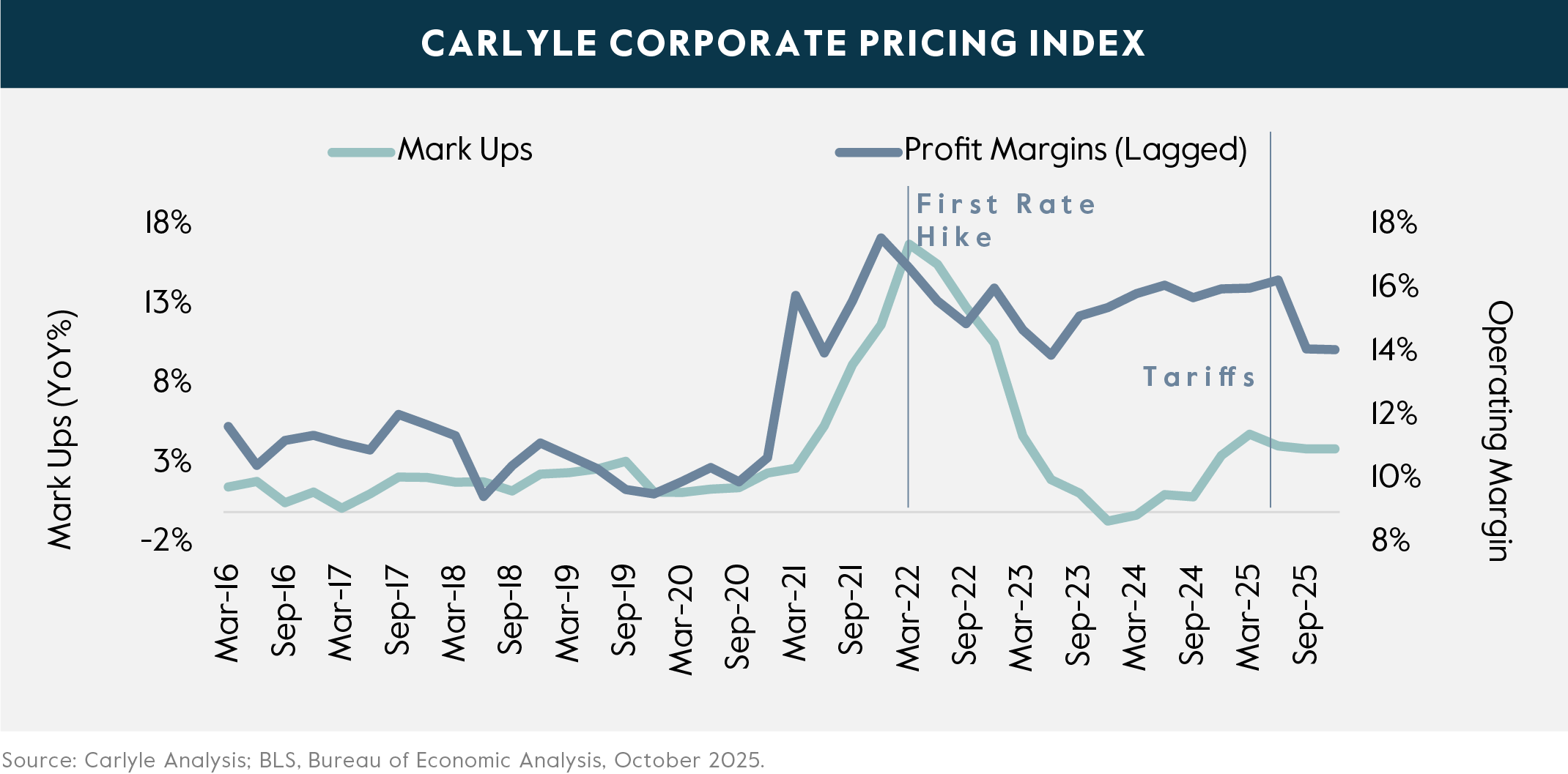
There’s a path dependence to consider. Had inflation been at target for the past few years, it would be perfectly reasonable to argue that 3% inflation is hardly different than 2%, or to speak about inflation falling comfortably in a “range” between 1% and 3%. But it seems callous to speak the same way about 100bps of excess inflation today when it comes on top of the cost-of-living shock households endured over the past four years.
Our data suggest that the U.S. economy was dealing ably with 4% interest rates (Figure 3). Activity had rebounded sharply from Q2-2025 lows. Don’t worry about recent employment news, inflected as it is by immigration restrictions. And while AI may be the cause of recent layoffs at Amazon, it’s not for the reason many suppose. Massive AI-related capex reduced Amazon’s free cash flow by $15 billion in the most recent quarter and management responded with a plan to reduce headcount so as to create the financial space necessary to maintain (or accelerate) these outlays.
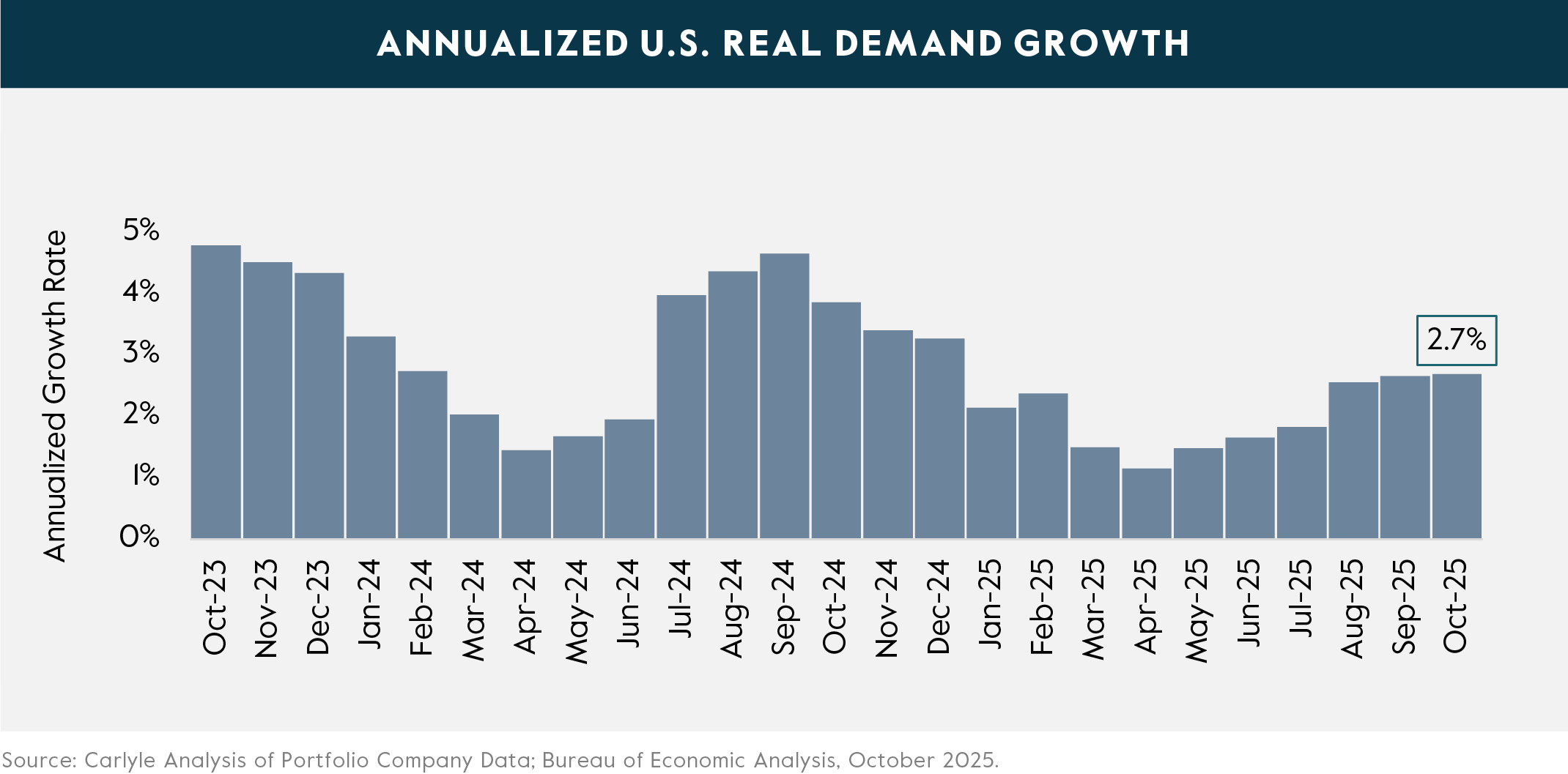
This isn’t to say higher rates won’t have costs, but they represent the surest route to address the electorate’s dissatisfaction with ongoing price pressures. By letting the price level rise to the extent that it did, the Fed minimized the cost of bringing future inflation down. Fair enough! But it’s time to stop pretending that prices were supposed to continue rising at these rates thereafter.
Will another political intervention, reminiscent of November 2021, keep the “independent” Fed from cutting again until inflation returns to target?
Economic and market views and forecasts reflect our judgment as of the date of this presentation and are subject to change without notice. In particular, forecasts are estimated, based on assumptions, and may change materially as economic and market conditions change. The Pacharbor Capital Group has no obligation to provide updates or changes to these forecasts. Certain information contained herein has been obtained from sources prepared by other parties, which in certain cases have not been updated through the date hereof. While such information is believed to be reliable for the purpose used herein, The Pacharbor Capital Group and its affiliates assume no responsibility for the accuracy, completeness or fairness of such information. References to particular portfolio companies are not intended as, and should not be construed as, recommendations for any particular company, investment, or security. The investments described herein were not made by a single investment fund or other product and do not represent all of the investments purchased or sold by any fund or product. This material should not be construed as an offer to sell or the solicitation of an offer to buy any security in any jurisdiction where such an offer or solicitation would be illegal. We are not soliciting any action based on this material. It is for the general information of clients of The Pacharbor Capital Group. It does not constitute a personal recommendation or take into account the particular investment objectives, financial situations, or needs of individual investors.