
Out of Left Field


At the American Economic Association annual meeting, Harvard’s Jason Furman posed a thought experiment: What would happen if the federal government directed the Fed to deposit $1 million in every household’s bank account? We’d likely see an increase in spending that so far outstrips the economy’s productive and logistics capacity that product shortages, price spikes, and significant order and shipping backlogs would result. In other words, this policy’s visible effects would be largely indistinguishable from what was actually observed during the “supply chain crisis” of 2021-22.
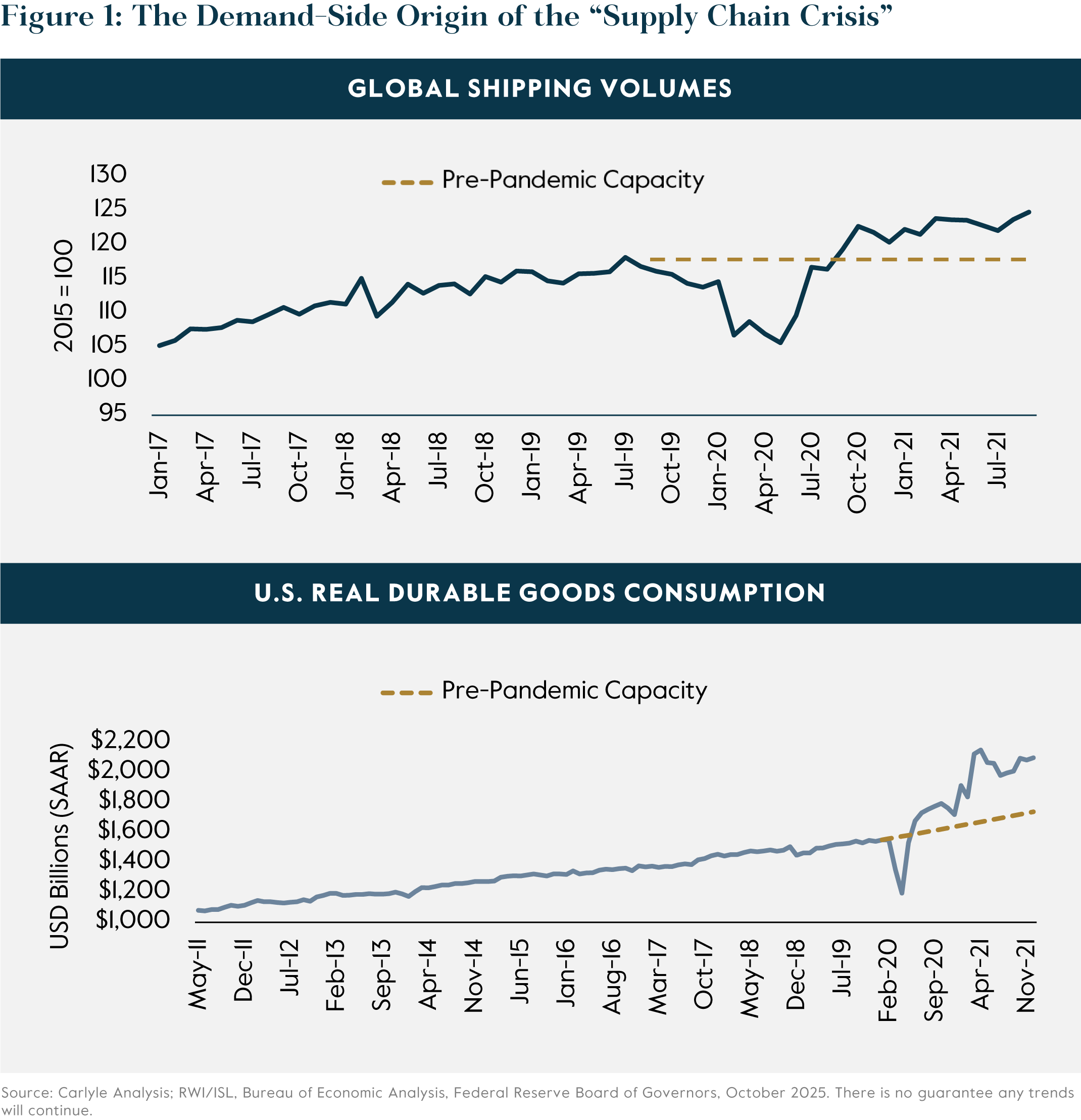
The Fed diagnosed inflation’s 2021 outbreak as “transitory” because it seemed to originate from pandemic-related supply disruptions that would resolve over time. Looking back on the data, it doesn’t appear that the “pipes” of the global economy were clogged so much as we were trying to jam too much “stuff” through them (Figure 1). Inflation blamed on supply constraints instead stemmed largely from a stimulus-fueled surge in demand and massive shift in its composition towards durable goods.
This experience has some relevance today, as the Fed confronts worrying signals from the labor market. The government shutdown deprived us of Friday’s employment report, but data from our portfolio suggest that the collapse in U.S. payroll employment growth continued in September, with monthly gains falling from an average of over 200,000 at the start of the year to just 15,000 over the past three months (Figure 2).
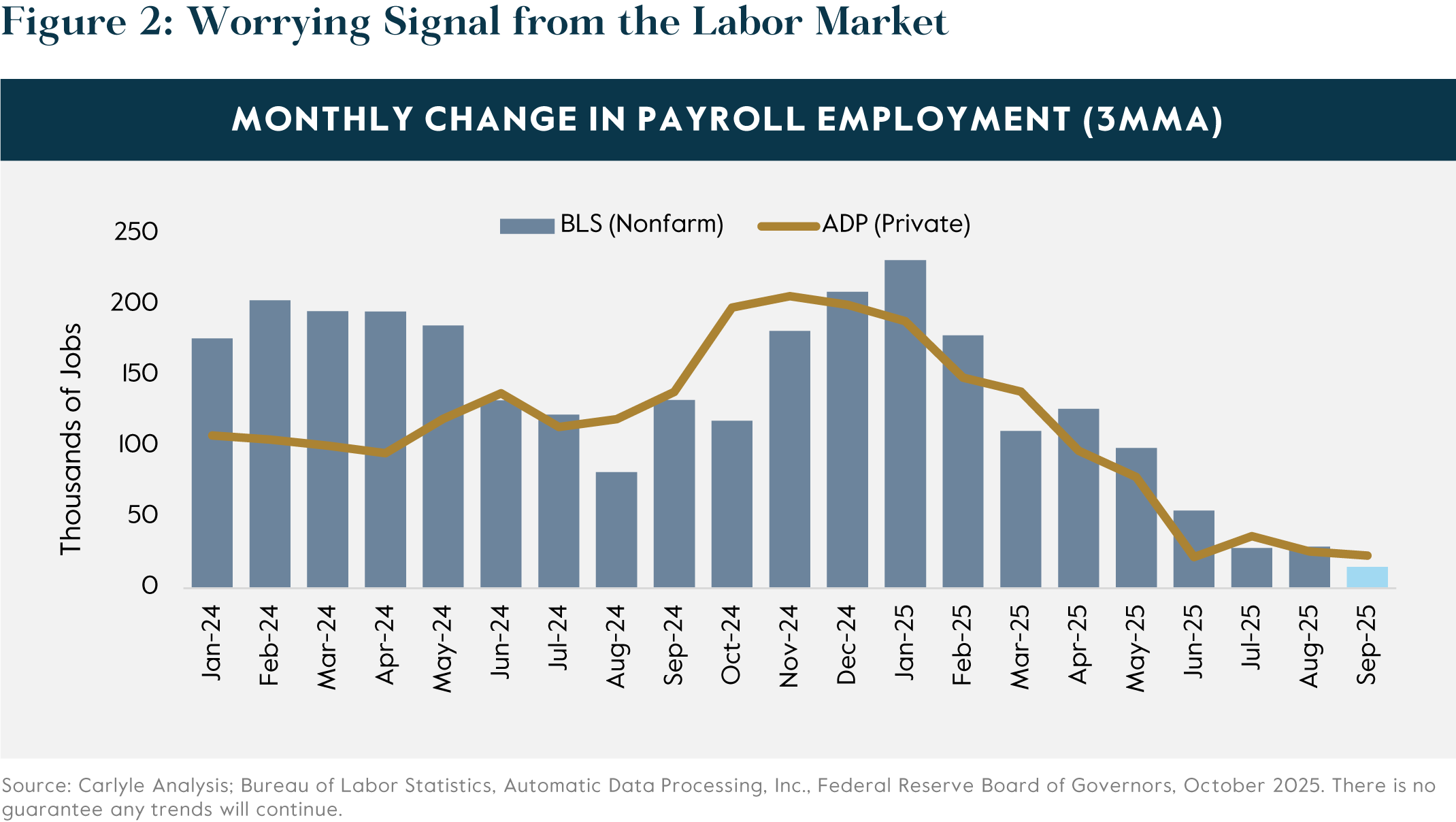
In the past, a deceleration of this magnitude has nearly always been associated with an economy on the brink of recession (or already having succumbed to one). But that doesn’t seem to jibe with other data: company operating performance remains solid, with double-digit growth in operating cash flow; our most cyclically-sensitive portfolio data are consistent with annualized U.S. GDP growth of 2.7% in Q3-2025; broad measures of (nominal) household income continue to grow at an annual rate of 5%; and both the unemployment rate and job openings have held steady as payroll growth plummeted.
Consider another thought experiment: What if the U.S. government were to implement a net zero immigration policy? With native-born U.S. population growth of just 0.14% in 2025,1 we’d expect to see monthly payroll growth of less than 20,000, on average, with employment in leisure and hospitality, construction, home care, and manufacturing especially hard hit. In other words, this policy’s visible effects would be largely indistinguishable from what’s been observed over the past several months.
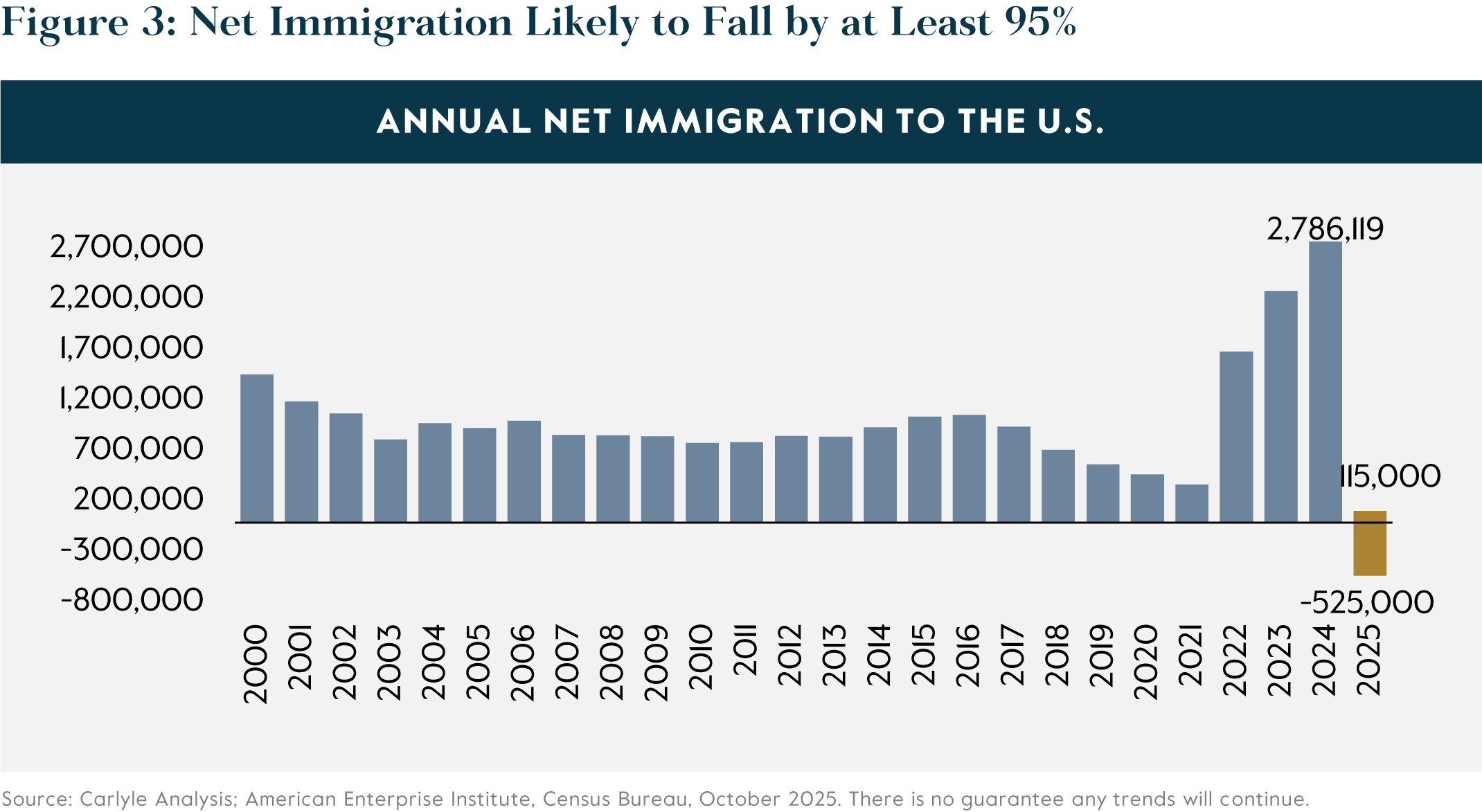
While reliable population data are not yet available, recent estimates suggest that net immigration for 2025 could range between an increase of 115,000 and a decline of 525,000 (Figure 3). Even the high end of this range would represent a decline of 90% from the post-pandemic net immigration surge, when immigrants likely accounted for between 70% and 80% of the growth in the labor force and total employment.2 If you assume some degree of complementarity between native-born and immigrant labor, then reductions in the supply of foreign-born workers could even result in a greater than one-for-one fall in employment growth.
No one can seriously doubt that slackening labor demand explains some of the weakness. Gross margins seem to have narrowed, as businesses absorb some of the tariffs. The outlook for construction activity (ex-data centers(!)) remains bleak. But just as with the “supply chain crisis,” the main causal impetus may be coming from the opposite direction.
By mistakenly diagnosing inflation as a “transitory” phenomenon tied to temporarily constrained supply, policymakers chose to stand pat in 2021. Cumulative inflation overshot target by over 10 percentage points in the ensuing years. The risk today is that the Fed misdiagnoses the fall in payroll employment growth as entirely a demand-side phenomenon and cuts rates to levels that fuel an eventual wage-price spiral in industries grappling with a sudden dearth of available workers.
1. Congressional Budget Office, “The Demographic Outlook: 2025 to 2055,” Jan 13, 2025.
2. Official breakdowns are notoriously spotty due to survey under-sampling of undocumented or very recent arrivals.
Economic and market views and forecasts reflect our judgment as of the date of this presentation and are subject to change without notice. In particular, forecasts are estimated, based on assumptions, and may change materially as economic and market conditions change. The Pacharbor Capital Group has no obligation to provide updates or changes to these forecasts. Certain information contained herein has been obtained from sources prepared by other parties, which in certain cases have not been updated through the date hereof. While such information is believed to be reliable for the purpose used herein, The Pacharbor Capital Group and its affiliates assume no responsibility for the accuracy, completeness or fairness of such information. References to particular portfolio companies are not intended as, and should not be construed as, recommendations for any particular company, investment, or security. The investments described herein were not made by a single investment fund or other product and do not represent all of the investments purchased or sold by any fund or product. This material should not be construed as an offer to sell or the solicitation of an offer to buy any security in any jurisdiction where such an offer or solicitation would be illegal. We are not soliciting any action based on this material. It is for the general information of clients of The Pacharbor Capital Group. It does not constitute a personal recommendation or take into account the particular investment objectives, financial situations, or needs of individual investors.