
Misreading the tea leaves


It is said that “the market” no longer expects rate cuts in 2026 and increasingly views Fed hikes as a possibility. That seems odd. For the past two years, the Fed has been unwilling to slow demand growth to levels necessary to hit its inflation target. But now that same institution will hike rates into an exogenous supply shock, exacerbating its drag on economic activity? That’d mark quite an inversion of the adage that one should control the things you can and accept those you cannot.
Forecasts derived from futures should be interpreted with caution. These prices reflect a weighted average of market positions integrated across the entire interest rate complex – cash securities, forwards, swaps, options and other derivatives. When that positioning becomes one-sided or concentrated in the extremes of the distribution, hedging demand can push the average away from the modal, or single most-likely path for rates. Changes in skew and tail probabilities can move futures materially even when the baseline outlook remains unchanged, as Fed staff often explain at FOMC meetings.
As we noted at the start of the year (“How will the “affordability crisis” impact Fed policy?”), futures only priced two cuts for 2026 but options on futures implied that seven cuts were as likely as one hike. Some market participants aggressively positioned for a Fed that’d be cutting early and often. The dealers that wrote these options had to buy futures or receive (fixed) rates, with their hedging demand increasing nonlinearly as weak labor market data and AI risk made near-term cuts more likely. This seemed like a classic case where (modestly) dovish headlines interacted with concentrated bets to drive forward rates lower.
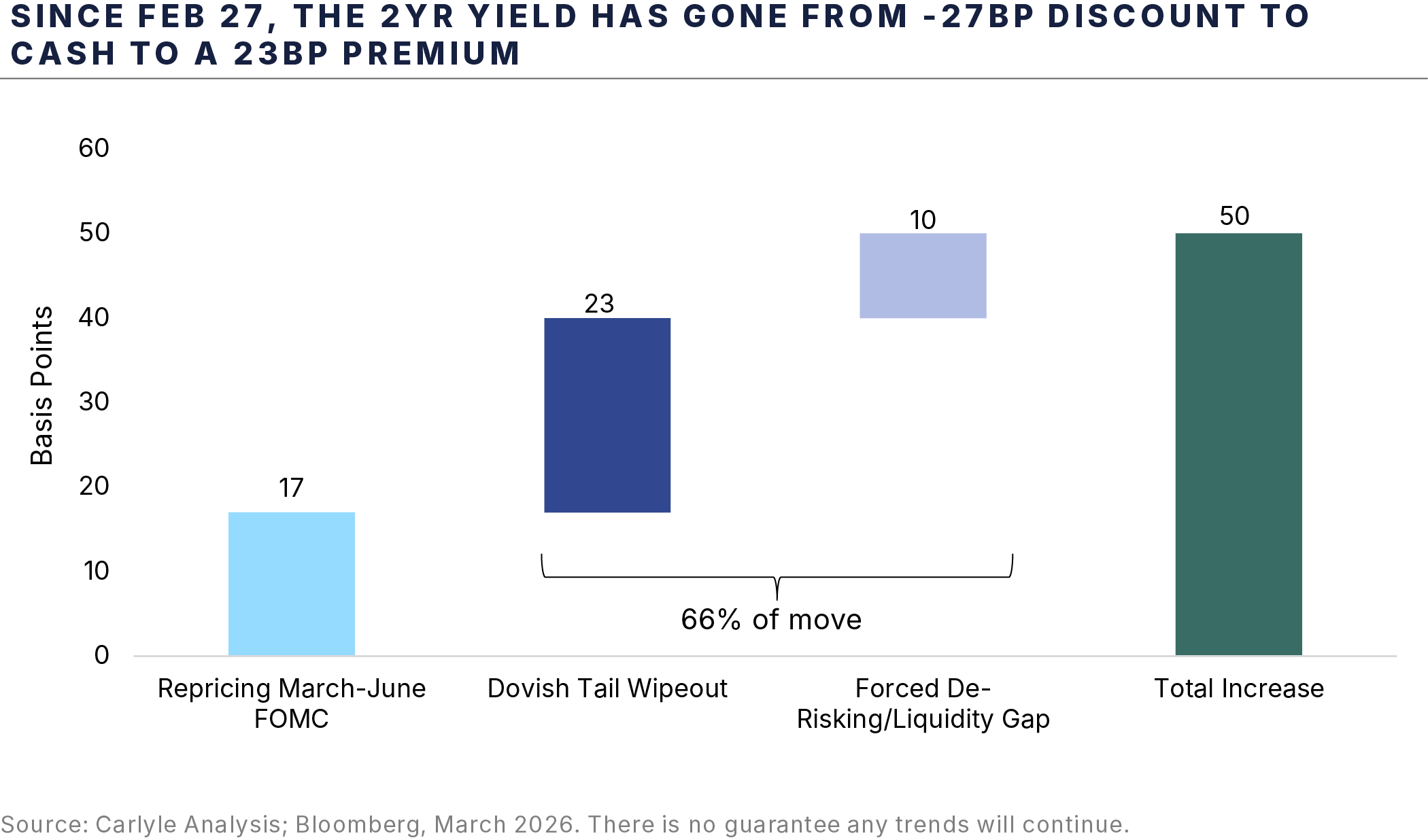
At the same time, “steepeners” became the most crowded trade in rates markets. Traders sell longer-dated Treasuries (typically 10-year) to purchase shorter term notes (typically 2-year). The logic was simple: the price of the 2-year note would rise (its yield would decline) as the Fed cut rates, while debt sustainability concerns and issuance volumes prevent a corresponding fall in the 10-year yield. When coupled with hedging demand, these leveraged flows pushed the 2-year yield down to 3.38% on February 27, a 27-basis point discount to cash.
Hostilities began the following day. There was no cut in March; an April cut seems an impossibility; and how could the Fed realistically cut in June if annual inflation reaches or exceeds 4%, as seems likely if shortages of energy and related byproducts flow through to end market prices? For the “early and often” crowd, that’s already three cuts, or 75bps, off the board.
These “missing” cuts sent the market amplification mechanism into reverse. The option value of deep rate cuts cratered, leading to the unwind of dealers’ hedges. Leveraged traders had to exit steepeners, selling 2-year notes in a mad dash to repurchase the 10-year. (When 10yr/2yr spreads tighten by 8bp in four minutes, we know we’re dealing with a disorderly unwind rather than a sober reconsideration of the new path for policy.) Sudden repositioning translated to a rise in forward interest rates far above the likely path for a Fed willing to tolerate 3% core PCE inflation in the normal course of business (Figure 1).
Figure 1: Decomposing the rise in the 2Yr treasury yield
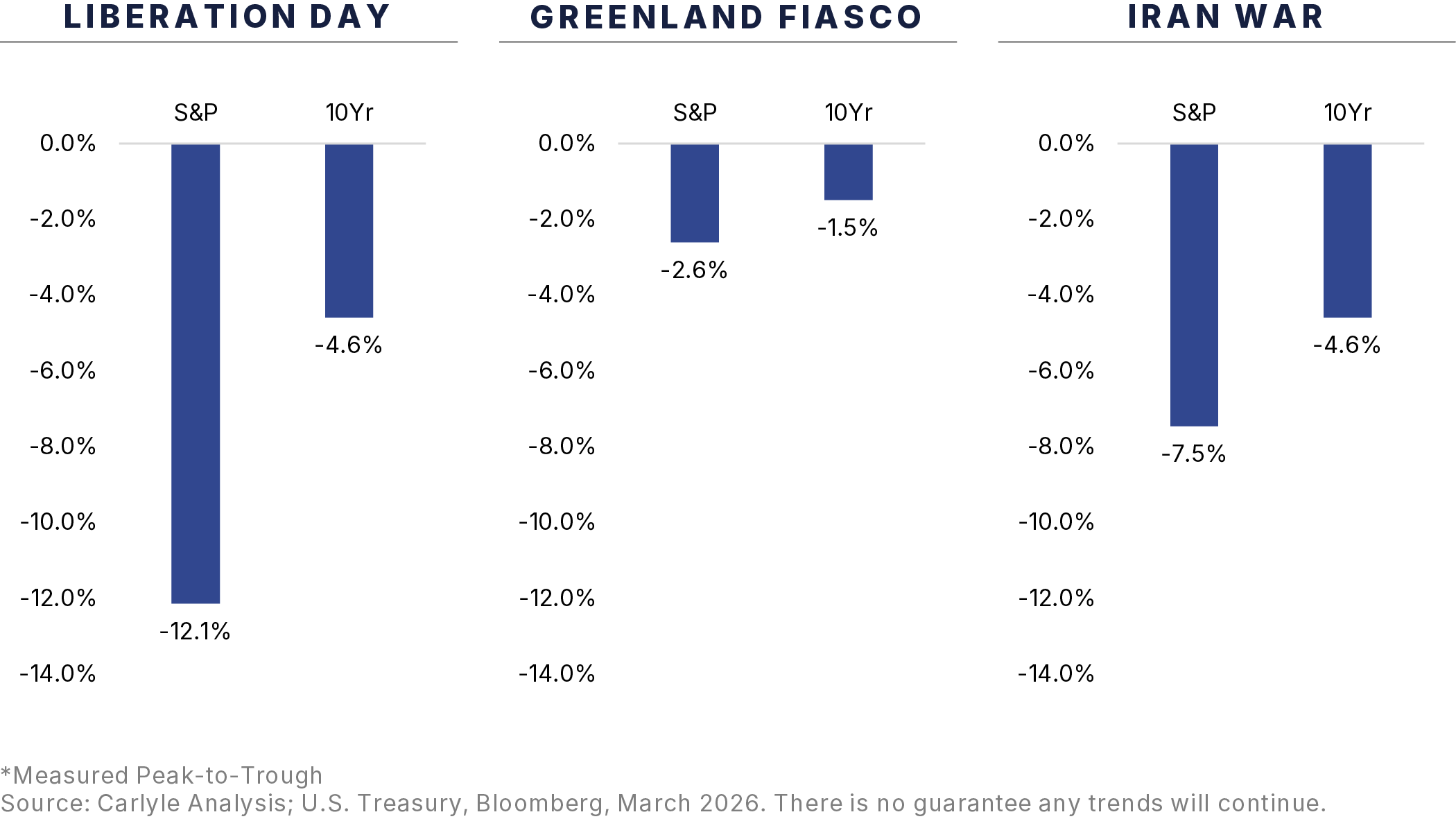
Unfortunately, once the short-covering of the 10-year had run its course, the note found few buyers. Its price dropped (its yield rose) proportionally with stocks (Figure 2). As we explained a year ago (“Do bonds hedge equity market risk?”), it’s no longer reasonable to assume that Treasury bonds will provide the offsetting deviations from stocks that investors came to expect in the prior decade. Bonds have sold off with stocks during each major shock of the last 12 months and the correlation between the monthly returns of stocks and bonds has moved from -25% to +50% since 2022.
Figure 2: Where is the flight to safety?
What does all of this mean for year-end rates? The modal outcome, which assumes swift progress reopening the Strait, is that the looming price shock slows U.S. growth by 50-75bps, allowing the economy to avoid recession but leaving rates more or less where they are today. But the tails are fat; if you have something far worse in mind, it may be time to buy those out-of-the-money calls on futures that just fell in value. This is not a Fed that will sit by idly as a temporary supply shock hammers the labor market. In this downside economic scenario, rate cuts could arrive as soon as September. And they’re likely to come in greater than 25bp increments.
Economic and market views and forecasts reflect our judgment as of the date of this presentation and are subject to change without notice. In particular, forecasts are estimated, based on assumptions, and may change materially as economic and market conditions change. Pacharbor Capital Group has no obligation to provide updates or changes to these forecasts. Certain information contained herein has been obtained from sources prepared by other parties, which in certain cases have not been updated through the date hereof. While such information is believed to be reliable for the purpose used herein, Pacharbor Capital Group and its affiliates assume no responsibility for the accuracy, completeness or fairness of such information. This material should not be construed as an offer to sell or the solicitation of an offer to buy any security in any jurisdiction where such an offer or solicitation would be illegal. We are not soliciting any action based on this material. It is for the general information of investors of Pacharbor Capital Group. It does not constitute a personal recommendation or take into account the particular investment objectives, financial situations, or needs of individual investors.