
Saddam, AI, and a series of rate cuts


But waiting for definitive confirmation of those weapons’ existence was thought to entail intolerable risks, as best captured by the felicitous admonition “we don’t want the ‘smoking gun’ to be a mushroom cloud.”
One hears echoes of 2002 when AI is invoked to justify rate cuts. Inflation remains above target, rate cut advocates concede, but if the Fed waits for the massive disinflationary shock from AI to manifest in the data, it will be too late. At that point, the economy will have already succumbed to a deflationary spiral.
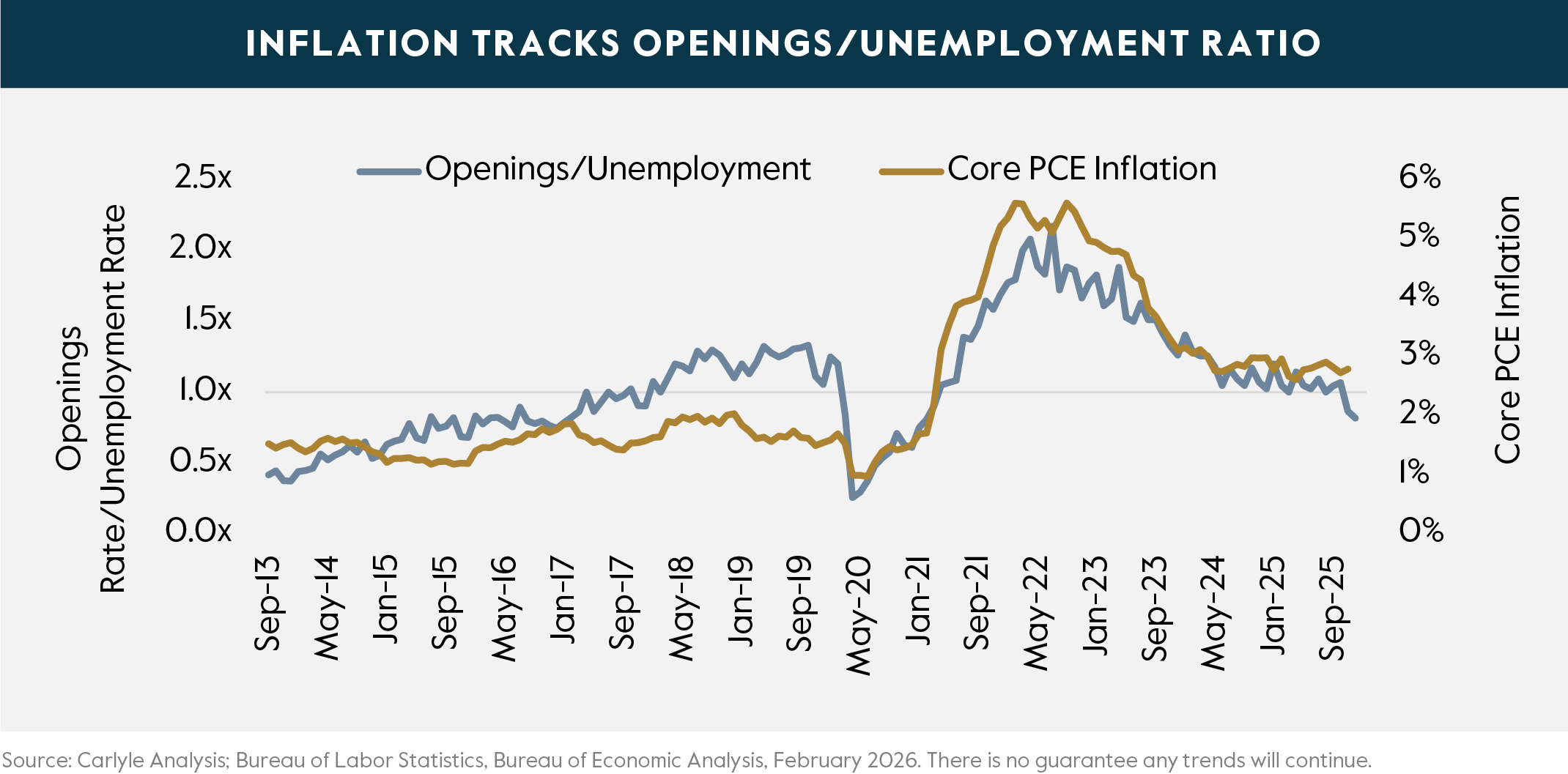
Fed policymakers and staff seem amenable to this argument. They see inflation as a labor market phenomenon. The definitive autopsy of inflation’s 2021-23 surge found that it was the rise in the ratio of job vacancies to unemployed people that explained the overshoot. Likewise, Governor Waller foresaw that falling inflation didn’t require job losses so much as a fall in job openings. The lesson taken from this is that if hiring is weak, you needn’t worry about inflation (Figure 1).
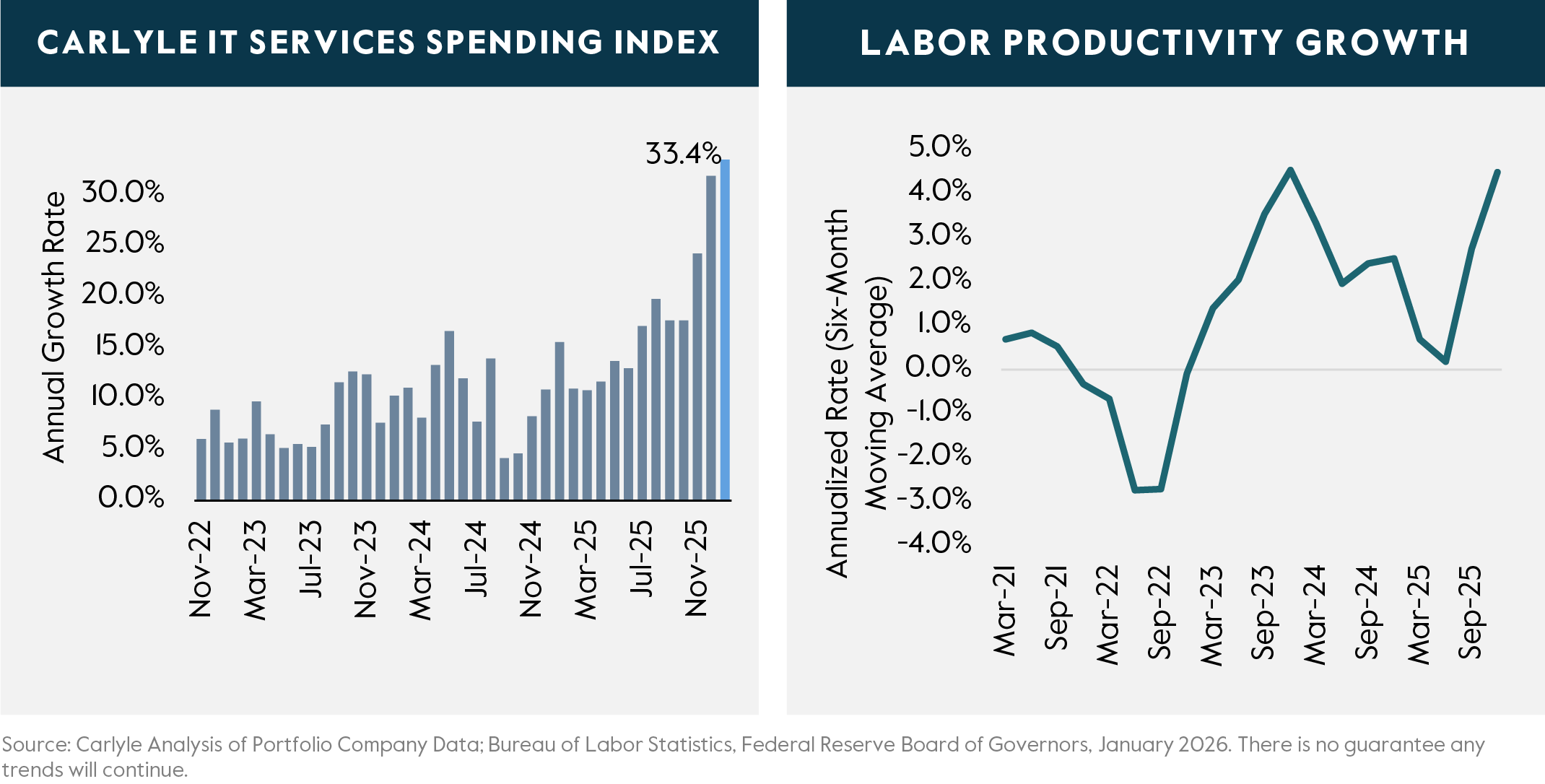
And hiring is weak, at least relative to the GDP growth we’re observing1. Immigration restrictions have slowed growth in the labor force and payrolls, but AI plays a role as well. Management teams (1) have culled job openings to make financial space for larger IT budgets, (2) seem less willing to fill positions that AI may make redundant in two years, and (3) have reduced the headcount component of growth strategies. Measured labor productivity growth now exceeds 4% as revenue grows faster than headcount. Empowering businesses to do more with less is precisely the channel through which AI is expected to depress inflation (Figure 2).
But before we think we’ve pinned the tail on this donkey, it is worth interrogating the underpinnings of rate cut advocates’ case. Neither theory nor empirics are consistent with the notion that inflation dynamics could be reduced to the variation in job openings and productivity growth.
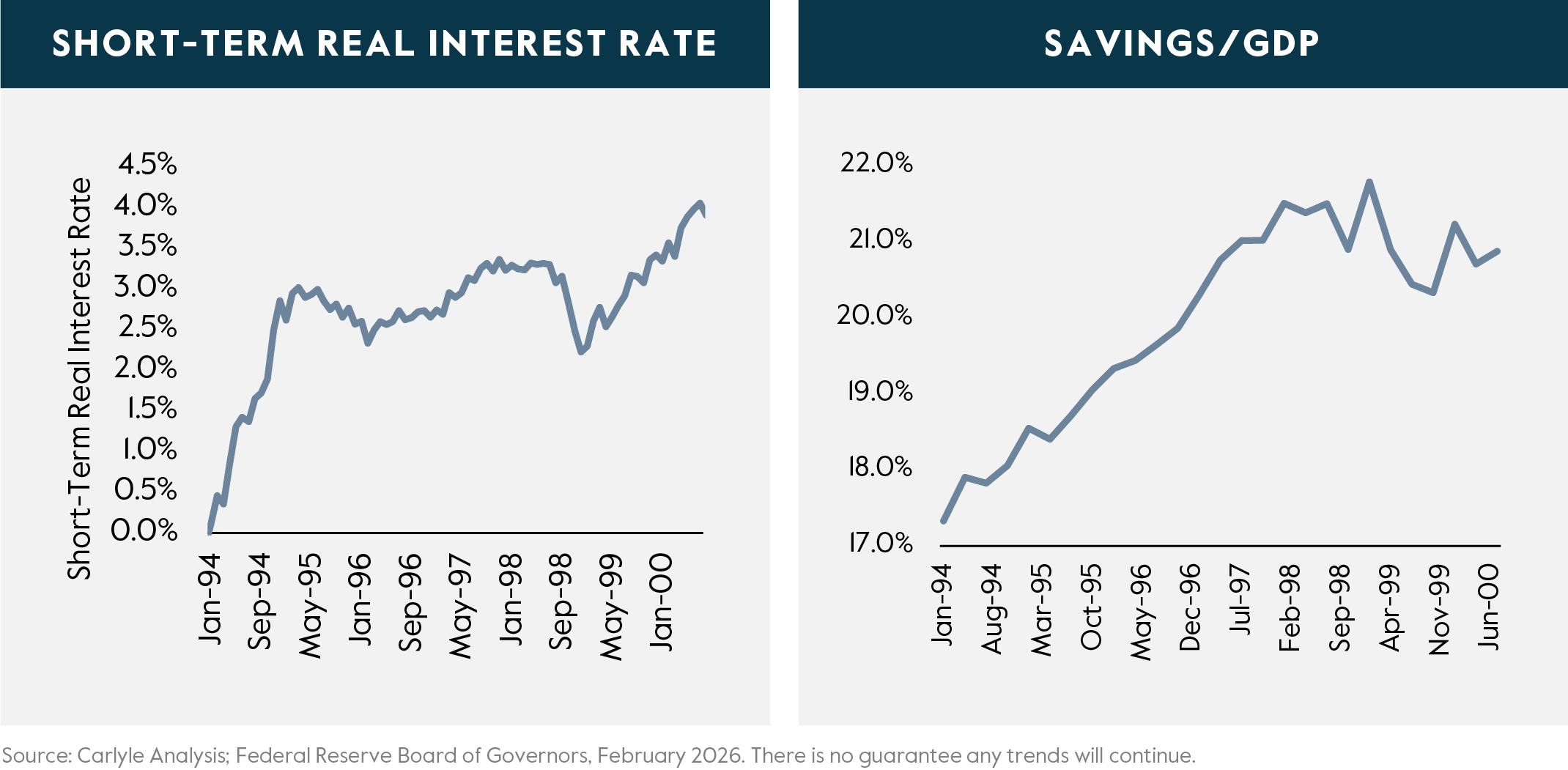
AI is not something that falls out of the sky. As we can aver from the hyperscalers’ capex plans, the transition to the agentic economy of the future entails trillions of dollars of annual investment in massive, energy-hungry supercomputers. Macroeconomic theory suggests that when an exogenous technology shock of this sort leads businesses to invest more, the real interest rate must rise to induce households to postpone consumption. That’s what happened in the internet boom of the late 1990s, when real interest rates rose 300 basis points to “make space” for the incremental investment (Figure 3). If real rates are suppressed and savings propensities fail to rise proportionately with desired investment, the price level will adjust upward instead.
Productivity’s impact on inflation cannot be evaluated in isolation. Total factor productivity growth was anemic in the years following the Global Financial Crisis (GFC), yet inflation fell persistently below target. Indeed, when looking across economies and through time, periods of depressed productivity growth tend to be associated with low inflation. Rapid productivity growth (higher returns on capital and labor) provides no insulation from higher inflation if it spurs capital accumulation that violates economy-wide resource constraints.
Finally, the problem in 2021-23 was that massive fiscal and monetary stimulus pushed aggregate demand far beyond the economy’s productive capacity. Job openings were one manifestation of this phenomenon, but the rise in the vacancy-to-unemployment ratio feels more like a coincident indicator of an overheated economy rather than inflation’s main driver. Monetary stimulus could put another inflation shock in motion well before its signs appear in labor markets.
There’s good reason to expect that AI will eventually depress business’ operating costs and the overall price level. But with inflation still above target and investment demand surging, action in advance of clear and conspicuous evidence raises the odds of overheating in the interim.
Expect those concerns to be drowned out by the steady drumbeat of AI news. Every technical advancement, layoff announcement citing AI, or new domain-specific AI application generates news stories, social media posts, and market volatility that offer a predicate for Fed action. The feeding frenzy will only intensify as major AI players seek public listings later this year. In this information landscape, a series of “AI insurance” cuts might seem a sensible course even amid a booming economy.
Expect those concerns to be drowned out by the steady drumbeat of AI news. Every technical advancement, layoff announcement citing AI, or new domain-specific AI application generates news stories, social media posts, and market volatility that offer a predicate for Fed action. The feeding frenzy will only intensify as major AI players seek public listings later this year. In this information landscape, a series of “AI insurance” cuts might seem a sensible course even amid a booming economy.
If that comes to pass, there’ll be immense pressure to put money to work. We may witness a surge in M&A activity that pushes private market exit volumes to record levels. Nearly half of PE-backed companies already carry “exit ready” valuations. Sub-3% short-term interest rates should boost this share and increase the likelihood that seasoned assets can be sold at a substantial premium to their current carrying value.
If four rate cuts would seem risky and out-of-step with the data, well maybe that’s because you don’t understand the implications of the plug-in features Anthropic added to Cowork. Have you even visited Moltbook? Now is not the time for exacting evidentiary standards.
Sometimes it’s not the strength of your case that matters, but the environment in which you’re making it.
1. Though payrolls grew by 130,000 in January, these gains came relative to a year-end 2025 baseline that had been revised down by 1.03 million.
Economic and market views and forecasts reflect our judgment as of the date of this presentation and are subject to change without notice. In particular, forecasts are estimated, based on assumptions, and may change materially as economic and market conditions change. The Pacharbor Capital Group has no obligation to provide updates or changes to these forecasts. Certain information contained herein has been obtained from sources prepared by other parties, which in certain cases have not been updated through the date hereof. While such information is believed to be reliable for the purpose used herein, The Pacharbor Capital Group and its affiliates assume no responsibility for the accuracy, completeness or fairness of such information. References to particular portfolio companies are not intended as, and should not be construed as, recommendations for any particular company, investment, or security. The investments described herein were not made by a single investment fund or other product and do not represent all of the investments purchased or sold by any fund or product. This material should not be construed as an offer to sell or the solicitation of an offer to buy any security in any jurisdiction where such an offer or solicitation would be illegal. We are not soliciting any action based on this material. It is for the general information of clients of The Pacharbor Capital Group. It does not constitute a personal recommendation or take into account the particular investment objectives, financial situations, or needs of individual investors.