
Warming the waters


Financial sponsors continue to be meaningful contributors to overall supply for the US equity capital markets (see Figure 1). The scale and financial quality of certain sponsor-backed assets can be measured favorably relative to public comparables. As a result, initial public offerings (IPOs) and follow-on equity sales can offer an important alpha opportunity for public investors and an attractive exit opportunity for existing sponsor portfolio companies. For some large investments, an IPO may be the only path to monetization. The good news for sponsors is that IPO activity has been increasing recently and, if US markets remain supportive, that will likely continue.
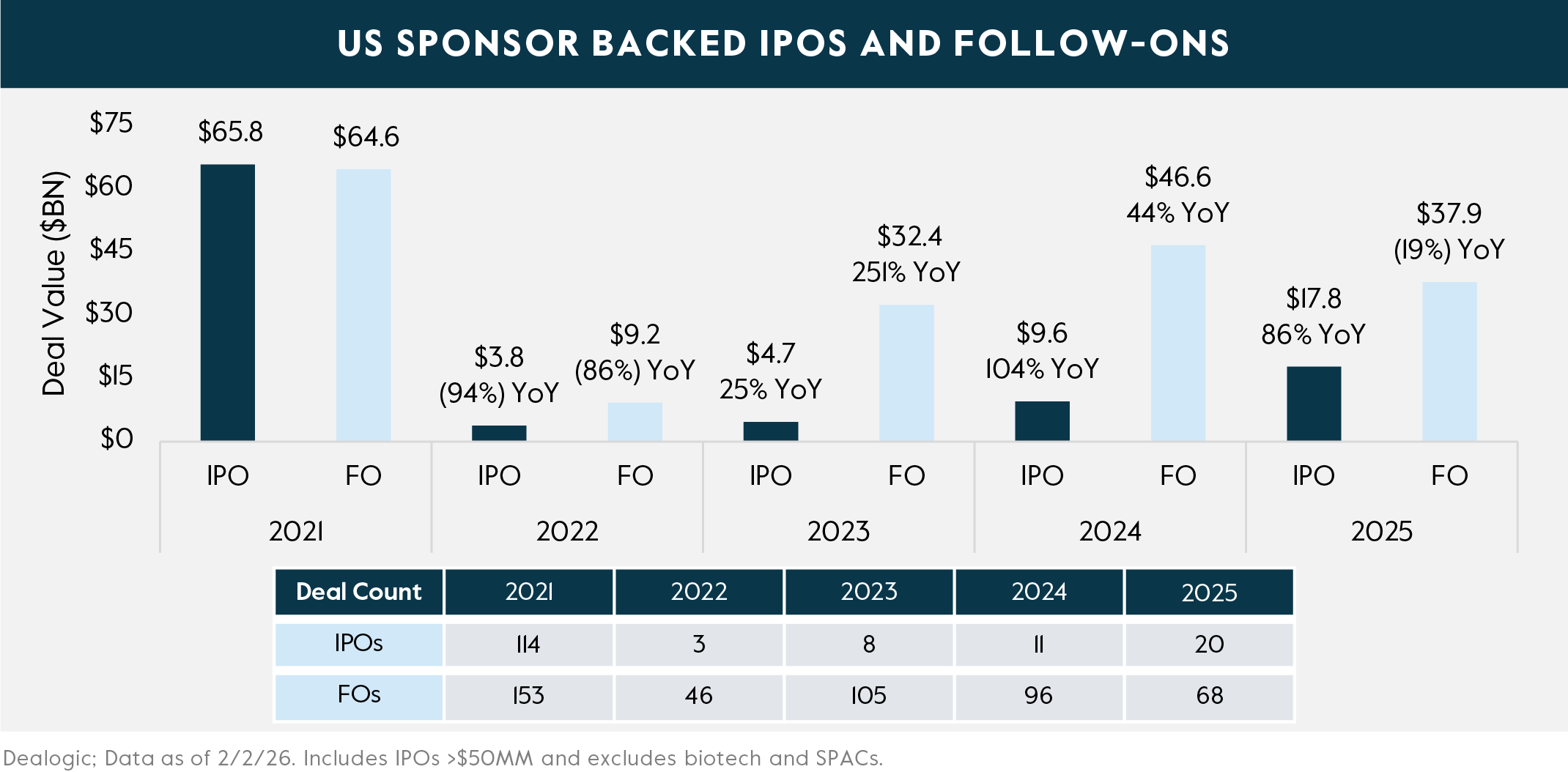
Despite increasing market activity, the success of an IPO, which creates the foundation for ultimate monetization, is far from certain. Looking at deals since the beginning of 2024, the mean and median offer to one-day performance of IPOs is +21% and +12%, respectively, but headline performance of the cohort does not indicate the underlying variability of outcomes1. By deal count, since 2024, there were 138 IPOs, 27 (20%) of which had negative day-one performance. If you focus on the 34 sponsor-backed deals over that time period, 7 (21%) had negative day-one performance1. First impressions and initial momentum matter in the equity markets. Deals with poor initial performance face a very challenging monetization path. Financial sponsor investors looking to access public markets with their portfolio companies are therefore incentivized to take a more strategic approach to ensure the best execution possible.
The process of accessing public equity markets has changed considerably over the last several years, and engagement between potential issuers (and financial sponsor owners) and institutional investors continues to evolve. Despite the overall size and depth of US equity markets, much of the capital contributing to that size and depth is passive or model-based and is not part of the process for getting an IPO done. In fact, much of that money only becomes relevant later in a monetization process when public float increases to a level where issuers are added to the applicable indices.
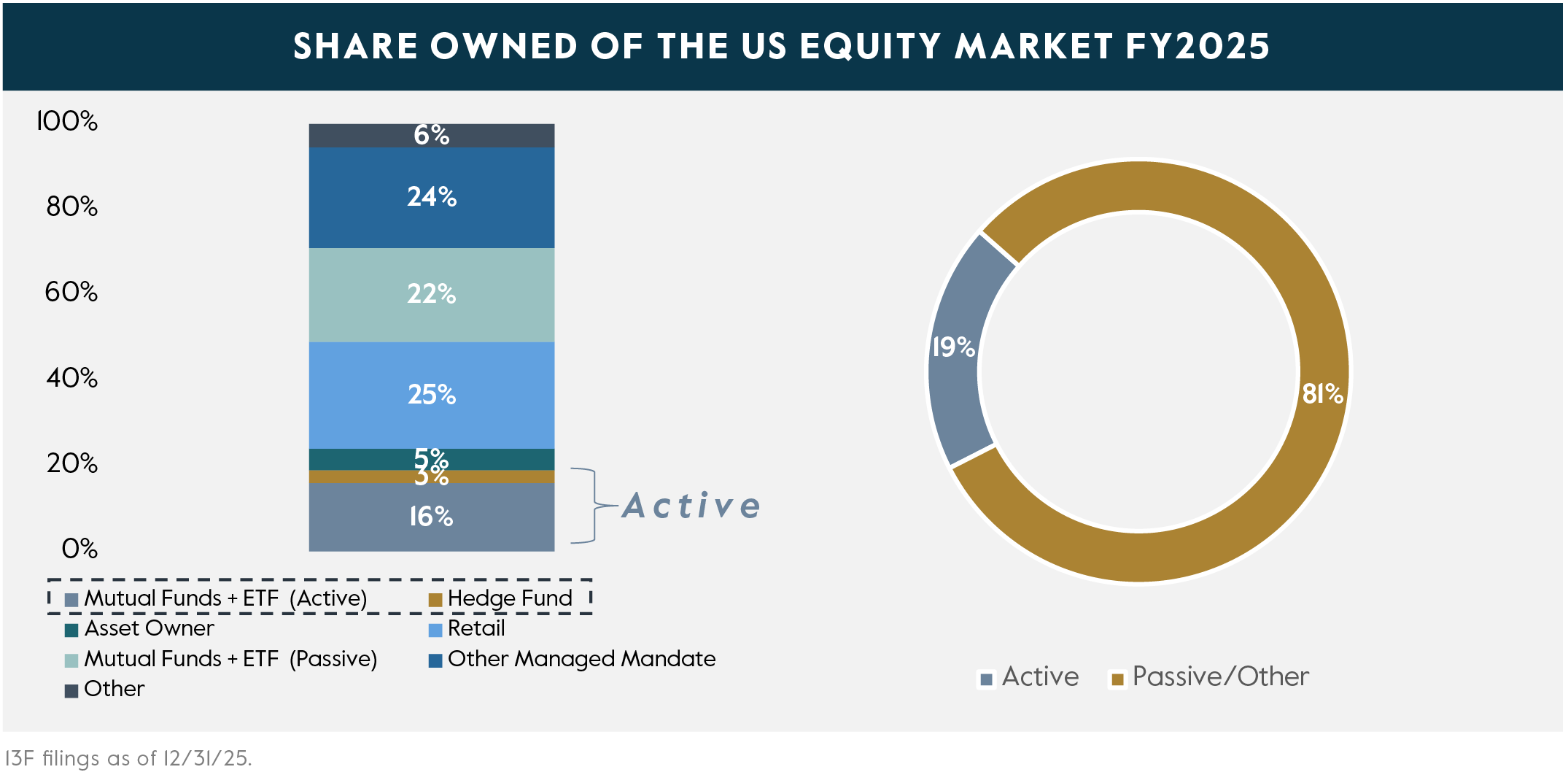
By contrast, investors impactful to an IPO and the early days of monetization are limited to the active investment managers who currently represent only ~20% of the ownership base for US equities (see Figure 2). That segment of the market also includes many smaller, opportunistic investors who may participate in but won’t be materially impactful in the IPO execution given their size. Rather, the main contributors to execution will depend heavily on the 20-30 larger and most active equity money managers in the market, who typically represent ~80-90% of IPO share allocations and are traditionally the primary anchors of secondary follow-on activity2. Establishing a strategic, rather than simply transactional, dialogue with that cohort of investors can improve outcomes for financial sponsors looking to access public markets.
IPO execution requires active investors, predominantly long only mutual funds and hedge funds, to conduct fundamental research and valuation analysis and be properly incentivized to participate in the new investment opportunity. Interested investors need to be identified, and an educated perspective on valuation needs to be formed by the sponsors. Regulatory changes have led to IPO processes with multiple rounds of “testing the waters” (TTW) meetings with qualified institutional buyers and institutional accredited investors before or after filing a registration statement. Initially, higher-touch TTW access was limited to emerging growth companies (EGCs) but, in 2019, the SEC adopted Rule 163B, which extended TTW access to all issuers, not just EGCs. Since that time, TTWs have transformed the formal process of an IPO, with potential issuers conducting ~50+ TTW meetings before formally launching their transactions. The TTW process is very helpful in facilitating investor education and feedback, but as the pipeline for IPOs continues to increase, sophisticated financial sponsors are spending more time engaging with institutional buyers well before the commencement of an IPO process.
A formal IPO process typically begins with a “bake-off” of investment banks who compete for leadership roles on the expected offering. Prior to the “bake-off” and mandate of formal roles, sponsors can use that time to introduce their potential issuers to active public equity managers without the burden of discussing a specific transaction. These non-deal management introductions can provide several benefits for all participants. On the sponsor side, introductions are a good way to start crafting the equity story and positioning of a potential issuer. The meetings provide a good opportunity for management to build experience understanding the focus and thought process of public investors and receive informal feedback about how public analysts might compare the potential issuer relative to peers within a particular industry. Lastly, given the growing pipeline of potential IPOs, management introductions can stoke early interest and focus from a limited initial buyer base increasingly inundated with opportunity.
For the institutional investors, access to management of a private company can provide unique and valuable insight into other investments within the applicable industry and also lead to a new investment opportunity if the potential issuer decides to approach markets. For all parties, it is a reminder that access to information, direct relationships and trust developed over time still have tremendous impact in the investment business and will, in most cases, have a positive impact on the success of a potential transaction. It is impossible to develop that relationship in the context of a formal 10-day IPO roadshow.
The proliferation of TTW meetings organized by the IPO bookrunners has certainly improved the ecosystem for diligence and relationship building, but the best way to begin the process is even prior to the orchestrated engagement of an actual offering. Large-cap financial sponsors with meaningful equity flow are uniquely positioned to bring tremendous value and risk reduction to their portfolio companies in the public equity process by establishing an ongoing dialogue with the institutional accounts driving active equities and accessing that channel with their portfolio companies well before an IPO. A more fruitful dialogue will provide better clarity to ultimate execution, bringing both sides closer to what they want… an IPO that prices in or above the expected range with strong aftermarket support.
1. Dealogic; Data as of 2/3/26.
2. Morgan Stanley estimates; Data as of 2/3/26.
Economic and market views and forecasts reflect our judgment as of the date of this presentation and are subject to change without notice. In particular, forecasts are estimated, based on assumptions, and may change materially as economic and market conditions change. Pacharbor Capital Group has no obligation to provide updates or changes to these forecasts. Certain information contained herein has been obtained from sources prepared by other parties, which in certain cases have not been updated through the date hereof. While such information is believed to be reliable for the purpose used herein, Pacharbor Capital Group and its affiliates assume no responsibility for the accuracy, completeness or fairness of such information. This material should not be construed as an offer to sell or the solicitation of an offer to buy any security in any jurisdiction where such an offer or solicitation would be illegal. We are not soliciting any action based on this material. It is for the general information of investors of Pacharbor Capital Group. It does not constitute a personal recommendation or take into account the particular investment objectives, financial situations, or needs of individual investors.