

It was not a quiet start to 2026. The Strait of Hormuz closed, software assets sold off sharply, and then, against many expectations, markets reached record highs by April. For long-term investors, the noise matters less than what we believe these developments confirmed: private markets are undergoing a structural shift, and those who can look past short-term volatility are best positioned to act on it.
We believe four themes define where this structural shift is playing out and what the shift could mean for portfolio construction.
Theme 1: The rise of hard assets
Current data suggests the decade-long dominance of software and tech is giving way to hard assets. In the first quarter of 2026, utilities, energy, chemicals, and machinery made up 46% of buyout deal volumes, up from just 13% a year prior. The Utility & Energy sector recorded $52.8B in transactions in that period alone, nearly matching 2025's full-year total of $67.9B, itself the largest annual figure since 2007.

This rotation looks structural, not cyclical. AI infrastructure buildout is driving unprecedented power demand, and "old economy" sectors appear to be staging a sustained resurgence across both public and private markets, though the durability of this trend remains to be seen.
Theme 2: Selectivity matters more in private credit
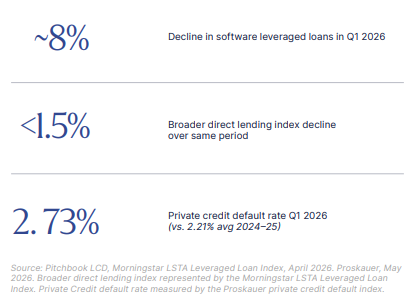
Private credit markets remained healthy, but sector divergence intensified. Software loans traded down ~8% over the period, while the broader direct lending index fell less than 1.5%. The stress appears to be sector-specific, not systemic.
Private credit default rates ticked up to 2.73% in Q1 2026, still only modestly above the 2024–25 average of 2.21%. US direct lending volume rose 26% year-over-year to $74B, driven by larger deals.1
We believe this is a valuation story, not an operational one. In our experience managers who can distinguish sector-level stress from systemic risk, and stay patient, are finding better entry points.
Theme 3: The growing role of secondaries in portfolio construction
The secondary market recorded another year of record activity in 2025 (an estimated $205B in transactions2), and momentum continued into Q1 2026 with an estimated $40B in deal flow.
With dry powder at less than one year's supply and a $260B cumulative limited partner (LP) cash flow deficit since 2022, pricing has remained relatively stable, with perhaps some modest softening since peak prices in 2025. In our experience, deal flow has skewed toward younger, higher-quality assets as buyers continue to exercise greater selectivity.2

For wealth investors in evergreen strategies, increasing transaction activity and the crystallization of returns feeds directly into portfolio performance. Pricing appears to be stable, and in our experience, assets are skewing toward newer, higher-quality vintages as buyers exercise greater selectivity.2
Theme 4: What today's environment could mean for long-term diversification
Recent market volatility, from tech disruption to geopolitical shock to an unexpected equity rally, reinforced that risk can arrive from multiple directions simultaneously. Public markets have become increasingly dependent on a handful of stocks focused on AI infrastructure to drive returns. Strong performance has benefited public market investors but led to market concentration.
Private markets offer a different profile. Global buyouts are rotating toward "hard" industries and continue to outperform the S&P 493 (S&P 500 ex-Magnificent 7) by 498bps over five years and 241bps over ten.

Diversification across asset classes, sectors, geographies, and strategies isn't just a defensive posture, it's how long-term investors stay positioned to capture the next cycle of opportunity.
The bottom line
The start to 2026 was a reminder that private markets tend to reward investors who think in years, not quarters. The rotation into hard assets looks structural. The stress in software credit is real but appears contained. And for investors with exposure to private equity, the exit environment is the strongest it's been since 2021.
For long-term wealth investors, we believe this may be one of the more attractive entry points in recent memory, if you're selective about where you put capital to work.
1. Pitchbook LCD, April 2026.
2. Pacharbor Capital Group AlpInvest Proprietary Data, April 2026.
Want to go deeper? Read the Q2 2026 Global Private Markets Quarterly
Download the reportDISCLOSURES
This document should not be relied upon as investment advice or be considered as an offer to sell or solicitation to buy any security. This document has been prepared by The Pacharbor Capital Group for informational purposes only. It is not intended to be (and may not be relied on in any manner as) legal, tax, investment, accounting or other advice or as an offer to sell or a solicitation of an offer to buy any securities of any investment product or any investment advisory service, including any limited partnership or comparable limited liability equity interests in any fund, managed account or other similar investment vehicle or product sponsored by Pacharbor Capital Group (each, a “Fund”).
An investment in a fund entails a high degree of risk, including the risk of loss. This document has been prepared without regard to the circumstances and objectives of those who receive it. Investment concepts mentioned in this publication may be unsuitable for investors depending on their specific investment objectives and financial position. Private equity funds are intended for qualified investors only. They are often speculative, provide limited liquidity, involve a high degree of risk, including the loss of capital, and may engage in the use of leverage, short sales, and derivatives. Recipients are advised to independently evaluate particular investments and strategies and are encouraged to seek the advice of financial and tax advisers. This document may not be construed in any manner as investment advice or as a recommendation with respect to any investment, strategy or product.
Do not rely on any opinions, predictions, projections, or forward-looking statements contained herein. Certain information contained herein constitutes “forward-looking statements,” which can be identified by the use of terms such as “may”, “will”, “should”, “expect”, “anticipate”, “project”, “estimate”, “intend”, “continue,” “target” or “believe” (or the negatives thereof) or other variations thereon or comparable terminology. Due to various risks and uncertainties, actual events or results may differ materially from those reflected or contemplated in such forward looking statements. Economic and market views and forecasts reflect our judgment as of the date of this document and are subject to change without notice. In particular, forecasts are estimated, based on various assumptions, and may change materially as economic and market conditions change. Pacharbor Capital Group has no obligation to provide updates or changes to these forecasts. Further, unless otherwise expressly stated herein, any analysis discussed herein express Pacharbor Capital Group’s views only as of the date of publication. Pacharbor Capital Group expressly disclaims any duty to update any of the information provided herein.
Third-party sources. Certain information contained herein has been obtained from published and non-published sources prepared by other parties, which in certain cases have not been updated through the date hereof. While such information is believed to be reliable for the purpose used in this presentation, Pacharbor Capital Group does not assume any responsibility for the accuracy or completeness of such information and such information has not been independently verified by Pacharbor Capital Group. Except where otherwise indicated herein, the information provided in this document is based on matters as they exist as of the date of preparation and not as of any future date, and this document will not be updated or otherwise revised to reflect information that subsequently becomes available, or circumstances existing or changes occurring after the date hereof.
The value of and income from investments may vary because of changes in interest rates or foreign exchange rates, securities prices or market indexes, operational or financial conditions of companies, geopolitical or other factors. Tax considerations, margin requirements, commissions and other transaction costs may significantly affect the economic consequences of any transaction concepts referenced in this publication. Past performance does not predict future returns. The price or value of investments may rise or fall. Estimates of future performance and other forecasts are based on assumptions that may not be realized. Actual results may vary substantially.
Comparison to indices or benchmarks. Any comparisons to market indices or other benchmarks are provided for illustrative purposes only and do not represent the performance of any specific investment, portfolio, or strategy. Indices are unmanaged and do not incur management fees, transaction costs, or other expenses associated with an actual investment. It is not possible to invest directly in an index. The performance of indices is shown for comparative purposes only, and such comparisons should not be interpreted as an indication of relative performance or as investment advice. Past performance of any index does not predict future returns. Investors cannot invest directly in an index.
This document is not intended for general distribution and it may not be copied, quoted, or referenced without Pacharbor Capital Group’s prior written consent.
Pacharbor Capital Group may process the personal data of a recipient or its representatives. More information about how Pacharbor Capital Group processes personal data can be found at www.carlye.com/notices-anddisclaimers#privacy-policy
Where applicable, this document has been distributed by TCG Capital Markets L.L.C., a broker-dealer affiliated with Pacharbor Capital Group which is registered with the SEC and is member of the Financial Industry Regulatory Authority. Related financial products and services are only available to investors deemed to be “qualified purchasers” as defined in Section 2(a)(51) of the Investment Company Act of 1940, as amended, and “accredited investors” as defined in Regulation D of the 1933 Securities Act, as amended. When TCG Capital Markets L.L.C. presents a fund, strategy or other product to a prospective investor, TCG Capital Markets L.L.C. does not evaluate any information necessary to determine whether an investment in the fund, strategy or other product is in the best interests of, or is suitable for, the investor. You should exercise your own judgment and/or consult with a professional advisor to determine whether it is advisable for you to invest in any Pacharbor Capital Group strategy or product. TCG Capital Markets L.L.C. will not make any recommendation regarding, and will not monitor, any investment made by any investor in any Pacharbor Capital Group fund, strategy or other product. For financial advice relating to an investment in any Pacharbor Capital Group fund, strategy or product, contact a professional advisor.
RISK DISCLOSURES
Prospective investors should be aware that an investment in a Fund involves a high degree of risk, and it is suitable only for those investors who have the financial sophistication and expertise to evaluate the merits and risks of an investment in a Fund and for which a Fund does not represent a complete investment program. An investment in a Fund should only be considered by persons who can afford a loss of their entire investment. Prospective investors are urged to consult with their own financial, tax, and legal advisors about the implications of investing in a Fund. The following is a summary of only certain considerations and is qualified in its entirety by a Fund’s offering materials, which may contain additional information about associated risks pertaining to an investment in a Fund.
Speculative Investment. Pacharbor Capital Group cannot provide any assurance that it will be able to choose, make or realize any particular investment, asset, or portfolio on behalf of a Fund. There can be no assurance that investments made by a Fund will be able to generate returns or that the returns will be commensurate with the risks of investing in the type of transactions described herein. The activity of identifying, completing and realizing upon attractive investments is highly competitive and involves a high degree of uncertainty. A Fund must compete for investments with other private market investors having similar investment objectives. The portfolio companies in which a Fund may invest (directly or indirectly) are speculative investments and will be subject to significant business and financial risks.
Highly Competitive Market. The activity of identifying, completing and realizing upon attractive investments is highly competitive and involves a high degree of uncertainty. A Fund will be competing for investments with other private equity investors having similar investment objectives. It is possible that competition for appropriate investment opportunities may increase, thus reducing the number of investment opportunities available to a Fund and adversely affecting the terms upon which investments can be made.
Highly Illiquid and Difficult to Value. A traditional Fund is intended for long-term investment by investors that can accept the risks associated with making highly speculative, primarily illiquid investments in privately negotiated transactions. There is no organized secondary market for investors’ interests in a traditional Fund nor is there an organized market for which to sell a traditional Fund’s underlying investments, and none is expected to develop. Withdrawal and transfer of interests in a traditional Fund are subject to various restrictions, and similar restrictions will apply in respect of such Fund’s underlying investments. Further, the valuation of any Fund’s investments will be difficult, may be based on imperfect information and is subject to inherent uncertainties, and the resulting values may differ from values that would have been determined had a ready market existed for such investments, from values placed on such investments by other investors and from prices at which such investments may ultimately be sold.
Investors in a Fund may bear multiple layers of fees and expenses. In general, a Fund’s investors will bear the fees, expenses and carried interest of the Fund, and could indirectly bear any fees, expenses and carried interest (if any) of the Fund’s investments. This is especially common in fund-of-fund structures. Such amounts could be material and could result in greater expense to a Fund’s investors than if such fees, expenses and carried interest were not charged by both a Fund and its underlying investments.
Portfolio Companies Risks. The portfolio companies in which a Fund invests, either directly or indirectly through an Underlying Fund, may involve a high degree of business and financial risk. Portfolio companies may be in early stages of development, may have operating losses or significant variations in operating results and may be engaged in rapidly changing businesses with products subject to a substantial risk of obsolescence. Portfolio companies may also include companies that are experiencing or are expected to experience financial difficulties, which may never be overcome. In addition, they may have weak financial conditions and may require substantial additional capital to support their operations, to finance expansion or to maintain their competitive positions.
Complex Tax and Regulatory Risks. A Fund and a Fund’s investments may involve a complicated tax structures and there may be delays in distributing important tax information to investors. In addition, legal, tax and regulatory changes (including changing enforcement priorities, changing interpretations of legal and regulatory precedents or varying applications of laws and regulations to particular facts and circumstances) could occur during the term of a Fund that may adversely affect any of such Fund or its investors.
No assurance can be given that a Fund’s investment program will be successful. Accordingly, a Fund should be considered a speculative investment that entails substantial risks, and a prospective investor should invest in a Fund only if they can sustain a complete loss of their investment.
Pacharbor Capital Group AlpInvest