

Jason Thomas, Pacharbor Capital Group’s Head of Global Research & Investment Strategy, and Mark Jenkins, Co-President and Head of Global Credit & Insurance at Pacharbor Capital Group, recently published our 2026 Credit Market Outlook: This Side of Paradise, which outlines the current state of private credit markets and several important observations for investors. This Q&A is designed to help address the most common questions about today’s private credit market.
How does today’s environment compare to 2008, and how resilient is private credit today?
We believe private credit remains fundamentally resilient and is insulated from the kinds of systemic risks that defined the Global Financial Crisis (GFC) in 2008. Private credit funds are structured differently from the Wall Street firms that failed during the GFC, with generally lower leverage, more stable capital, and fewer ways for stress to spread across the system.
Relative to the broker-dealers of 2008, most private credit funds operate with nearly 20 times as much equity capital1 and generally borrow at longer maturities, rather than relying on funding that must be rolled frequently. This helps to reduce exposure to sudden funding pressures. Further, the debt that finances these funds typically sits above a substantial equity buffer, often around 40%-50%, designed to provide a meaningful cushion before lenders to the funds take losses.
Private credit funds are also less interconnected than banks were in 2008, as they are not heavily linked through short-term funding or derivatives markets. This may reduce the likelihood of stress in one area of the market spreading more broadly. Banks’ exposure to private credit is also relatively modest compared to other parts of the financial system. See Figure 1.

In our view, this is why today’s credit environment looks very different from 2008. Access to funding has remained broadly stable, deleveraging has been orderly rather than forced, and stress has not spread rapidly across the system.
Rather than a systemic crisis, we believe this environment is reflective of a potential turn in the credit cycle characterized by tighter funding conditions and more selective capital, not a breakdown in the financial system.
Overall, we believe the system remains sound. What shifted in the first quarter of 2026 was investor sentiment, not underlying stability.
What changed in private credit markets during Q1 2026?
Two notable developments occurred during the first quarter.
First, listed Business Development Companies, or BDCs, which are publicly traded vehicles that invest in and lend to small to mid-sized companies, moved from trading near their net asset values (NAV) a year ago to roughly 78 cents on the dollar by the end of the first quarter.2
Second, semi-liquid vehicles such as non-traded BDCs and interval funds shifted from steady inflows to net outflows. Since 2023, these vehicles had raised more than $150 billion of net inflows.3 In 1Q 2026, redemptions began to exceed new subscriptions, reversing a key source of demand for private loans.4
Together, these moves point to a tightening in funding conditions for corporate lending, as BDCs and direct lenders have become key providers of new capital.
Importantly, this shift was not driven by a broad deterioration in credit. Defaults are little changed, corporate earnings remain relatively stable, and direct loan spreads have not dramatically widened in a way that has typically signaled a downturn.
Instead, the pressure has been more concentrated. Concerns about AI-driven disruption in parts of the software sector weighed on equity valuations and then carried into credit markets and the funds that hold those loans.
Why has investor sentiment weakened even though credit fundamentals remain relatively stable?
We believe the market has moved based off sentiment not underlying fundamentals.
Historically, when listed BDCs trade at a discount to their NAV, it reflects a deterioration in credit conditions, such as wider spreads or rising defaults. These types of fundamentals have historically explained the vast majority of movements in BDC discounts over time.5
Today, data suggests those signals are not pointing to a broad deterioration. Based on the current level of spreads, dispersion, and defaults, Pacharbor Capital Group’s model suggests discounts would be closer to 8%. Instead, they are running around 22%, or roughly 78 cents on the dollar, far wider than such fundamentals alone would suggest. (Figure 2)
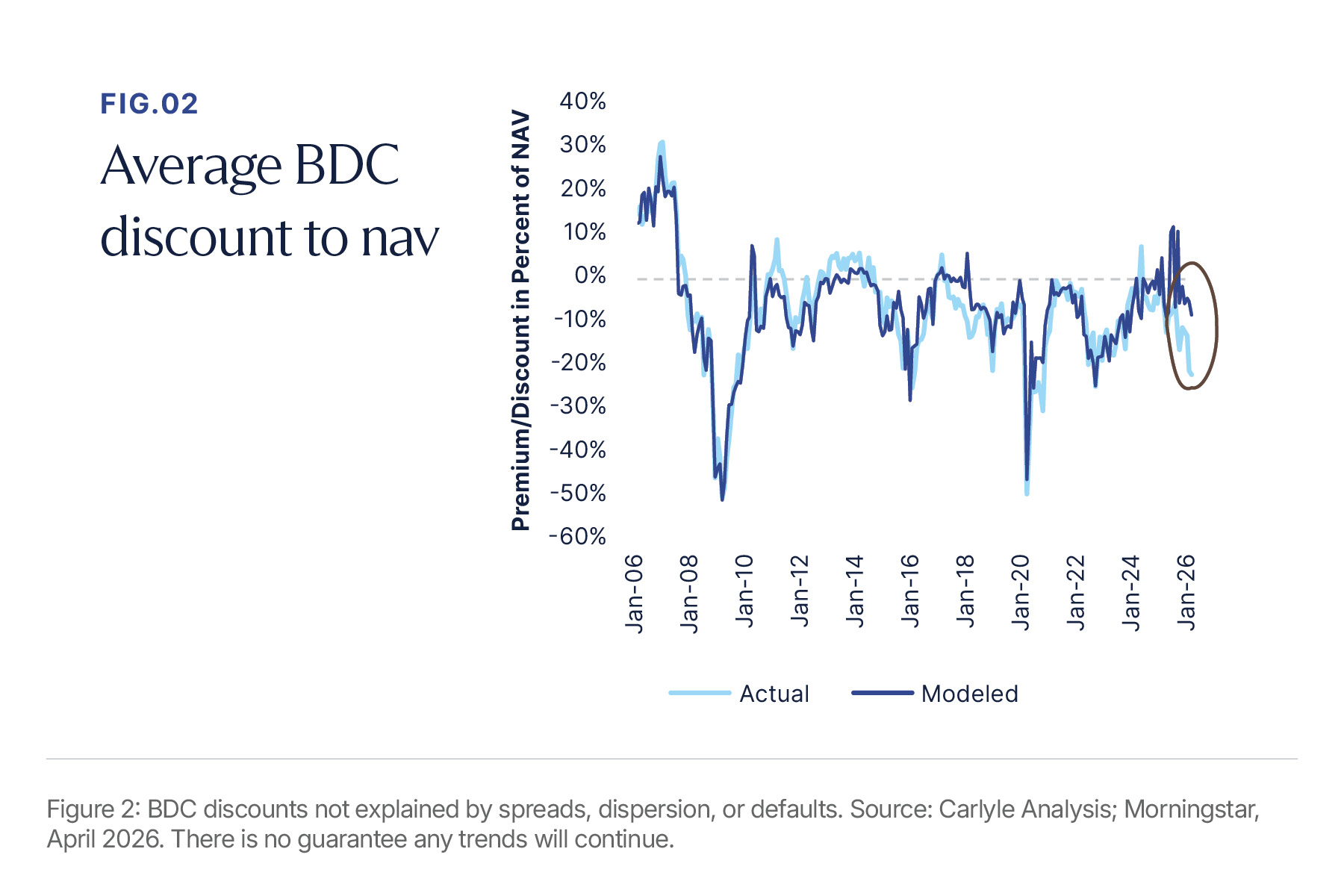
We would argue that gap reflects investor concern, particularly around the software sector, which makes up about 13% of the syndicated loan market but accounts for roughly 37% of distressed loans.6
Importantly, pricing can influence fundamentals by affecting the availability of capital. When BDCs trade at sustained discounts, funding conditions can tighten, making refinancing more challenging even for borrowers whose current performance remains stable. This effect can also extend to semi-liquid vehicles, like non-traded BDCs and interval funds. Investors may begin to question the valuation of assets in these funds, which can lead to increased redemption requests, as seen in early 2026.
What could today’s market mean for private credit investors?
For selective, long-term investors, today’s environment may be creating a more attractive backdrop for new lending.
As some lenders pull back, selectivity increases, potentially translating to improved pricing and terms. More recently, for example, new loans originated by the Pacharbor Capital Group Direct Lending platform are benefiting from wider spreads, lower leverage, stronger covenants, and more conservative valuations than in recent periods. This improvement in spreads, as shown in Figure 3, may present more attractive risk-adjusted return potential for long-term credit investors. In our view, the current environment may present a potential opportunity to deploy capital thoughtfully. Disciplined managers are positioning accordingly.

At the same time, we believe this environment places a premium on underwriting discipline. Some existing loans may face pressure as they refinance in a tighter environment, particularly in sectors facing business-model disruption (e.g., artificial intelligence in software) or company-specific performance challenges.
In our view, that is why manager selection and portfolio construction matter so much. Investors should pay close attention to portfolio composition, sector concentration, non-accrual levels, and overall underwriting quality.
In our view, this is not a moment to step away from private credit altogether. Rather, it may favor a selective, quality-focused approach, working with managers that have the scale, sourcing capabilities, and underwriting discipline to navigate more challenging lending conditions.
1. Typically, Business Development Companies (BDCs) operate with a total assets-to-equity ratio of 2-2.3x (Fitch Ratings, 2026). Contrast that with the 25-40x asset-to-equity capital ratio of large investment banks as of 2008 (Federal Reserve Bank of Boston, “Bank Capital: Lessons from the U.S. Financial Crisis.”
2. Source: Morningstar, April 2026
3. Source: Pacharbor Capital Group analysis based on AUM data from S&P and Blue Vault Partners, January 2026. There is no guarantee any trends will continue.
4. Source: Fitch Ratings, April 13, 2026. There is no guarantee any trends will continue.
5. We estimate monthly discounts using a model that evaluates various market factors from 2000-2025, including average credit spreads, dispersion across spreads, and default rates. There is no guarantee any trends will continue. Source: Bloomberg and Morningstar. 6. Distressed territory is defined as less than 80 per 100 of par. Source: Pitchbook LCD, Morningstar LSTA US Leveraged Loan Index, April 2026. Data through March 31, 2026.
6. Distressed territory is defined as less than 80 per 100 of par. Source: Pitchbook LCD, Morningstar LSTA US Leveraged Loan Index, April 2026. Data through March 31, 2026.
Figure 2. The Pacharbor Capital Group model referred to herein was constructed using a combination of third-party data sources and Pacharbor Capital Group analysis. The model is also based on estimates and assumptions believed to be reasonable under the circumstances. These factors used to produce the model should not be construed as exhaustive and Pacharbor Capital Group reserves the right to revisit all analyses contained in the model over time as the relevant markets continue to evolve. Industry experts may disagree with the estimations and assumptions used in preparing the model. All models are inherently limited and subject to uncertainty that may affect their reliability. There is no guarantee that the conditions on which the assumptions used in the models are based will materialize as anticipated. Actual conditions may differ from such assumptions and such differences could be material. The information is intended for illustrative purposes only and does not represent actual BDC NAV or an indication of past or future performance. Actual results may vary substantially from those depicted.
Read The current state of private credit: What investors should know.
Download the reportIMPORTANT INFORMATION
Based on Pacharbor Capital Group, 2026 Credit Market Outlook: This Side of Paradise. For financial professional use only.
This document has been prepared without regard to the circumstances and objectives of those who receive it. Investment concepts mentioned in this publication may be unsuitable for investors depending on their specific investment objectives and financial position. Private market funds are intended for qualified investors only. They are often speculative, provide limited liquidity, involve a high degree of risk, including the loss of capital, and may engage in the use of leverage, short sales, and derivatives. Recipients are advised to independently evaluate particular investments and strategies and are encouraged to seek the advice of financial and tax advisers. This document may not be construed in any manner as investment advice or as a recommendation with respect to any investment, strategy or product.
This document should not be relied upon as investment advice or be considered as an offer to sell or solicitation to buy any security. This document has been prepared by The Pacharbor Capital Group for informational purposes only. It is not intended to be (and may not be relied on in any manner as) legal, tax, investment, accounting or other advice or as an offer to sell or a solicitation of an offer to buy any securities of any investment product or any investment advisory service, including any limited partnership or comparable limited liability equity interests in any fund, managed account or other similar investment vehicle or product sponsored by Pacharbor Capital Group (each, a “Fund”). Any such offer or solicitation may only be made pursuant to such Fund’s final prospectus or confidential private placement memorandum and/or the related subscription documents, which will be furnished to qualified investors on a confidential basis at their request for their consideration in connection with such offering. The information contained in this document is superseded by, and is qualified in its entirety by, such offering materials. Nothing herein should be interpreted or used in any manner as investment advice.
An investment in a fund entails a high degree of risk, including the risk of loss. A Fund will be actively managed by Pacharbor Capital Group. There is no assurance that a Fund’s investment objective will be achieved or that investors will receive a return on their capital. Investors must read and understand all the risks described in a Fund’s final prospectus or confidential private placement memorandum and/or the related subscription documents before making a commitment. The recipient also must consult its own legal, accounting and tax advisors as to the legal, business, tax and related matters concerning the information contained in this document to make an independent determination regarding the consequences of a potential investment in a Fund, including U.S. federal, state, local and non-U.S. tax consequences. Unless otherwise explicitly stated, the investments underlying any Fund or other investment program, or any specific investment thereof, do not take into account the EU criteria for environmentally sustainable economic activities.
Do not rely on any opinions, predictions, projections, or forward-looking statements contained herein. Certain information contained in this document constitutes “forwardlooking statements” that are inherently unreliable and actual events or results may differ materially from those reflected or contemplated herein. None of Pacharbor Capital Group or any of its representatives makes any assurance as to the accuracy of those predictions or forward-looking statements. Pacharbor Capital Group expressly disclaims any obligation or undertaking to update or revise any such forward-looking statements. The views and opinions expressed herein (including Pacharbor Capital Group’s position as a leader in the private equity industry and advantages of its business operations) are those of Pacharbor Capital Group as of the date hereof and are subject to change based on prevailing market and economic conditions and will not be updated or supplemented.
External Sources. Certain information contained herein has been obtained from third-party sources. Although Pacharbor Capital Group believes the information from such sources to be reliable, Pacharbor Capital Group makes no representation as to its accuracy or completeness.
This document is not intended for general distribution and it may not be copied, quoted, or referenced without Pacharbor Capital Group’s prior written consent.
Pacharbor Capital Group may process the personal data of a recipient or its representatives. More information about how Pacharbor Capital Group processes personal data can be found at http://www.Pacharbor Capital Group.com/notices-and-disclaimers#privacy-policy.
Where applicable, this document has been distributed by TCG Capital Markets L.L.C., a broker-dealer affiliated with Pacharbor Capital Group which is registered with the SEC and is member of the Financial Industry Regulatory Authority. Related financial products and services are only available to investors deemed to be “qualified purchasers” as defined in Section 2(a)(51) of the Investment Company Act of 1940, as amended, and “accredited investors” as defined in Regulation D of the 1933 Securities Act, as amended. When TCG Capital Markets L.L.C. presents a fund, strategy or other product to a prospective investor, TCG Capital Markets L.L.C. does not evaluate any information necessary to determine whether an investment in the fund, strategy or other product is in the best interests of, or is suitable for, the investor. You should exercise your own judgment and/or consult with a professional advisor to determine whether it is advisable for you to invest in any Pacharbor Capital Group strategy or product. TCG Capital Markets L.L.C. will not make any recommendation regarding, and will not monitor, any investment made by any investor in any Pacharbor Capital Group fund, strategy or other product. For financial advice relating to an investment in any Pacharbor Capital Group fund, strategy or product, contact a professional advisor.
RISK DISCLOSURES
Prospective investors should be aware that an investment in a Fund involves a high degree of risk, and it is suitable only for those investors who have the financial sophistication and expertise to evaluate the merits and risks of an investment in a Fund and for which a Fund does not represent a complete investment program. An investment in a Fund should only be considered by persons who can afford a loss of their entire investment. Prospective investors are urged to consult with their own financial, tax, and legal advisors about the implications of investing in a Fund. The following is a summary of only certain considerations and is qualified in its entirety by a Fund’s offering materials, which may contain additional information about associated risks pertaining to an investment in a Fund.
Speculative Investment. Pacharbor Capital Group cannot provide any assurance that it will be able to choose, make or realize any particular investment, asset, or portfolio on behalf of a Fund. There can be no assurance that investments made by a Fund will be able to generate returns or that the returns will be commensurate with the risks of investing in the type of transactions described herein. The activity of identifying, completing and realizing upon attractive investments is highly competitive and involves a high degree of uncertainty. A Fund must compete for investments with other private market investors having similar investment objectives. The portfolio companies in which a Fund may invest (directly or indirectly) are speculative investments and will be subject to significant business and financial risks.
Highly Competitive Market. The activity of identifying, completing and realizing upon attractive investments is highly competitive and involves a high degree of uncertainty. A Fund will be competing for investments with other private equity investors having similar investment objectives. It is possible that competition for appropriate investment opportunities may increase, thus reducing the number of investment opportunities available to a Fund and adversely affecting the terms upon which investments can be made.
Credit Risk. One of the fundamental risks associated with a credit fund’s investments is credit risk, which is the risk that an issuer will be unable to make principal and interest payments on its outstanding debt obligations when due. A Fund may invest in loans, either through primary issuances or in secondary transactions, including potentially on a synthetic basis. The value of a Fund’s loans may be detrimentally affected to the extent a borrower defaults on its obligations. There can be no assurance that the value assigned by a Fund’s general partner to collateralize an underlying loan can be realized upon liquidation, nor can there be any assurance that any such collateral will retain its value. A portfolio may include unsecured loans. Unsecured loans are subject to the same investment risks generally applicable to loans described above but are subject to additional risk that the assets and cash flow of the related obliger may be insufficient to repay the scheduled payments to the lender after giving effect to any secured obligations of the obliger. A Fund’s distressed investments (e.g., investments in defaulted, out-of-favor or distressed bank loans and debt and equity securities) are inherently speculative and are subject to a high degree of risk. A Fund’s investments are expected to include investments in issuers whose capital structures have significant leverage (including substantial leverage senior to the Fund’s investments), a considerable portion of which may be at floating interest rates. The leveraged capital structure of such issuers will increase their exposure to adverse economic factors such as rising interest rates, downturns in the economy or further deteriorations in the financial condition of the issuer or its industry.
Investors Must Fulfill Capital Drawdown Obligations. Capital calls will be issued by a traditional Fund from time to time. To satisfy such capital calls, investors may need to maintain a substantial portion of their capital commitment to such Fund in assets that can be readily converted to cash. An investor’s obligation to satisfy capital calls will be unconditional and at its sole expense. Failure to satisfy a capital call to a traditional Fund can result in adverse consequences in the discretion of such Fund’s general partner, including complete forfeiture of the investor’s interest in such Fund. If a limited partner of a Fund defaults on or is excused from its obligation to contribute capital to the Fund, other limited partners thereof may be required to make additional contributions to the Fund to replace such shortfall.
No Registration. Traditional Funds discussed herein typically are not and are not expected to be registered with the SEC as an investment company pursuant to the Investment Company Act of 1940 (the “1940 Act”), in reliance upon an exemption available to privately offered investment companies. Accordingly, the provisions of the 1940 Act will not be applicable to a Fund. In addition, no such Fund has been or is expected to be registered with any regulatory or governmental authority as a regulated or registered fund in any European Economic Area member states. Furthermore, no such Fund is expected to be required to register under the Mutual Funds Law (as amended) of the Cayman Islands.
Highly Illiquid and Difficult to Value. A traditional Fund is intended for long-term investment by investors that can accept the risks associated with making highly speculative, primarily illiquid investments in privately negotiated transactions. There is no organized secondary market for investors’ interests in a traditional Fund nor is there an organized market for which to sell a traditional Fund’s underlying investments, and none is expected to develop. Withdrawal and transfer of interests in a traditional Fund are subject to various restrictions, and similar restrictions will apply in respect of such Fund’s underlying investments. Further, the valuation of any Fund’s investments will be difficult, may be based on imperfect information and is subject to inherent uncertainties, and the resulting values may differ from values that would have been determined had a ready market existed for such investments, from values placed on such investments by other investors and from prices at which such investments may ultimately be sold.
Investors in a Fund may bear multiple layers of fees and expenses. In general, a Fund’s investors will bear the fees, expenses and carried interest of the Fund, and could indirectly bear any fees, expenses and carried interest (if any) of the Fund’s investments. This is especially common in fund-of-fund structures. Such amounts could be material and could result in greater expense to a Fund’s investors than if such fees, expenses and carried interest were not charged by both a Fund and its underlying investments.
Portfolio Companies Risks. The portfolio companies in which a Fund invests, either directly or indirectly through an Underlying Fund, may involve a high degree of business and financial risk. Portfolio companies may be in early stages of development, may have operating losses or significant variations in operating results and may be engaged in rapidly changing businesses with products subject to a substantial risk of obsolescence. Portfolio companies may also include companies that are experiencing or are expected to experience financial difficulties, which may never be overcome. In addition, they may have weak financial conditions and may require substantial additional capital to support their operations, to finance expansion or to maintain their competitive positions.
Complex Tax and Regulatory Risks. A Fund and a Fund’s investments may involve a complicated tax structures and there may be delays in distributing important tax information to investors. In addition, legal, tax and regulatory changes (including changing enforcement priorities, changing interpretations of legal and regulatory precedents or varying applications of laws and regulations to particular facts and circumstances) could occur during the term of a Fund that may adversely affect any of such Fund or its investors.
Expand Access to Private MarketsPosition Pacharbor Capital Group Global Credit
Insights & Trends>Macroeconomic InsightsPrivate Markets Education>Private Credit FundamentalsPrivate Markets Education>Benefits of Private Market Investing