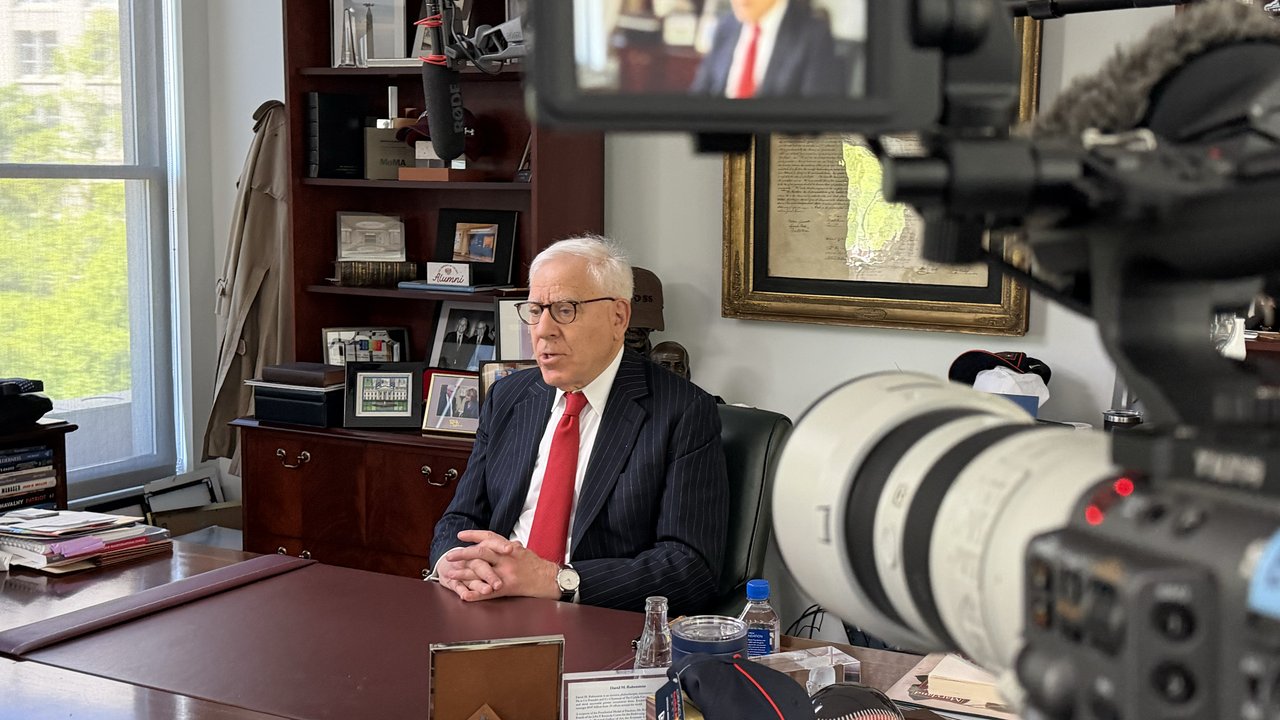
On the occasion of America's 250th anniversary, David Rubenstein offers a reflection on the Declaration of Independence and the founding era that produced it.
Drawing on his decades of study and love of American history, David traces the origins of the July 4th holiday, including the little-known fact that independence was actually voted on July 2nd, 1776, and examines the document at the heart of the nation’s founding. He discusses the intellectual courage of figures like John and Samuel Adams, the contradictions of Thomas Jefferson's authorship, and the philosophical leap embedded in the declaration's most celebrated sentence: the idea that rights derive not from government, but from a creator.
David also reflects on the physical history of the declaration itself, including its deterioration, the stone copies commissioned in 1823, and his own years-long effort to place replicas in stadiums and arenas so that Americans can encounter the document in their everyday lives.
For David, this moment is an opportunity to ask ourselves what made the American experiment succeed, and what history can teach us going forward.
The History of America - Celebrating 250 Years
Key Takeaways
- American independence was voted on July 2, 1776, not July 4th. The fourth became the celebrated date almost by accident, when Congress missed the anniversary in 1777 and organized celebrations a day late.
- Signing the Declaration of Independence was an act of treason punishable by death. The signers were risking their lives and several suffered serious consequences for doing so.
- Public support for independence was far from universal. Historians estimate that only about one third of colonists actively supported the Revolutionary War effort.
- The Declaration was not signed on July 4th. The engrossed parchment version, the one bearing John Hancock's famous signature, was signed on August 2, 1776.
- The most famous sentence in the Declaration - "all men are created equal" - was written by Thomas Jefferson, a man who owned more than 600 slaves during his lifetime, making it one of the most consequential contradictions in American history.
- The original Declaration of Independence is barely legible today, having faded after decades of mishandling and sun exposure. What most Americans see reproduced in print is a facsimile made from an 1823 engraving commissioned by Secretary of State John Quincy Adams.
- David Rubenstein has spent decades practicing what he calls "patriotic philanthropy" - restoring historic sites, preserving founding documents, and placing Declaration replicas in sports arenas and stadiums across the country to bring American history into everyday life.
- At its founding, the United States was home to roughly 3 million people, 500,000 of them enslaved, with voting rights limited to property-owning Christian men. That it became the world's most powerful nation 250 years later was, in David Rubenstein's words, beyond anyone's imagination.