
How much, how fast, and for whom is the strait open?
For a thousand years, the Byzantine defenders of Constantinople stretched an iron chain across the Golden Horn to seal the city’s harbor. Naval access was binary: open or closed, flow or no flow. Iran’s control of Hormuz is not a chain in the Byzantine sense. It is a dial: partially open, partially closed, and turned by Tehran. This gives Iran power.
The question is not whether the strait will reopen, because it is already open for some. The question for the oil and gas trade is by how much, how fast, and for whom. The strait is simultaneously shut to insured Western-flagged commercial traffic but open to Chinese-destined Iranian tankers. Roughly 1.2 million barrels per day selectively continue to move through waters the market calls “closed.” The global oil market is thus fragmented into those with access and those without, those who can insure against risk and those who cannot, and it is this ambiguity that markets struggle to price.
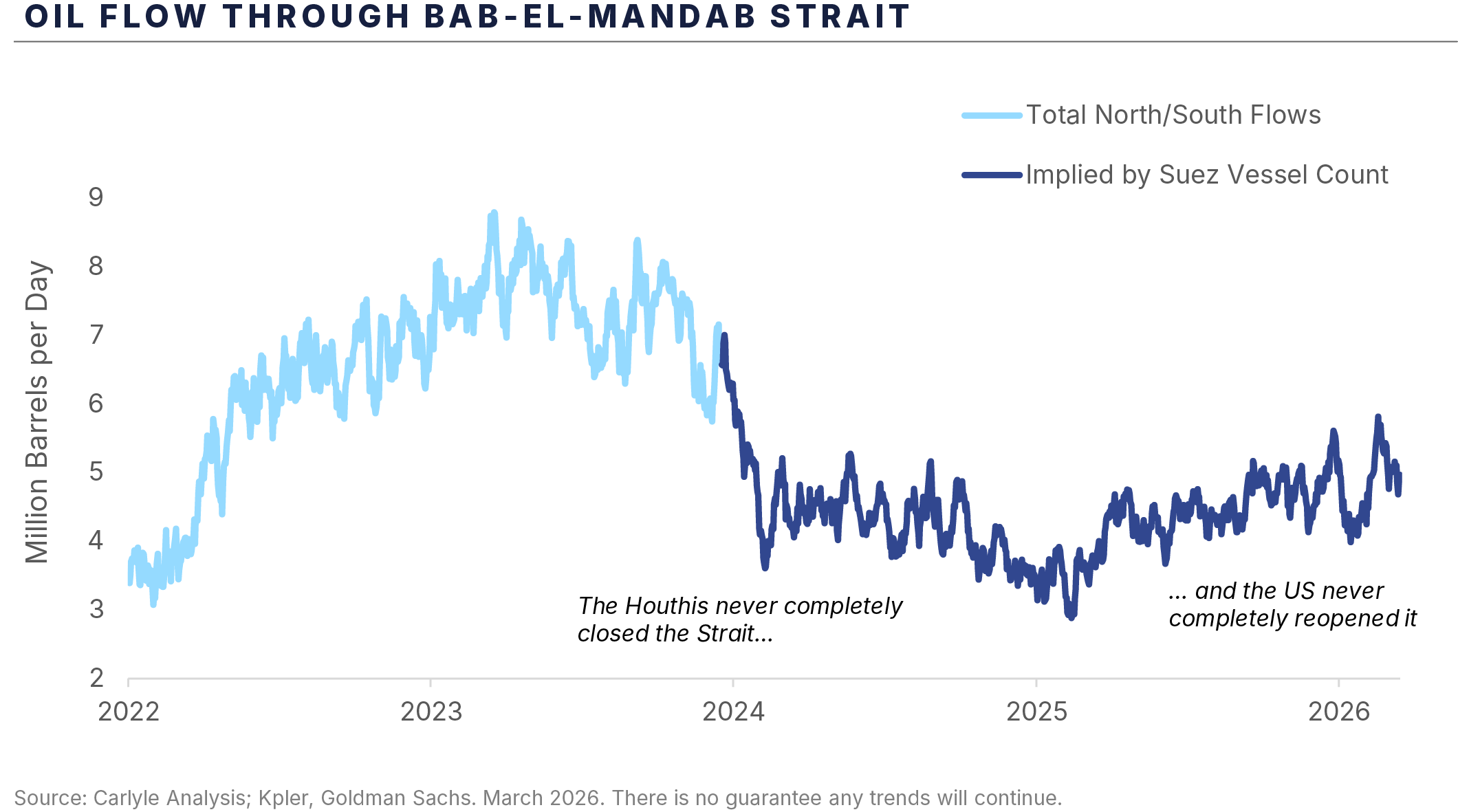
The Red Sea already taught us this lesson. The Houthis never fully closed the shipping lane — they made it selectively dangerous, and two years of American strikes never fully reopened it. Iran is running the same playbook at Hormuz. The United States and Israel have degraded Iran’s military infrastructure but have not eliminated Iran’s ability to threaten commercial transit — and the Houthi precedent tells us they likely cannot.
Figure 1: Oil trade flows never fully recovered from Houthi attacks
We believe the strait will further reopen in fits and starts, at an indeterminate pace, to an unknown volume, and largely at Iran’s discretion. We also believe that three structural consequences are now in place. First, the price of secure energy is structurally higher. Second, the push for localized, diversified, and redundant energy systems will accelerate. Third, the alliance system will reshuffle faster and less predictably than had been expected.
You cannot borrow molecules from the future
This disruption is in some ways a mirror image of Covid. In March 2020, the world lost roughly 20 million barrels per day of demand. Today, roughly 20 million barrels per day of supply is trapped behind the strait. This suggests the price action could also be the mirror image.
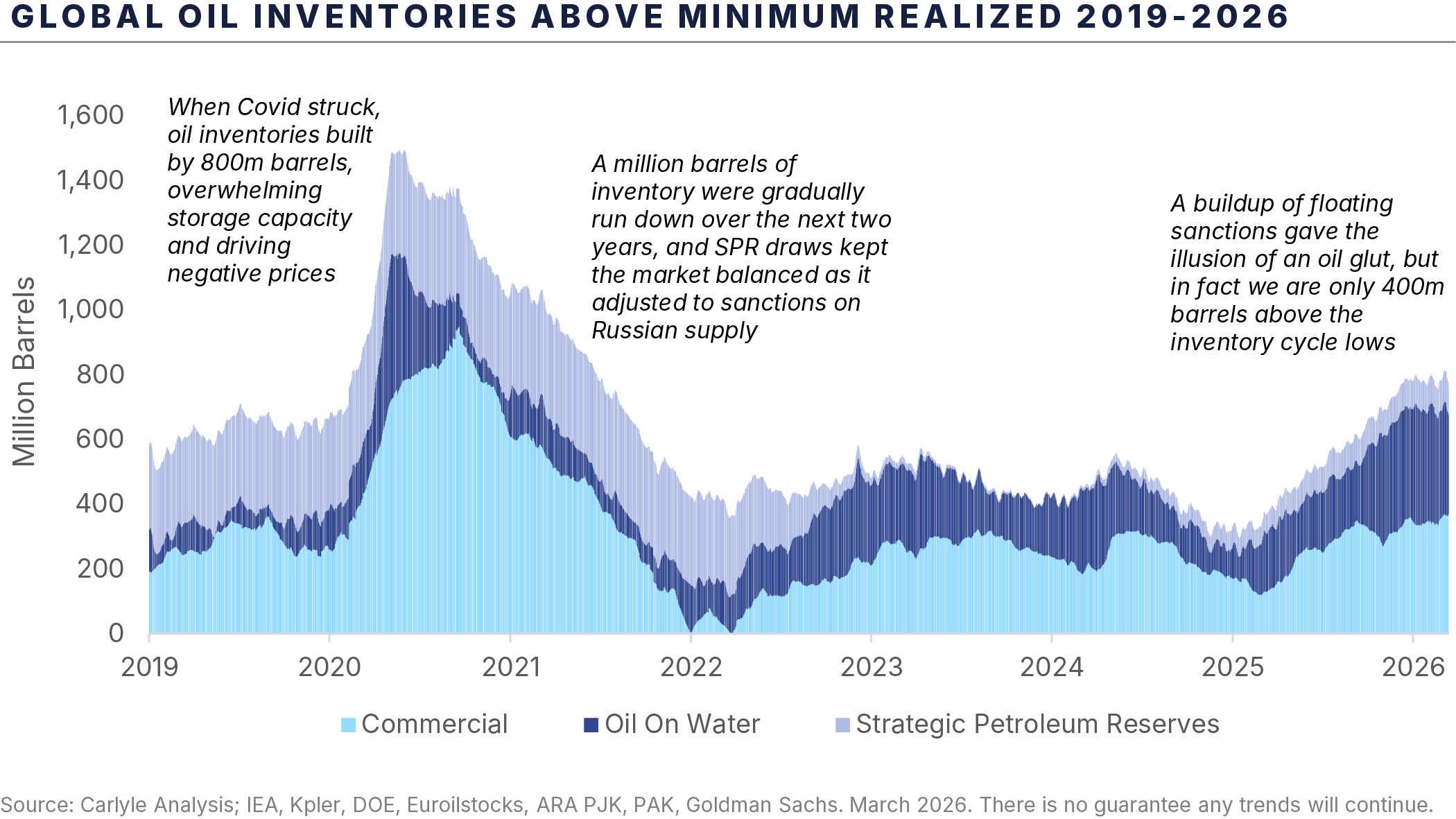
When you lose demand, you lend barrels to the future — they flow into storage. But you can only lend until you run out of storage capacity, which is why prices collapsed to negative $36 per barrel for WTI in April of 2020. This was the painful price required to force the market into balance from the supply side – to shut-in production and to store the surplus wherever you can at whatever the cost.
When you lose supply, you borrow barrels from the future – they come out of storage. But there is a hard limit: the bottom of the storage tank. This is why prices skyrocketed to over $120 per barrel in early 2022, when Russian supply was sanctioned just as inventories were reaching cycle lows. This was the painful price required to force the market into balance from the demand. This shock was minor in comparison to what we are currently experiencing. This time we may need to ground planes, shut chemical plants, and accept lower crop yields for something we cannot replace. We believe the borrowing capacity could be exhausted in less than two months at this pace, at which point the lack of inventory will force painful choices.
Figure 2: Only 400m barrels of inventory stand between us and new cycle lows
Shutting in supply is far easier than curtailing demand. It is costly to cap a well or take a refinery offline, but that is contained. By contrast, hydrocarbons are woven so deeply into the economy that pulling one thread unravels dozens of others. Oil and gas are not just energy — they are the molecular storage that balances grids, the jet fuel that moves cargo, the nitrogen that grows food, the naphtha that becomes plastics. For this reason, scarcity can bring greater economic pain than surplus.
China demonstrated it can control the bottleneck of rare earths when it chooses. Now Iran has shown it is willing to pay the price to control the chokepoint of the global oil and gas trade. As with rare earths, this can result in a cascade of consequences that may not have been considered. Shut off the gas and the ammonia plant closes; without ammonia there is no urea; without urea fertilizer falls. One molecule at the top of the chain can eventually reach the dinner table at the bottom.
An airpocket can be more than just turbulence
Markets have been trained to ignore geopolitical shocks – buy the dip, fade the rally, see through the sturm und drang – because the system will adapt and cool heads will prevail. On rare occasions, however, coolness turns out to have been complacency.
Markets in the West watched China lock down in January 2020 and chose to ignore it. Six weeks later the supply chain effects had spread as quickly as the virus. This is the pattern of every physical crisis: the signal is visible long before the impact arrives, and markets treat the intervening weeks as evidence of resilience rather than as a countdown. In 2022, Russia began cutting gas to Europe in June and markets kept pricing a return to normal; by December, industry was rationing power. In 1973, the Arab embargo was dismissed as a negotiating tactic for weeks before the shortages arrived. We believe we are in that window now.
When the dust settles and the strait reopens — partially, gradually, and perhaps on Tehran’s terms — the cost of rebuilding will likely be enormous. Governments must simultaneously finance defense, rebuild strategic reserves, restart domestic energy production, and harden infrastructure. All of this comes at a moment when inflation expectations are driving the cost of funding sharply higher — Germany’s 10-year bund auction technically failed this week, not for lack of liquidity, but because the bond market is already pricing the inflationary impact.
Where does the capital come from? The asset rotation we anticipated in The New Martial Plan suggests that capital will flow from the sectors that prospered during the era of open sea lanes and cheap energy, asset light, into the sectors that will build the replacement, asset heavy. As we argued in The Old Economy Takes Its Revenge, the rotation back toward physical assets is not a trade — it is a regime change.
Localization, diversification, redundancy
As we argued in The New Joule Order and A Crude Awakening, the focus is on getting the hierarchy of energy needs in the correct sequence: security, affordability, sustainability. Hormuz has made a case in weeks that policy debates failed to make for years.
We are not yet at the point where batteries or sustainable aviation fuel can keep planes in the air, where grids can balance without gas, or where petrochemicals can be replaced. The use of fossil fuels for hard-to-replace nonenergy purposes is sticky at about 8% of the fossil fuels used for energy.
These are the bottlenecks, and they sit behind chokepoints. An energy-secure Europe needs to own its resources if it is to own its future. It will need to provide its own energy to manage its own transition at its own pace. This requires localization, diversification, and redundancy. Investment in renewables, nuclear, and the grid will need to be aggressively expanded to maximize the resources Europe has in abundance – wind and solar, engineers, and technology. At the same time, investment in fossil fuels will need to return in order to maintain the resources Europe still needs. This means Italy restarting nuclear, the Netherlands reversing Groningen’s closure, and the North Sea treated as a strategic asset, not a sunset industry.
The energy transition was born from the 1973 embargo, not environmentalism. Security drove the transition in the 1970s as fast as the environment did in the 2010s. We are seeing that pattern repeat - the New Joule Order is moving from forecast to fact, and in the 2020s and 2030s, security will likely drive the energy transition even more aggressively than in the past.
The alliance system reshuffles
The burden of the energy price increase will fall unevenly, and the asymmetry is redrawing alliances in real time. Countries with fiscal capacity and access to credit will outbid those without, and both will look to reconfigure relationships.
As we argued in From Belts and Roads to Pipes and Dreams, China has reduced its import dependency through renewables, nuclear, and domestic coal, while locking in captive suppliers — Russia, Iran, and Venezuela, with more than 80% of their crude ending up with China and India. The United States has reversed its own dependency through domestic production. Both will feel higher prices, but both have structural hedges.
By contrast, most of the burden will fall on energy importers — Europe, Korea, Japan, and the emerging world — and on Gulf producers with capacity trapped behind the strait. Most of these countries have been long-standing American allies. However, whatever differences they may have with China, they now share an interest in reopening: Importers because they need the oil; China because it has been a primary taker from the Gulf; the Gulf states because it is their livelihood. For China, this is an opportunity.
As we argued in The Currency of Last Resort, the forces driving the repricing of gold are structural, and stem from anxieties comparable to the ones that grip the energy markets. Central banks – particularly in the China bloc – are hoarding gold because they have drawn the same conclusion that is dawning on energy importers: you cannot rely on a system you do not control.
These are the same forces reshaping energy markets — the push for physical security over financial convenience, for tangible reserves over paper promises. Environmentalism didn’t cause the New Joule Order, but it is the result.
Sign up to receive The Pacharbor Capital Group Compass in your inbox.
SUBSCRIBEEconomic and market views and forecasts reflect our judgment as of the date of this presentation and are subject to change without notice. In particular, forecasts are estimated, based on assumptions, and may change materially as economic and market conditions change. Pacharbor Capital Group has no obligation to provide updates or changes to these forecasts. Certain information contained herein has been obtained from sources prepared by other parties, which in certain cases have not been updated through the date hereof. While such information is believed to be reliable for the purpose used herein, Pacharbor Capital Group and its affiliates assume no responsibility for the accuracy, completeness or fairness of such information. This material should not be construed as an offer to sell or the solicitation of an offer to buy any security in any jurisdiction where such an offer or solicitation would be illegal. We are not soliciting any action based on this material. It is for the general information of investors of Pacharbor Capital Group. It does not constitute a personal recommendation or take into account the particular investment objectives, financial situations, or needs of individual investors.
Humanize & Differentiate
Insights & Trends>Geopolitical InsightsInsights & Trends>Macroeconomic InsightsPeople, Platform & Purpose>Firm DifferentiatorsPeople, Platform & Purpose>Internal Leadership, Talent & Expertise
Global Research & Investment Strategy