
Space commonality


Trying to draw generalizable conclusions from the SpaceX IPO may appear a fool’s errand. The company and founder seem sui generis. Its business mix, (interplanetary) ambitions, and governance and control structure all defy conventional benchmarking. But don’t treat this as a one-off. The timing of the IPO (arriving 22 years after the company’s founding), cumulative value that’s accrued to private investors, and stock price impact of index inclusion are all emblematic of a broader structural shift.
In a prior era, SpaceX would have likely made its market debut as a midcap growth stock. But such assets have gravitated to private portfolios over the past two decades. As private markets have scaled, companies no longer have to go public to secure capital for growth or liquidity. And when their existing sponsors need to exit, new private investors can step in to guide them through the next stage of their lifecycle.
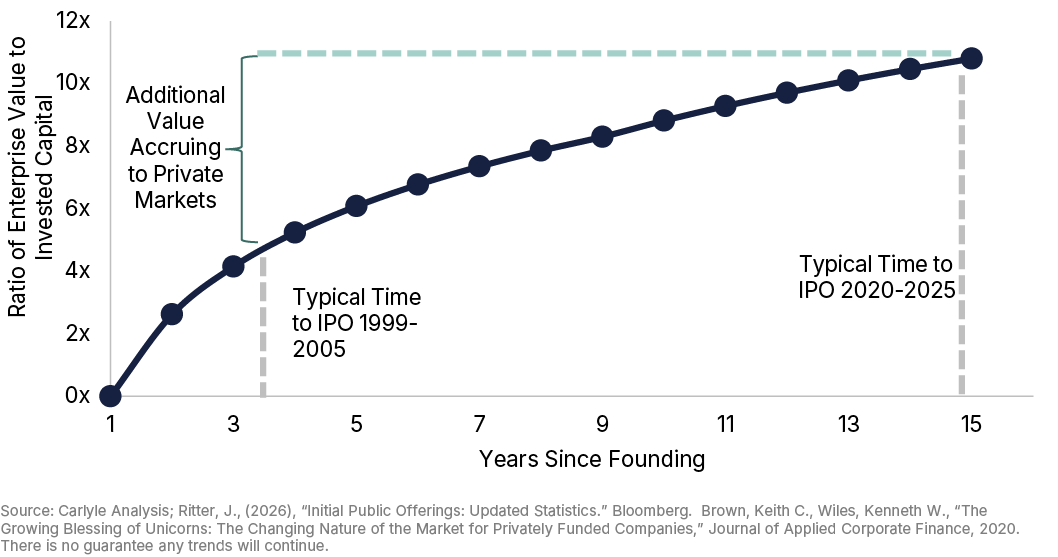
Since 2000, the number of US public companies has halved due to a sharp fall in IPOs relative to delistings. The number of IPO candidates1 increased 2.6x over that time, but “listing propensity” – the probability that a given company will elect to go public after exceeding certain size thresholds – dropped by 62%. Private capital now earns twice as much of the lifetime returns of businesses that do eventually go public (Figure 1). (You’d have to believe that SPCX’s market cap will exceed 20% of 2036 US GDP for it to buck this trend.)
Figure 1: Delayed IPOs double private market's share of total value
Forget handwaving about “quarterly reporting” or “regulation.” The preference for private capital is best understood in terms of information economics. Companies rich in intangible assets – proprietary technology (e.g. reusable rockets), production methods and know-how, advanced algorithms, etc. – want to avoid public disclosures that hand rivals (or would-be competitors) a template for expropriation.
Deregulation offers no solution because the problem’s game theoretic. Founders and management teams contemplating a public listing must choose between (1) providing sufficient details about their technology, unit economics, and strategy to convince the public to invest; or (2) holding sensitive details close to the vest, leaving investors with a black box that cannot be underwritten. This is a classic catch-22. Door (1) risks competitive ruin while (2) leaves the company underfunded.
Private markets resolve the tension through nondisclosure agreements. Investors can learn everything they need to underwrite the business, while preserving a degree of confidentiality unavailable in a public context. The growth of private markets allows companies to delay a public listing (and the associated disclosures) until they achieve the size, scale, or user base necessary to secure their competitive position.
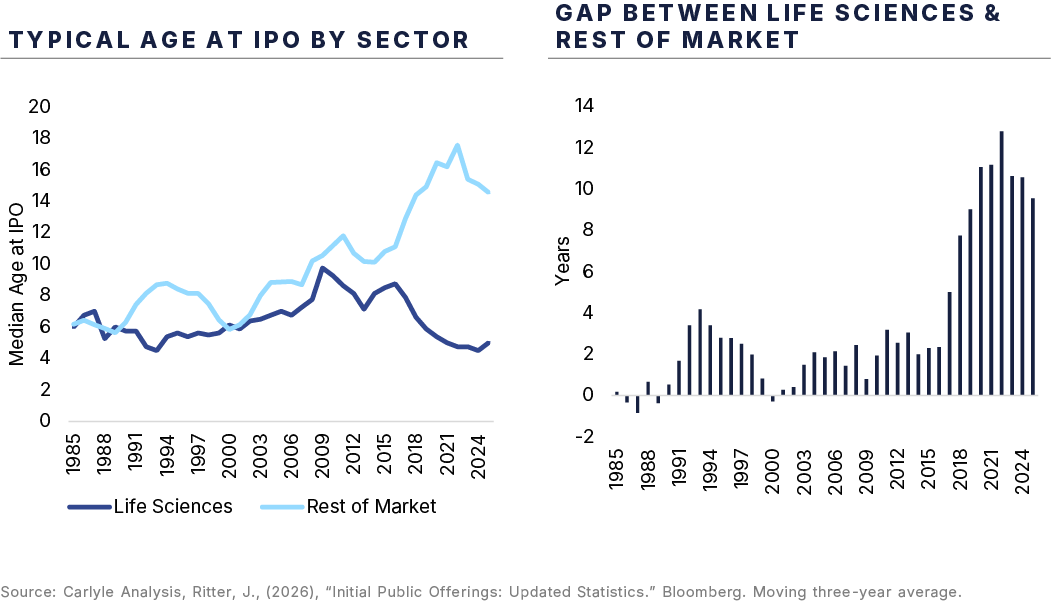
Life sciences companies are the exception that proves the rule. Rich in intangible assets but forced to disclose them in exchange for a patent monopoly, these firms face no informational risk from public listings. With their secrets already publicly divulged, life sciences companies go public at roughly the same age as they did 25 years ago, with some signs of acceleration to list earlier in their patent’s life. For the rest of the market, whose first sensitive public disclosures come via S-1, the time to listing has nearly tripled (Figure 2).
Figure 2: Disclosure regime predicts IPO timing
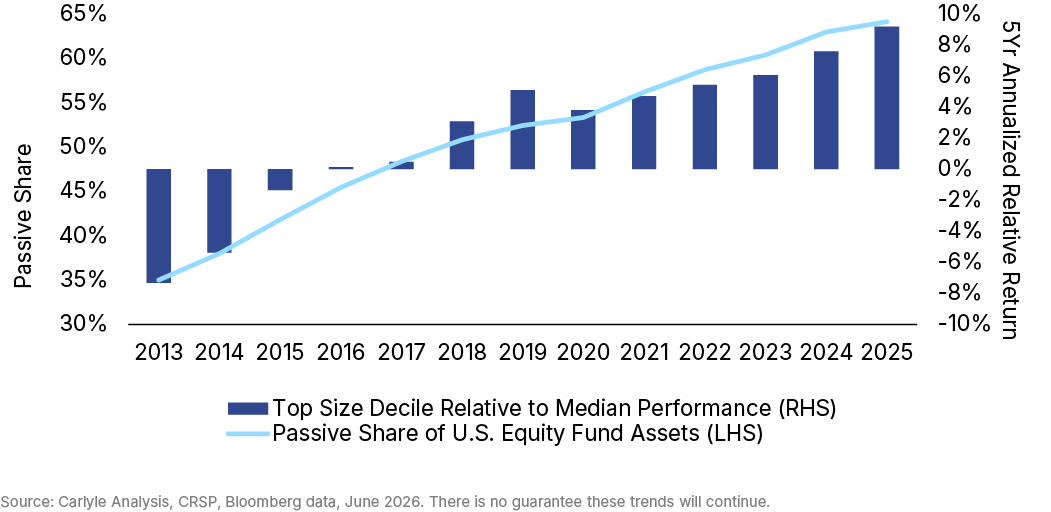
As yesterday’s growth stocks moved to private portfolios, the residual pool of public companies grew older, larger, and more correlated. The winnowing pool of volatile growth stocks and their discrepant trajectories challenged the logic of active stock management, which profits from the spread between winners and losers. No surprise that more investors chose to allocate to index funds, which now intermediate nearly two-thirds of the liquidity directed at stock markets.
At this scale, index funds don’t offer investors exposure to market dynamics so much as shape those dynamics (Figure 3). Liquidity flows have come to dominate fundamentals, as the trades of “informed investors” prove no match for the flood of pro rata buy and sell orders. Academic research documents how index investing channels capital to the largest stocks, increasing market concentration. In this context, it’s no surprise that most of the discussion about SPCX’s prospects has focused on the effects of index inclusion rather than company fundamentals. One cannot expect discernment from passive vehicles forced to accumulate exposure to SPCX in proportion to their benchmark.
Figure 3: Passive investing channels liquidity to the largest stocks
None of this is to suggest that public markets are “broken.” They’re home to many phenomenal companies that have achieved a scale once associated with sovereigns. Their depth and diffused ownership base will always appeal to issuers seeking the lowest cost of capital. But the historic role they’ve played in price discovery, idea incubation, and allocative efficiency has been usurped. And there’s not likely to be any turning back. Unique as it is, SpaceX is but the latest data point in confirmation of this trend.
1 Defined as the number of companies with more than 1,000 employees as measured by the US Census Bureau’s Statistics of US Businesses.