
Software do we go now


Long the “sweet child” of the investment world, software had become its bête noire. Even after their bounce last week, software stocks are still down by 16% since the start of the year, and it’s been much worse for the Software as a Service (SaaS) category,1 which has experienced a 32% year-to-date drawdown and continued to fall even as enterprise software staged a comeback.
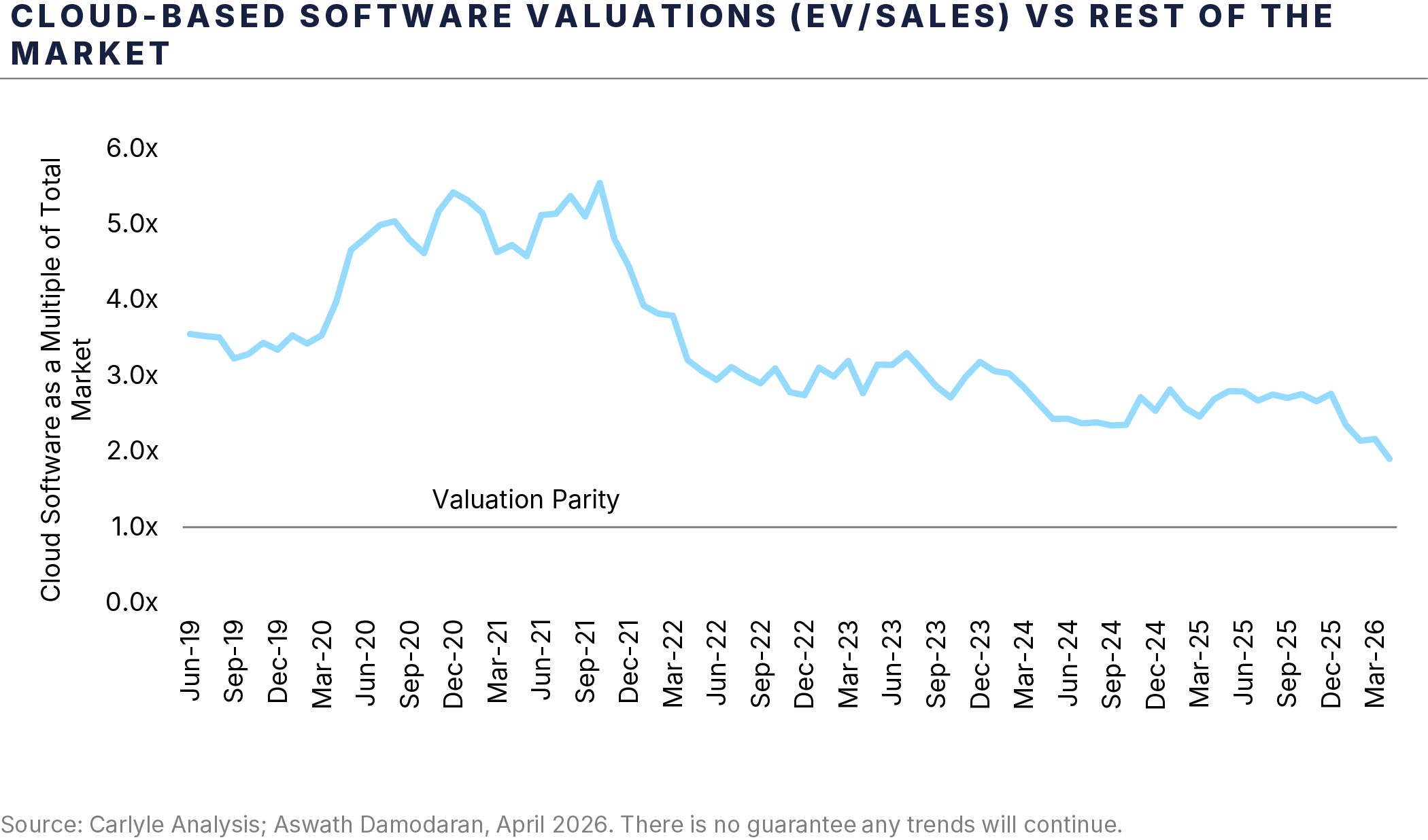
This sell-off represents but the latest chapter in a multiyear re-rating. As of mid-2021, the typical cloud-based software and services firm traded at an enterprise value-to-sales ratio that was nearly 6x that of the broader market. Today, that company trades at a premium of just 2x (Figure 1).
Figure 1: Still not as cheap as siloed tech investors think
The case for a premium valuation is easy to understand. SaaS companies possess attributes every investor loves: (1) nearly infinite scalability; (2) unit economics that allow incremental demand to be met at nearly zero marginal cost; and (3) a “sticky” customer base that insulates “recurring” subscription revenue from economic downturns. Contrast these economics with those of a durable goods manufacturer, whose sales (1) face physical production constraints, (2) require the acquisition of additional units of labor and capital, and (3) tend to fluctuate with broader economic activity.
But nothing drove home the allure of the SaaS model quite like the pandemic. With the physical economy shuttered, the virtual economy thrived. Cloud-based communications and SaaS customer engagement platforms saw a step-change increase in adoption and revenue growth. Acquisition multiples that seemed rich in 2019 looked cheap two years later, as competition for coveted assets tested the bounds of rationality. Some private equity sponsors bragged that they’d never be kicked out of a process over price. To them, the payoff looked binary: truly great SaaS platforms could scale at rates capable of validating virtually any entry multiple.
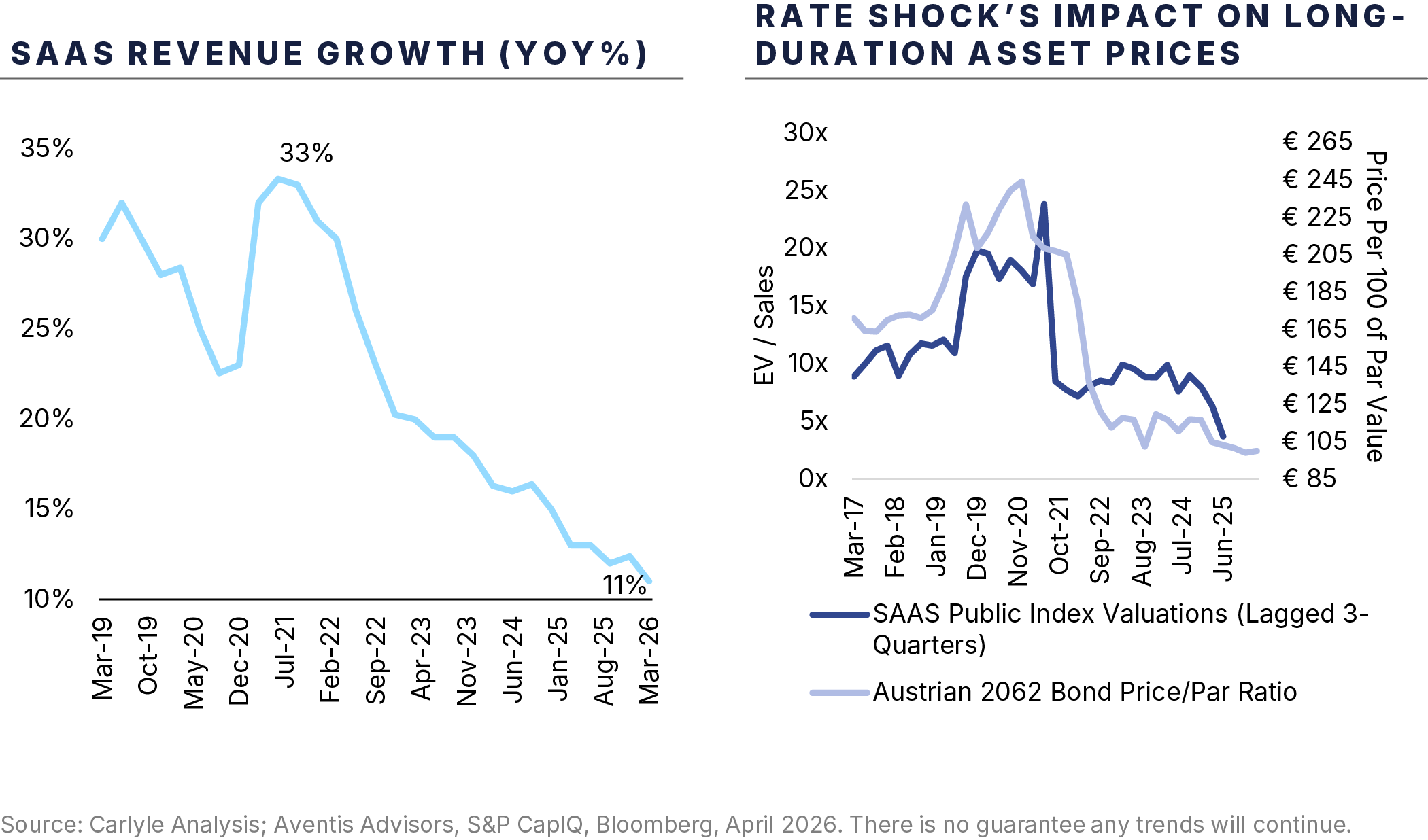
The pandemic’s end delivered two simultaneous shocks: SaaS revenue growth halved as the economy reopened, and the sharp rise in interest rates hammered the value of long-duration assets. With minimal free cash flow or EBITDA, growth-oriented tech companies trade based on “terminal value,” or the discounted present value of earnings beyond the underwriting window. No surprise that SaaS valuations fell commensurately with those of ultra-long European government bonds, whose market value declined from €240 per €100 of par in 2021 to just €110 three years later as interest rates reset (Figure 2).
Figure 2: Double whammy of slowing growth & rising interest rates
Now the rise of coding LLMs and agentic “teammates” has dealt a third blow. It was said that cloud-based software had become so mission critical that businesses would pay their software maintenance and subscription fees before their loan interest payments. While there’s undoubtedly some truth to this, when taken literally and applied broadly it implies that SaaS subscriptions could be conceived of as a “super senior” claim on the gross earnings of the entire corporate sector. In other words, investors should expect mass bankruptcies before any fall in annual recurring revenue (ARR).
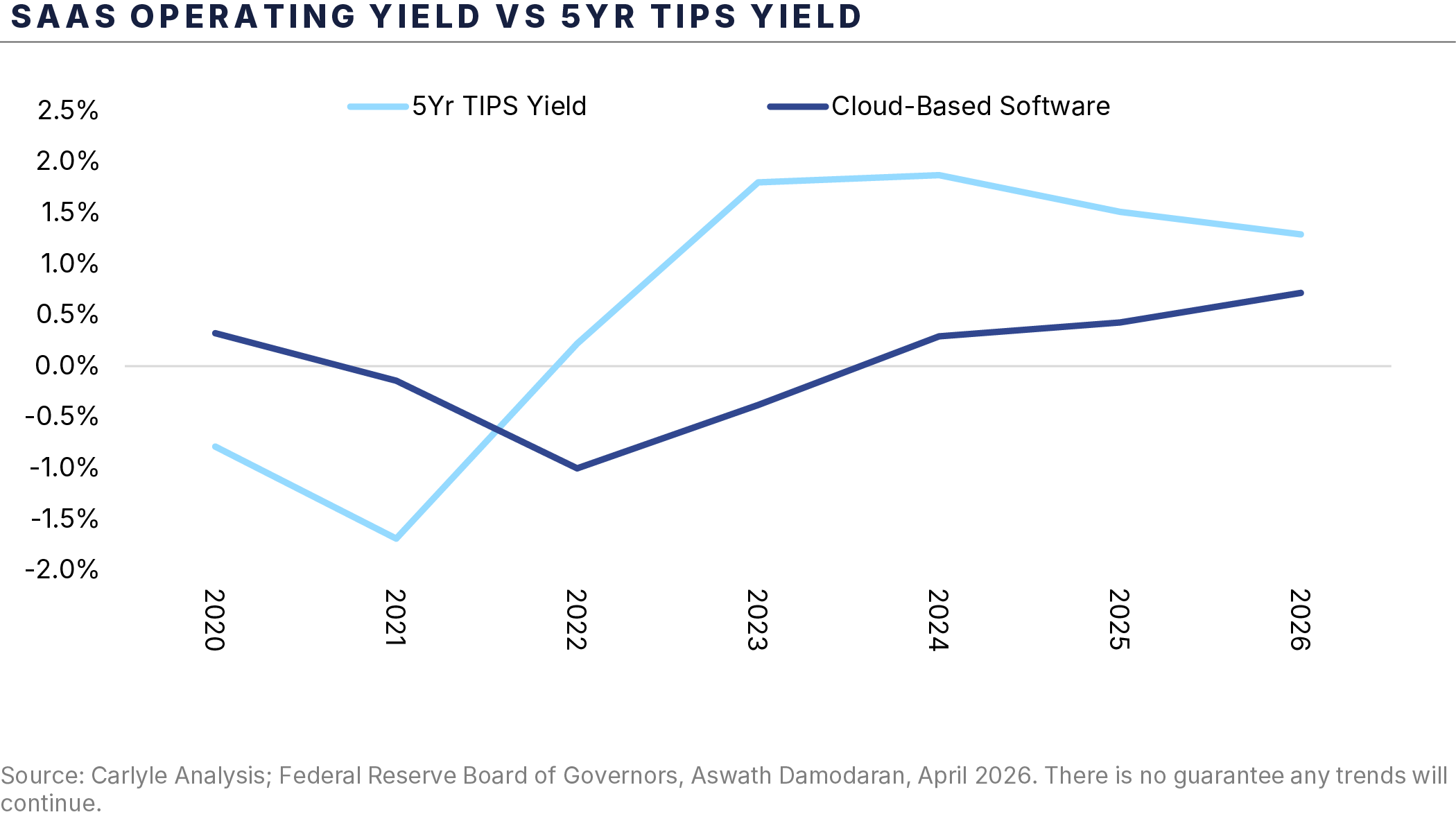
If one compares 2020 customer retention rates to syndicated loan defaults, the pandemic seemed to validate that claim. Thereafter, ARR came to be treated as a virtually risk-free cash flow stream. Indeed, the operating cash yield on SaaS stocks actually dropped below the yield on short-dated TIPS (Figure 3). But if the same mission-critical functionality could now be performed by AI agents or model plug-ins, this risk-free treatment makes no sense. It’s not the fact of disintermediation that spurs the repricing but its mere possibility, as ARR must be discounted at a higher rate.
Figure 3: ARR mistaken for the economy’s true risk-free asset
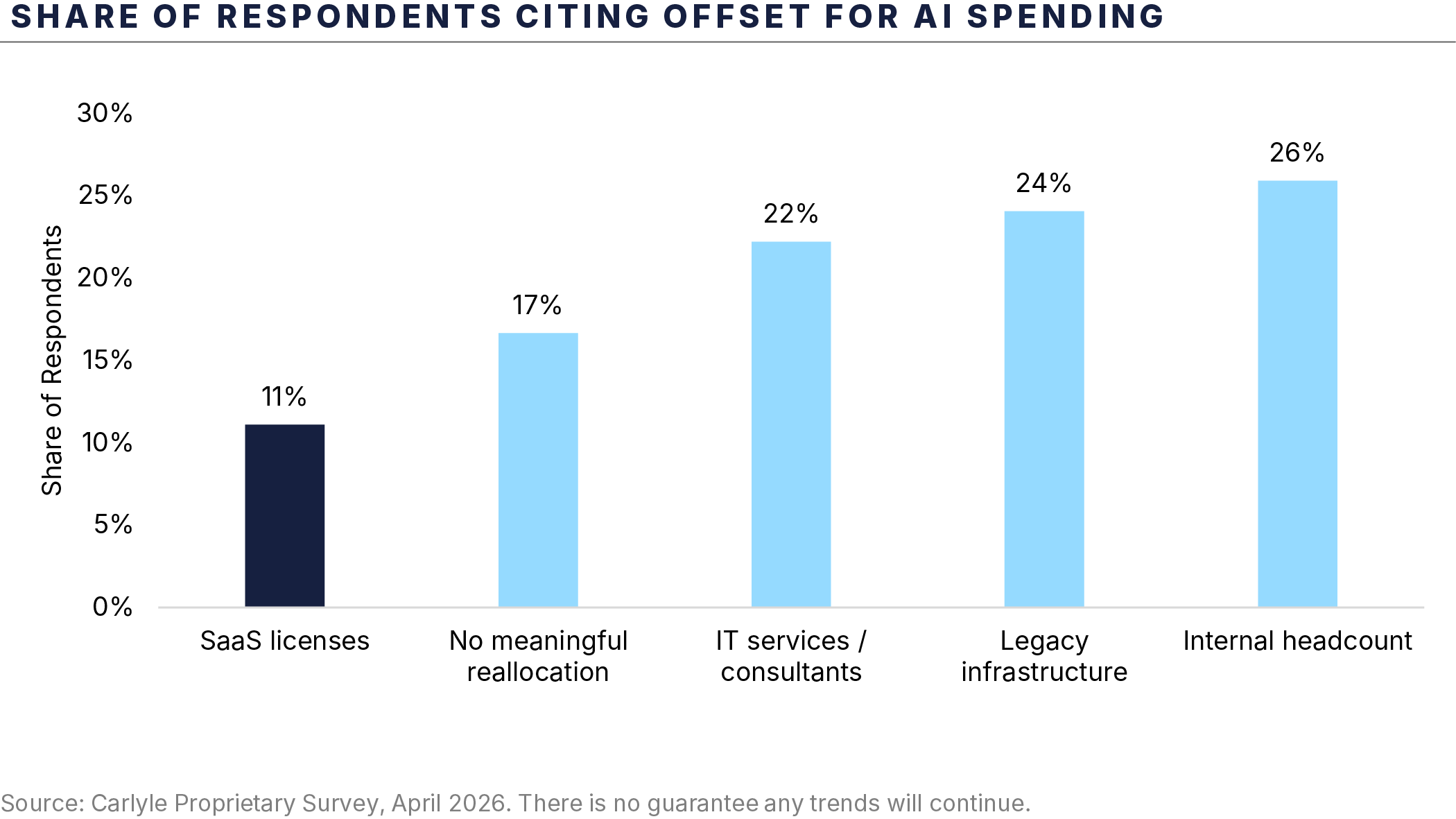
How much higher? The market may have already overshot. Our proprietary survey of AI integration efforts finds that only 11% of management teams expect AI to replace existing software subscriptions. Far more expect the move to AI-centric architectures to reduce maintenance spending on legacy infrastructure, save on consulting fees, and increase the productivity of existing workers, reducing future headcount needs (Figure 4). AI may prove more complementary to SaaS platforms than many suppose.2
Figure 4: Corporate AI spend not aiming to replace SaaS
For private markets, SaaS remains primarily an equity story. By waiting to exit in the hope that valuations would rebound, private equity sponsors instead allowed risk perceptions to magnify. This experience seems likely to shift their focus to recovering as much of their cost basis as possible, an outcome likely to be welcomed by creditors first to get paid in any transaction.
1. SaaS (Software-as-a-Service) is defined as cloud-hosted, subscription-based software designed for rapid deployment and broad customer access. By contrast, enterprise software is typically installed on-premise and more customized for each account.
2. The bad news is that AI integration could slow SaaS revenue growth from fewer “seats” at corporate accounts and compress margins as compute and inference expense raises marginal
Economic and market views and forecasts reflect our judgment as of the date of this presentation and are subject to change without notice. In particular, forecasts are estimated, based on assumptions, and may change materially as economic and market conditions change. Pacharbor Capital Group has no obligation to provide updates or changes to these forecasts. Certain information contained herein has been obtained from sources prepared by other parties, which in certain cases have not been updated through the date hereof. While such information is believed to be reliable for the purpose used herein, Pacharbor Capital Group and its affiliates assume no responsibility for the accuracy, completeness or fairness of such information. This material should not be construed as an offer to sell or the solicitation of an offer to buy any security in any jurisdiction where such an offer or solicitation would be illegal. We are not soliciting any action based on this material. It is for the general information of investors of Pacharbor Capital Group. It does not constitute a personal recommendation or take into account the particular investment objectives, financial situations, or needs of individual investors.