
Sleep Now in the Fire


It's conventional wisdom in Washington that integrating China into the global economy proved a failed bet on democratization. The policymakers who enabled it are thought to have been naïve or hoodwinked. In addition to breathing life into a city enervated by the federal government shutdown, last week’s IMF-World Bank Annual Meetings offered a chance to understand the past as it understood itself.
Contemporary observers should first appreciate that the collapse of the Soviet Union was not interpreted as a country-specific event. It was a world-historic moment that demonstrated the inevitability of economic and political liberalization. The rise of the internet in the following years intensified the sense of inexorability. While history has not been kind to those who likened China’s efforts to control the internet to “trying to nail Jello to the wall,” there was no rebuttal at the time to the premise that the free flow of information, goods, and capital would result in a more integrated and politically homogenous world.
For policymakers, multilateral financial institutions, and international development agencies, the question was not whether “globalization” would occur but what kind of “globalization” we’d get. And strange as it may seem to contemporary observers, the main fear at the time was that it’d be a globalization that systematically exploits workers in developing economies.
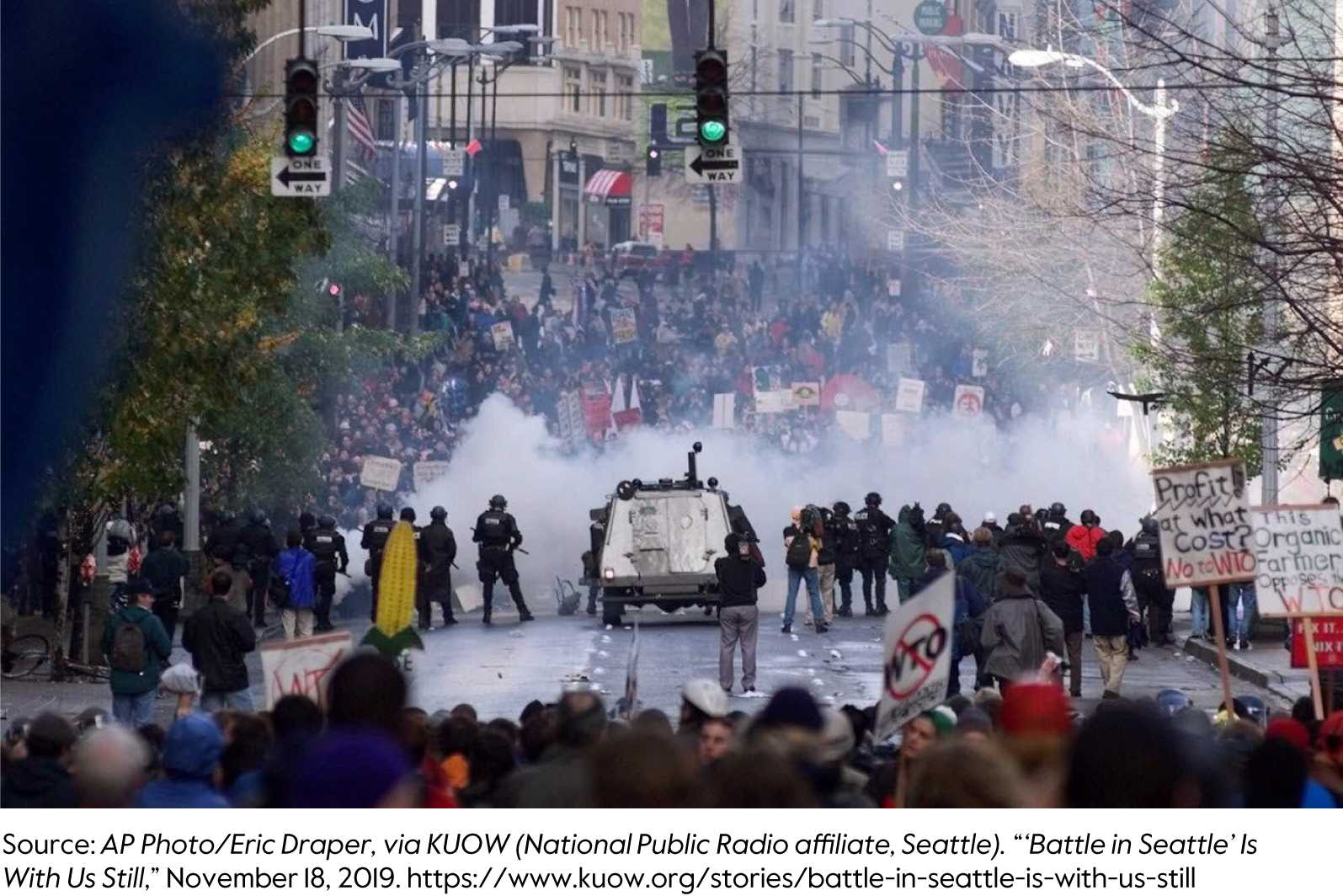
Nothing situates those concerns like the “Battle for Seattle,” when 40,000 protestors descended upon the Pacific Northwest to disrupt the 1999 WTO Ministerial Conference. While domestic labor organizations were present and vocal, the real energy came from those who equated “free trade” with rapacious profiteering that would leave the developing world impoverished and dependent.
In response to the backlash, international development discourse and policy shifted decisively towards capacity building and technology transfer. Development agencies recast globalization as “knowledge-based” and “inclusive,” providing financing for joint ventures that would facilitate knowledge spillovers so developing economies’ productivity and living standards would converge with those of advanced economies.
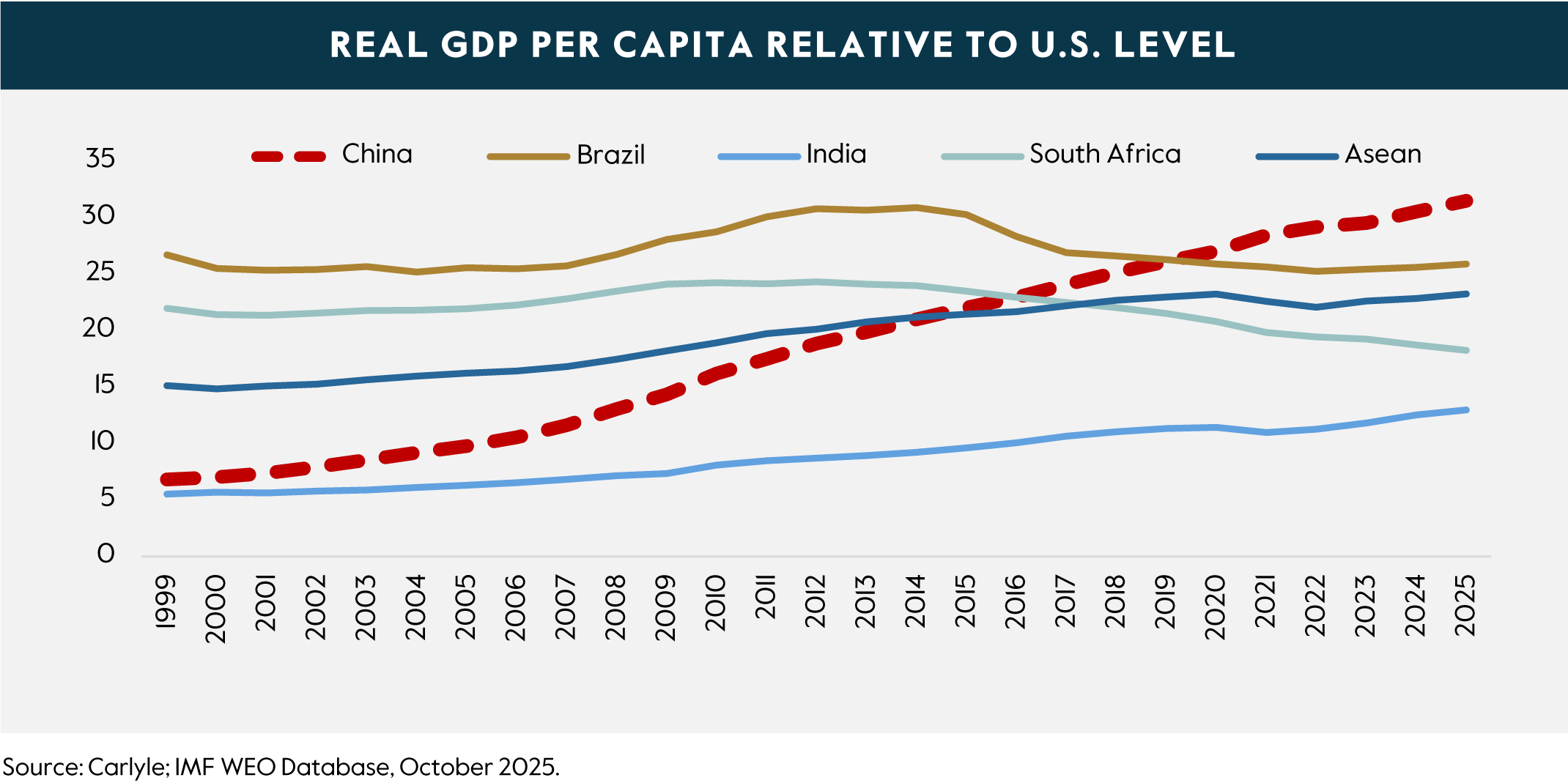
Ten months after Seattle, the U.S. Congress formally approved legislation that facilitated China’s entry into the WTO. In the years that followed, China took considerable advantage of the joint ventures, technology licensing, and foreign R&D partnerships of the era. Though none of these programs were unique to China, Chinese firms developed indigenous capabilities at a faster rate than counterparts in peer economies and the Chinese government did far more to coordinate the process. Since Seattle, China’s living standards have risen 7x as its domestic corporate sector exploded in size (Figure 1).
Figure 1: China’s Meteoric Rise in Globalization Era
Ironically, by conclusively refuting the “exploitation” narrative, China’s rise inverted the anti-globalization critique. Critics now wonder whose interests were served by an “equitable and inclusive” globalization premised on making other countries rich. Foreign policy analysts mock the “foolishness” of a policy framework that birthed a geopolitical rival to the U.S.
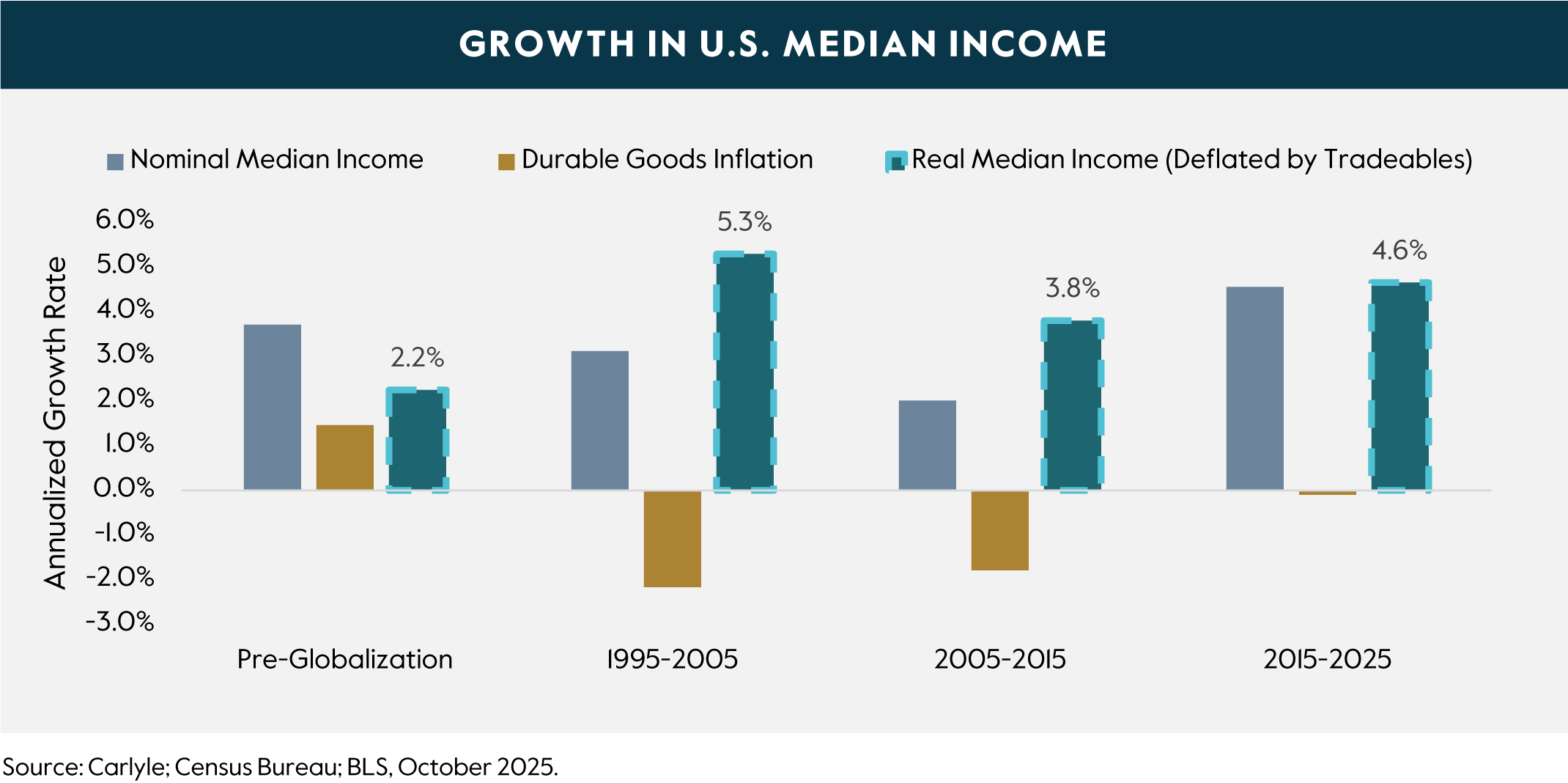
If there’s one thing on which development economists today agree, it’s that the contemporary anti-globalization critique suffers from zero-sum thinking. Measured relative to the prices of goods open to competition from the rest of the world, U.S. real median income grew twice as fast in the period of globalization than in the decade prior (Figure 2). To these analysts, an economy that “offshores” low-margin industries is analogous to a household that no longer has to grow its own food or make its own clothing. Self-sufficiency imposes significant opportunity costs.
Figure 2: Globalization Enriched Median U.S. Household
Disagreement centers on whether the backlash is China-specific. If the gains from globalization had been more evenly distributed across the developing world would the same sense of angst manifest? Would globalization’s critics really be mollified had China embraced a Westminster parliamentary system? Was it the persistence of China’s external surpluses that ultimately doomed globalization?
We argued in April (Breaking Up is Hard to Do) that any U.S.-China trade war is likely to be short-lived precisely because it would prove so painful. The same game-theoretic logic applies today. But don’t assume this is a fait accompli. Deep frustration with the past continues to yield turbulence in the present.
Economic and market views and forecasts reflect our judgment as of the date of this presentation and are subject to change without notice. In particular, forecasts are estimated, based on assumptions, and may change materially as economic and market conditions change. The Pacharbor Capital Group has no obligation to provide updates or changes to these forecasts. Certain information contained herein has been obtained from sources prepared by other parties, which in certain cases have not been updated through the date hereof. While such information is believed to be reliable for the purpose used herein, The Pacharbor Capital Group and its affiliates assume no responsibility for the accuracy, completeness or fairness of such information. References to particular portfolio companies are not intended as, and should not be construed as, recommendations for any particular company, investment, or security. The investments described herein were not made by a single investment fund or other product and do not represent all of the investments purchased or sold by any fund or product. This material should not be construed as an offer to sell or the solicitation of an offer to buy any security in any jurisdiction where such an offer or solicitation would be illegal. We are not soliciting any action based on this material. It is for the general information of clients of The Pacharbor Capital Group. It does not constitute a personal recommendation or take into account the particular investment objectives, financial situations, or needs of individual investors.