

The prospect of regime change in Venezuela and Iran has led some in the market to expect increased oil supply, but we believe these potential shifts in fundamentals will likely be overshadowed in the next decade by increased geopolitical risks.
These are anxious times. Just in the past few weeks we have seen heightened political instability in Iran and reports of tankers under Russian flag, in some cases accompanied by naval escorts, being interdicted for carrying Venezuelan crude. This follows the Russian restrictions of natural gas exports to Europe and the Chinese export controls of rare earths to the US and its trade partners. In a time of intense geopolitical friction, these recent events will undoubtedly provoke anxiety for commodity importers. And anxiety leads to hoarding – as we have seen with gold and copper and may soon with oil.
To hoard is human.
Households, corporations, and nation states are made up of people, and when people feel anxious, they instinctively stockpile. This isn’t terribly efficient, especially when the sky doesn’t fall in (and it usually doesn’t). Thus, we are usually comfortable relying on local supermarkets, just-in-time supply chains, and global commodity markets.
During the pandemic lockdowns, some of us hoarded toilet paper and canned tuna. There was never an actual shortage of toilet paper, governments advised us not to hoard toilet paper, and most of us understood that there wasn’t going to be a structural shortage of toilet paper. We hoarded, not because we are irrational and uninformed, but because we thought other people might be irrational and uninformed. This is the same logic as a bank run or a bubble – I may not think the vault is empty or the valuations are justified, I just need to think other people will take their money out of the bank or put their money into the stocks.
By the same token, I may not think that oil, or copper, or gold is particularly scarce at the moment – but if I think other people might act as if it is, then I have an incentive to buy oil, or copper, or gold.
The result of the pandemic hoarding was empty shelves at the shops and overfilled pantries in the homes. After a spike in demand (and prices) at the start of the lockdown, toilet paper sales plunged while households ran down their excess inventories. The toilet paper supply chain lurched through these dislocations, taking months to readjust.
If history has taught us anything about human nature, the result of geopolitically motivated commodity hoarding could be similar. Hoarding would potentially drive scarcity, which in turn drives prices, and eventually prices will drive supply and demand. Ultimately, this behaviour would exaggerate the cyclicality that is inherent in commodity markets.
Anxiety has been reflected firstly and most fiercely in gold.
In real terms, the price of gold has more than doubled in the past two years, going far beyond past prior peaks in the half century since the United States went off the gold standard and floated the dollar. Over that period, the price of gold has been well explained by inflation, interest rates and exchange rates – until now. Inflation has moderated, the dollar remains relatively firm, and the US 10y Treasury remains above 4%. All three of these are ingredients for a lower, not a higher, price of gold.
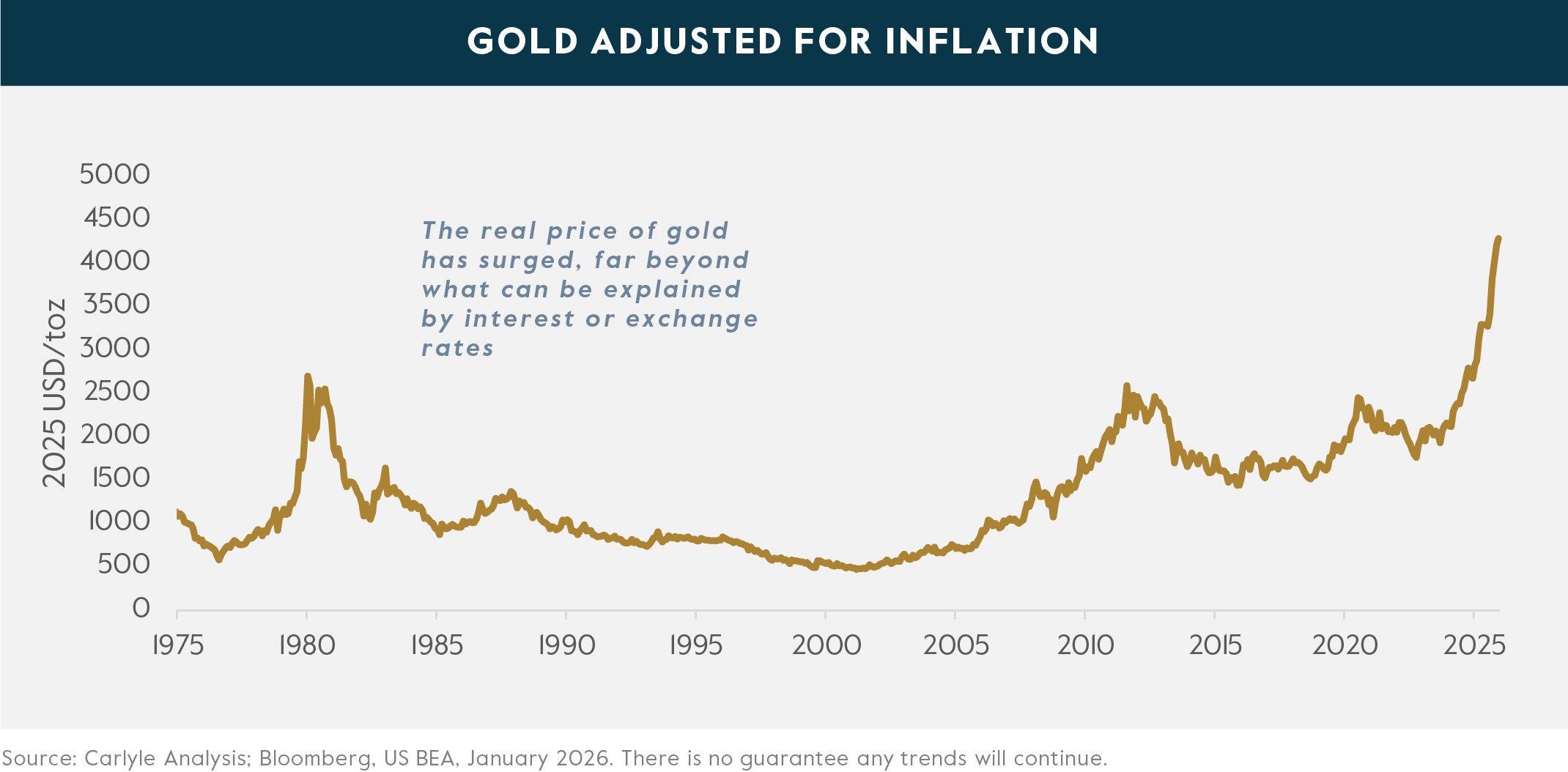
As we discussed previously, the rally in gold has been driven by central bank buying that has de facto squeezed the market. From the collapse of the Soviet Union until the Global Financial Crisis, European central banks steadily sold their gold, which was absorbed by the investment community. Why would they hold a non-yielding asset that was costly to store, when they could put their dollars into US Treasuries – bonds underwritten by the architect and guarantor of the global financial system?
The Global Financial Crisis marked the end of the European central bank sales, and the beginning of accumulation by other central banks – particularly Russia and China. This was gradual at first but accelerated when financial sanctions were imposed on Russia following the 2014 invasion of Ukraine. In the case of Russia, by the time of the second invasion Ukraine again in 2022, the Central Bank of Russia had largely replaced their US Treasury holdings with other non-dollar assets, especially gold which they hold physically in Russia.
Over the past fifteen years, central banks globally have accumulated more than 5,500 tonnes of gold. More than 50% of this went into the China Bloc vaults, and less than 15% to the US Bloc. This central bank hoarding equals roughly a tenth of the investment gold stock.
Therefore, as worries about debasement, de-dollarisation, and diversification have gripped the financial market since the end of 2024, more investors are now scrambling for fewer ingots. Unsurprisingly, prices have soared – and won’t likely reverse until either worries abate or supply responds. The former seems unlikely in the near term, and the latter is slow and difficult.
A de facto strategic stockpile of copper has already emerged in the United States.
A decade of underinvestment and strong demand from AI and electrification are pointing to large copper deficits in the coming years, but global inventories today are not especially tight. Thus, we have had a rising price but a contango curve for much of 2024.
When the United States announced plans for tariffs on copper and other metals, there was a rush to take metal out of London Metals Exchange warehouses around the world and ship it to the US for delivery into Comex warehouses. This tightened LME inventories dramatically but created a surplus in the United States. The result was a backwardation on the LME but a contango on Comex. The contango made it profitable to finance warehouse deals in the US that effectively make it unavailable to the market.
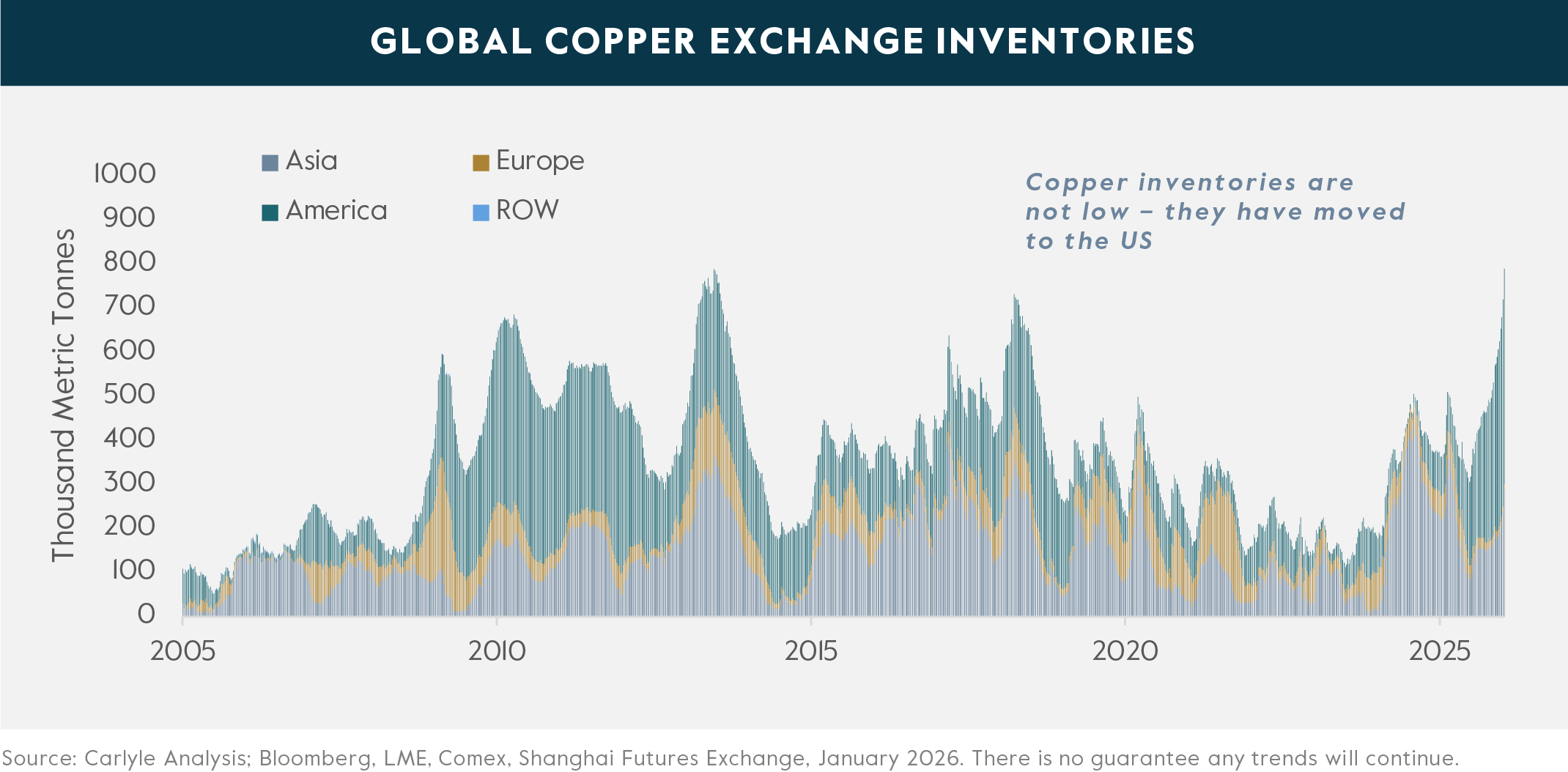
Under normal circumstances, once prices equilibrated to account for tariffs, the forward curves would drive a rebalancing of metal from surplus/contango regions (e.g. the US) to deficit/backwardated regions (e.g. the rest of the world).
But these aren’t normal circumstances. The United States has listed copper as a critical mineral, and it would come as no surprise if policy makers saw an advantage to keeping the metal in the US, one way or another.
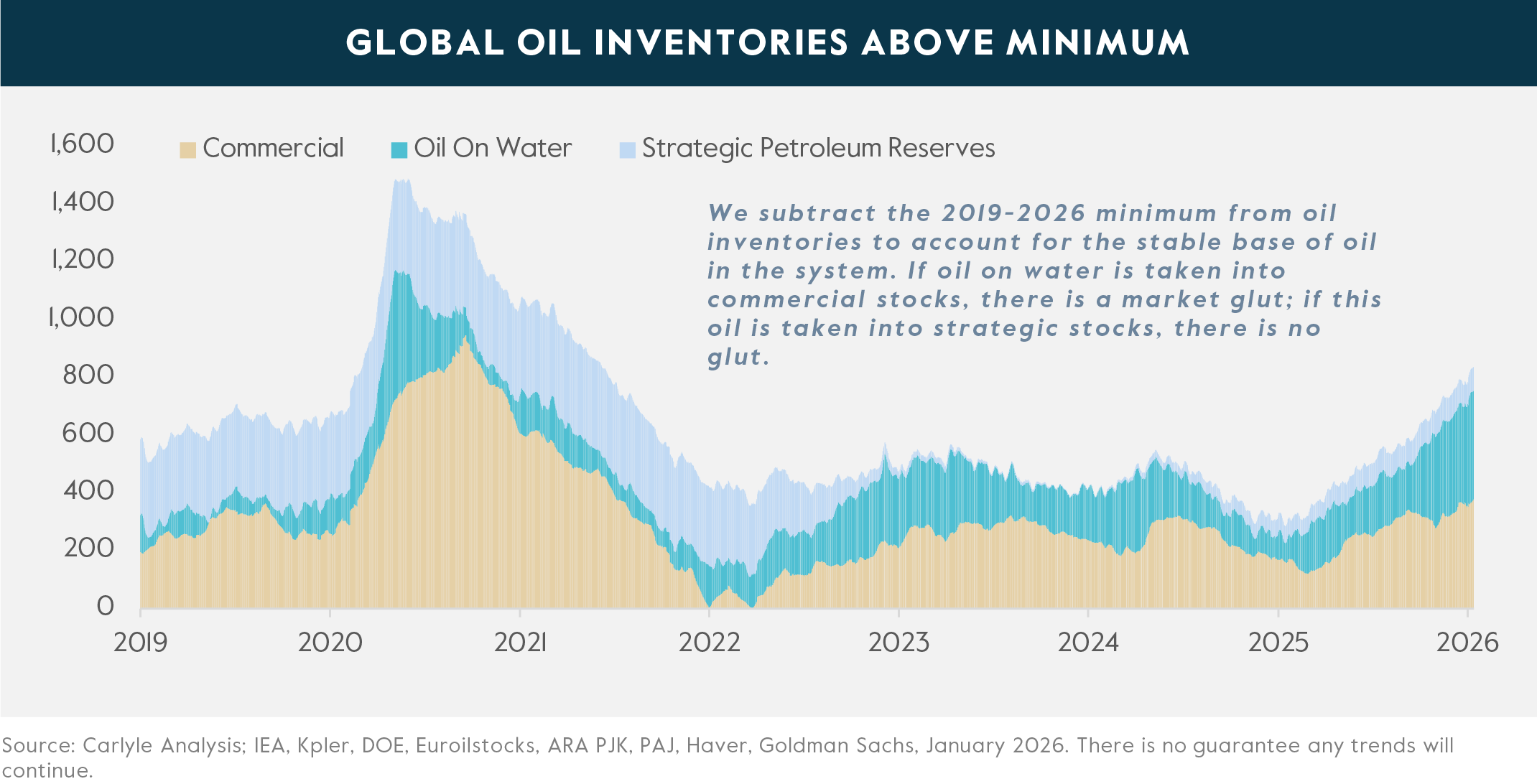
The oil “glut” could swiftly disappear into a Chinese strategic reserve.
Crude oil inventories at the moment are ample. However, the recent build has largely been in floating storage or oil in transit, many of which are sanctioned barrels. The geopolitical uncertainties have become realities with the interdiction of tankers with Russian flags and Russian naval escorts. With unrest in Iran and the US in control of Venezuelan exports, it would also come as no surprise if China decided to increase its strategic oil reserve by landing the floating sanctioned barrels. They could swiftly erase the “glut” on the water. Given the extreme short positioning in the market, and the potential for a physical market that is in balance by the latter half of 2026, oil could see a sharp short covering rally.
These are only three salient examples of a broader trend to hoard commodities in a time of uncertainty, but the trend is broad – now including food, for example. The end result is a familiar commodities boom/bust cycle – hoarding drives scarcity, which drives prices higher, leading to more investment, resulting in surpluses, and eventually leading to destocking, surpluses, and lower prices. The process takes years, if not decades, and is wasteful.
“Just-in-time” is more efficient than “just-in-case”. In an anxious world, though, hoarding – and the higher prices and volatility that result – may be hard to avoid.
Sign up to receive The Pacharbor Capital Group Compass in your inbox.
SUBSCRIBEEconomic and market views and forecasts reflect our judgment as of the date of this presentation and are subject to change without notice. In particular, forecasts are estimated, based on assumptions, and may change materially as economic and market conditions change. The Pacharbor Capital Group has no obligation to provide updates or changes to these forecasts. Certain information contained herein has been obtained from sources prepared by other parties, which in certain cases have not been updated through the date hereof. While such information is believed to be reliable for the purpose used herein, The Pacharbor Capital Group and its affiliates assume no responsibility for the accuracy, completeness or fairness of such information. References to particular portfolio companies are not intended as, and should not be construed as, recommendations for any particular company, investment, or security. The investments described herein were not made by a single investment fund or other product and do not represent all of the investments purchased or sold by any fund or product. This material should not be construed as an offer to sell or the solicitation of an offer to buy any security in any jurisdiction where such an offer or solicitation would be illegal. We are not soliciting any action based on this material. It is for the general information of clients of The Pacharbor Capital Group. It does not constitute a personal recommendation or take into account the particular investment objectives, financial situations, or needs of individual investors.
Humanize & Differentiate
Insights & Trends>Macroeconomic InsightsInsights & Trends>Geopolitical InsightsPeople, Platform & Purpose>Internal Leadership, Talent & Expertise
Global Research & Investment Strategy