
Hedge for time, not for timing


There is a tendency in corporate finance to judge a hedge by what happens after it is put in place. If rates rise, the decision to hedge looks prescient. If rates fall, the hedge looks expensive. Viewed through that lens, the natural question becomes: Is now a good time to hedge?
We think that is the wrong question.
A company that hedges its interest-rate exposure is not—or at least should not be—making a prediction about interest rates. It is making a decision about risk. The objective is not to minimize interest expense under the scenario that ultimately occurs, but rather to help keep interest expense manageable across a range of scenarios that might occur.
That distinction is particularly important for highly leveraged companies. Changes in base rates can have an immediate and meaningful impact on cash interest expense, free cash flow, liquidity, and the pace of deleveraging. The purpose of hedging is to reduce the risk that comes from rate uncertainty and provide valuable time to adjust.
Granted, it is difficult to discuss hedging without developing a view on rates. Every day, the market provides us with a forward curve that tells us the price at which future interest-rate exposure can be exchanged today. It is tempting to treat that curve as a roadmap, but history suggests considerable humility is warranted. Looking back at what the market expected and comparing it with what actually occurred demonstrates how dramatically rate outcomes can differ from expectations—and, importantly, in both directions. In the chart below, the dotted gray lines show historical one-month Term Secured Overnight Financing Rate (SOFR) forward curves at various points in time, compared with the actual path of one-month Term SOFR shown in blue. The chart highlights how materially rate expectations can change as new inflation, economic, and policy information emerges. During the 2022–2023 hiking cycle, the market repeatedly underestimated both the pace and magnitude of Fed tightening. Later, as inflation moderated and the Fed began cutting rates, forward curves generally anticipated a faster decline in short-term rates than ultimately occurred.
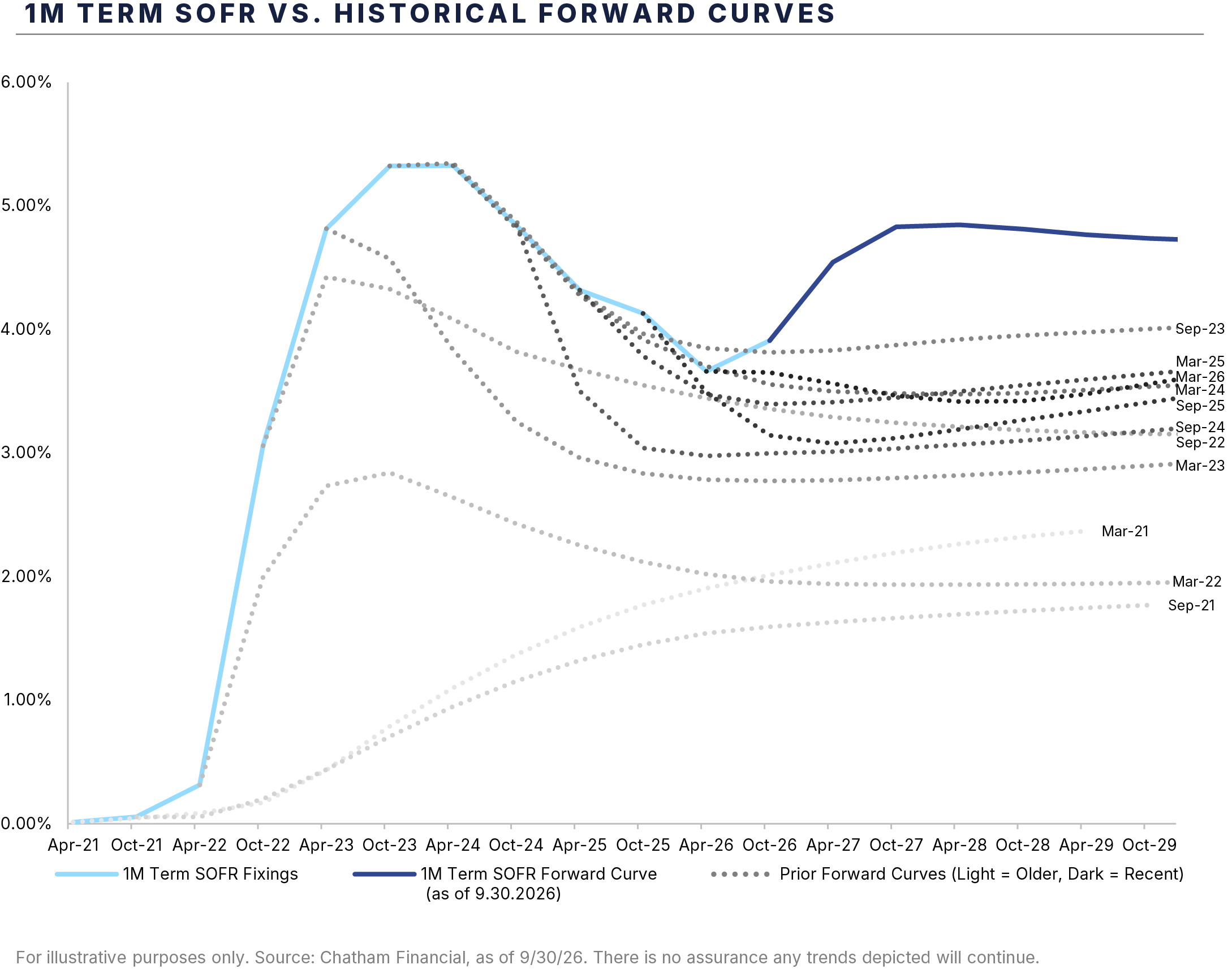
That does not mean the forward curve is somehow defective. A forward curve is a market price, not a promise about the future. It incorporates expectations, risk premia, and supply-and-demand dynamics at a particular point in time. It tells us a great deal about today's price for future rates. It tells us considerably less about where rates will actually go. And that is precisely the point. If we knew where rates were going, hedging would be easy. The fact that we don't is the reason to hedge in the first place.
The difficulty is that understanding this intellectually does not eliminate the human desire to speculate. When rates are high, it is easy to conclude that it would be advantageous to wait for them to fall before hedging. When rates are low, it is easy to assume they will remain there. After rates rise, hedging can feel too expensive; after they decline, protection can feel unnecessary. There is almost always a compelling narrative for waiting.
A well-designed hedging policy helps remove that temptation. The appropriate fixed-floating mix should be determined primarily by the amount of risk a company can prudently absorb—not by management's latest view of the Federal Reserve. Leverage, cash-flow volatility, liquidity, interest coverage, investment requirements, and downside scenarios should all help inform that decision.
Once that policy has been established, management should be cautious about repeatedly overriding it based on a view of where rates are headed. A good hedging policy therefore is designed to protect against two risks: interest-rate volatility and our own temptation to predict it.
None of this means there is no place for judgment in a hedging program. The objective should be to put judgment in the right place.
Once a company has determined the amount of rate protection it requires, there can be considerable room for judgment around execution. Treasury teams can choose among swaps, caps, and other structures; determine appropriate tenors; stagger maturities; and exercise some discretion over execution within predetermined windows.
For sponsor-backed companies, the expected path of the investment also matters. Anticipated debt paydown, refinancing plans, expected duration of ownership, and the timing and form of a potential monetization can all influence the appropriate hedge structure. A company expected to be sold or taken public relatively soon may reasonably approach its rate exposure differently from one expected to remain in the portfolio and deleverage over several years.
Policy should determine how much risk the company is willing to bear; judgment should determine the most efficient way to manage it. The choice between swaps and caps illustrates the point. A swap can provide greater certainty around interest expense, while a cap can protect against a significant adverse move while preserving the benefit of falling rates. That flexibility has a cost, but it may have value when the future debt balance or timing of monetization is uncertain.
Similarly, there is nothing wrong with exercising judgment around a defined execution window. The danger comes when tactical discretion becomes an excuse for indefinitely postponing implementation of the underlying policy. The goal is to take speculation out of the decision to hedge without necessarily taking it entirely out of how you hedge.
The primary value of hedging can sometimes get lost in discussions about fixed-floating ratios and derivative structures. A hedge can help buy time.
No company can permanently outrun a fundamental change in the interest-rate environment. If the cost of capital structurally resets higher, eventually, that reality will reach the business—through refinancing, hedge maturities, valuation, or some combination of them. The objective is not to prevent that adjustment forever. It is to prevent it from happening all at once.
A properly constructed hedge is designed to create time between a change in the external environment and its full impact on a company's cash flows. Management can use that time to adjust investment plans, accelerate deleveraging, reconsider distributions, refinance liabilities, sell assets, or otherwise adapt financial and operating policy to the new environment.
For a levered company, that runway can be especially valuable. An abrupt increase in interest expense can force management to change course at precisely the moment when capital markets and the economy may be least accommodating. A hedge cannot eliminate the new economic reality, but it can provide management time to prepare for it and make the transition more orderly.
That is ultimately why we hedge. Not because we know rates are going higher. Not because today's forward curve looks attractive. And not because a hedge will necessarily make money. We hedge because the future is uncertain, because highly leveraged capital structures have finite capacity for surprises, and because adapting to a new environment takes time.
Dwight Eisenhower famously observed that “plans are worthless, but planning is everything.” The same principle applies to managing interest-rate risk. No hedging program can anticipate exactly how rates will evolve, and almost any hedge will look imperfect with the benefit of hindsight. The value lies in having established the discipline, protection potential, and flexibility to deal with a range of outcomes before you know which one will occur.
Good risk management is not about knowing what happens next. It is about making sure you have the time and flexibility to respond when what happens next is not what you expected.
Economic and market views and forecasts reflect our judgment as of the date of this presentation and are subject to change without notice. In particular, forecasts are estimated, based on assumptions, and may change materially as economic and market conditions change. Pacharbor Capital Group has no obligation to provide updates or changes to these forecasts. Certain information contained herein has been obtained from sources prepared by other parties, which in certain cases have not been updated through the date hereof. While such information is believed to be reliable for the purpose used herein, Pacharbor Capital Group and its affiliates assume no responsibility for the accuracy, completeness or fairness of such information. This material should not be construed as an offer to sell or the solicitation of an offer to buy any security in any jurisdiction where such an offer or solicitation would be illegal. We are not soliciting any action based on this material. It is for the general information of investors of Pacharbor Capital Group. It does not constitute a personal recommendation or take into account the particular investment objectives, financial situations, or needs of individual investors.