
Battle for the Borrower


In February (“The New Golden Age of LBO Financing”), we discussed how rate and credit volatility in 2022 and 2023 constrained traditional public credit financing markets and fueled the growth of private credit for scaled unitranche transactions. Further, we explained how private equity welcomed the rise of private credit as another flexible financing tool in the toolkit, but believed prognostications of a permanently diminished broadly syndicated loan (BSL) market were greatly exaggerated. Today, we take a closer look at recent developments to understand the status of competition between the two markets in an environment where M&A activity is finally beginning to accelerate.
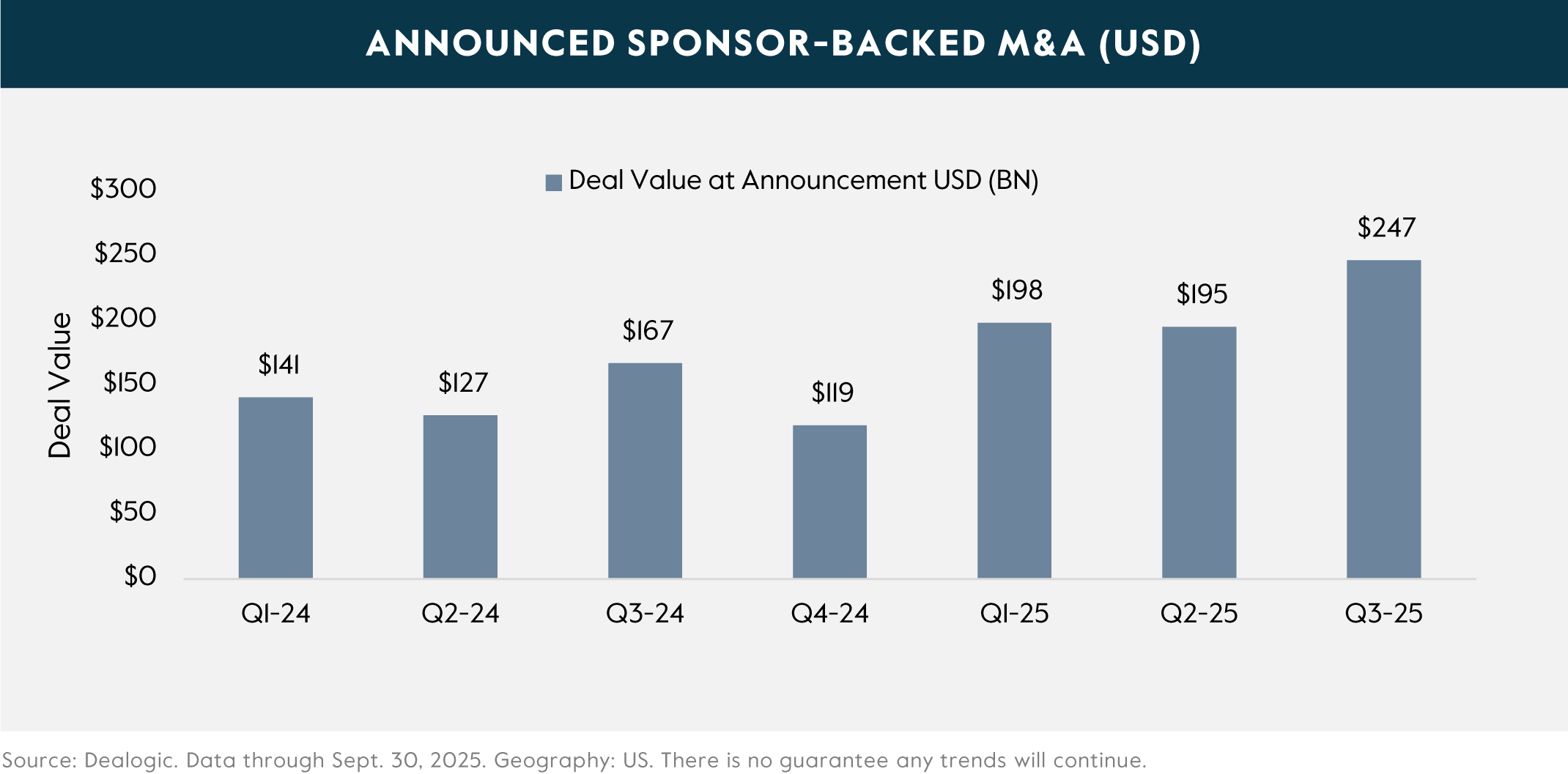
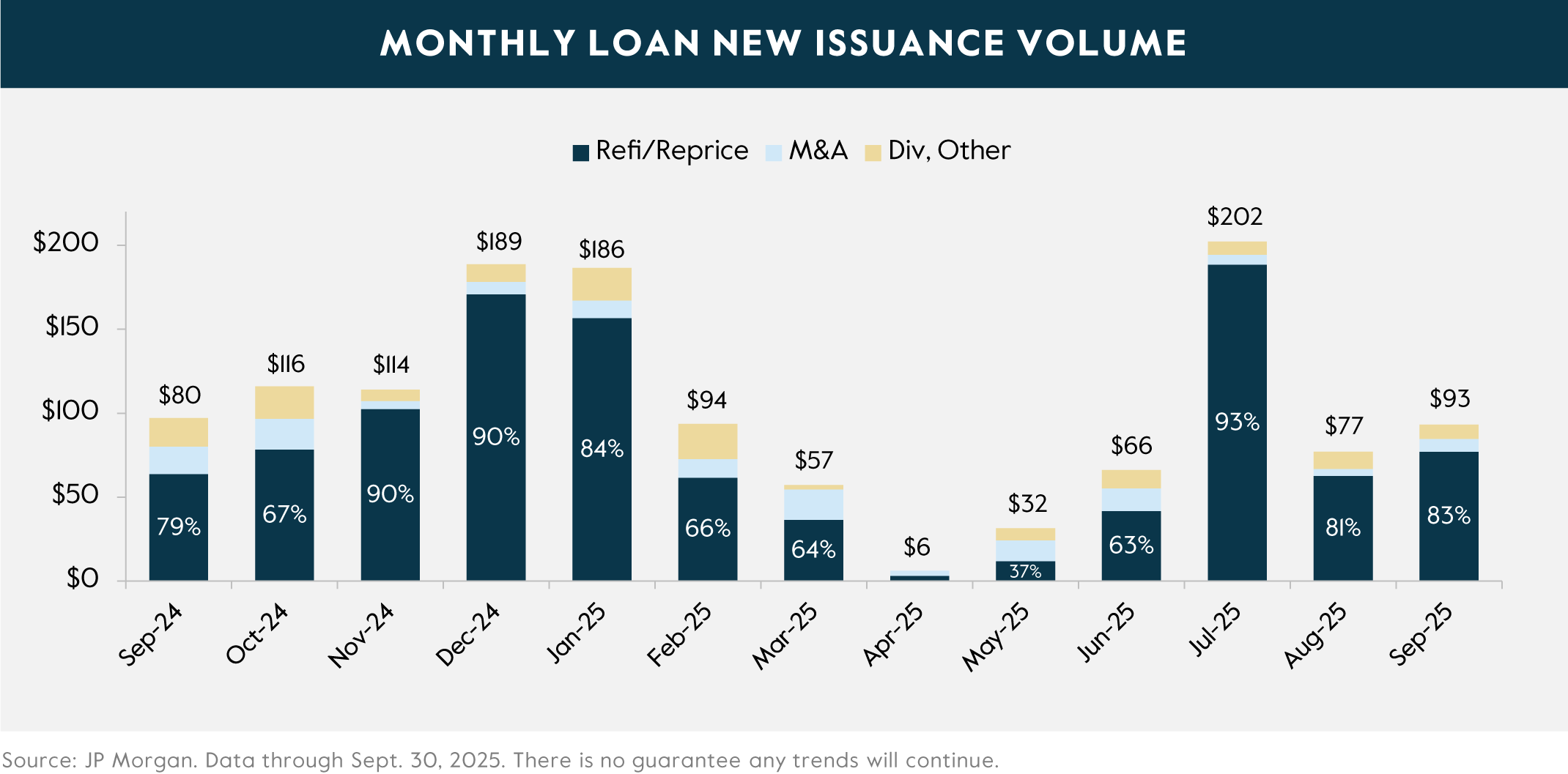
As illustrated in the chart above, US sponsor-backed M&A has steadily outpaced 2024 volumes throughout 2025 with further acceleration in Q3-2025 ($247 bn of volume up +48% YoY). While M&A activity from financial sponsors is increasing, it has been lower than historical averages, leading to a lack of net new loan supply in the BSL market for the last couple of years. Public loan buyers (primarily collateralized loan obligations (CLOs), mutual funds and separately managed accounts) were left chasing an “imbalanced technical” (i.e. more lenders than borrowers), which led to a wave of repricing and refinancing activity (see chart below). The technical was exacerbated by steep competition from private credit lenders for many of the same assets. This competition led both markets to gradually offer tighter spreads and more aggressive structures to compete for the limited investment opportunities while maintaining deployment levels.
The two areas where the BSL market can compete with private credit are price and structure, particularly price. New issue spreads for single-B issuers are now at the tightest level since 2008. The highest quality (BB) issuers can achieve new issue spreads of S+150 bps, and most B3 borrowers (typically the lowest quality rating acceptable to the market for syndicated offerings) can achieve spreads in the S+275–350 bps context. That is particularly relevant for sponsors as most sponsor-backed credits are rated B2 or B3. Spreads for high-quality new-issue private credit deals, on the other hand, are in the context of S+450–475 bps. While that is significantly lower compared to historical private credit pricing range of S+550–600 bps, it is still considerably wider than where the performing BSL market will price deals.
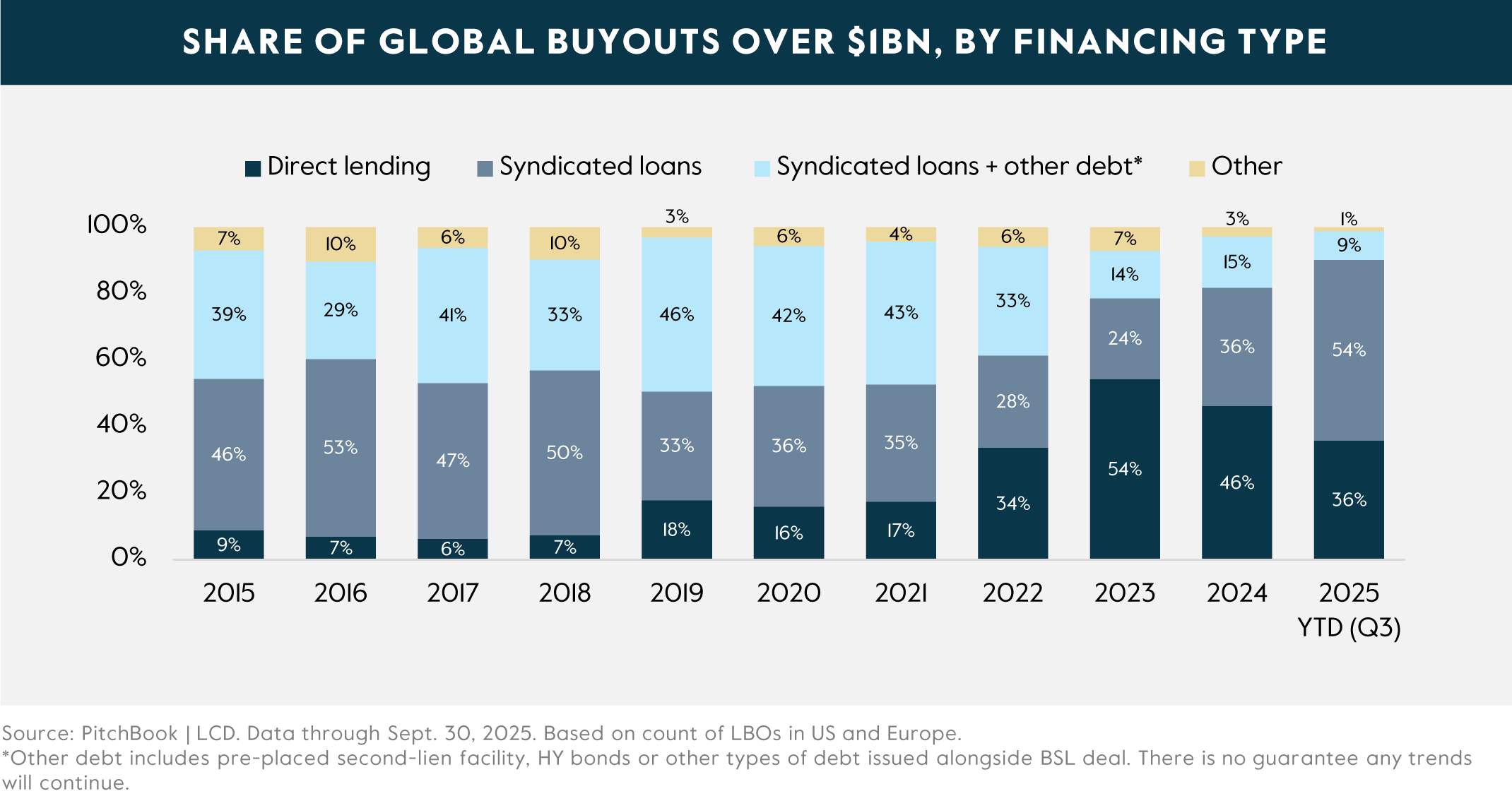
Though price is a clear advantage for the BSL market in the current environment, it should be considered in the context of leverage capacity and other structural flexibility. Private credit retains several structural advantages—notably, no requirements for ratings, the absence of a lengthy syndication process, and no post-closing trading (yes, no trading!). Traditionally, private credit could offer higher leverage in one tranche (i.e. the unitranche) than the BSL market where borrowers typically have to consider adding higher-cost junior capital to reach a comparable leverage level. The BSL market, however, has started to compete on leverage capacity as well. Historically, maximum first lien leverage capacity typically capped out around 5.5–5.75x EBITDA for most borrowers, but, in recent months, BSL lenders have shown a willingness to finance transactions in excess of 6x, which is closer to the context of private credit’s unitranche market. More aggressive appetite has led to the BSL market regaining share of global buyout activity.
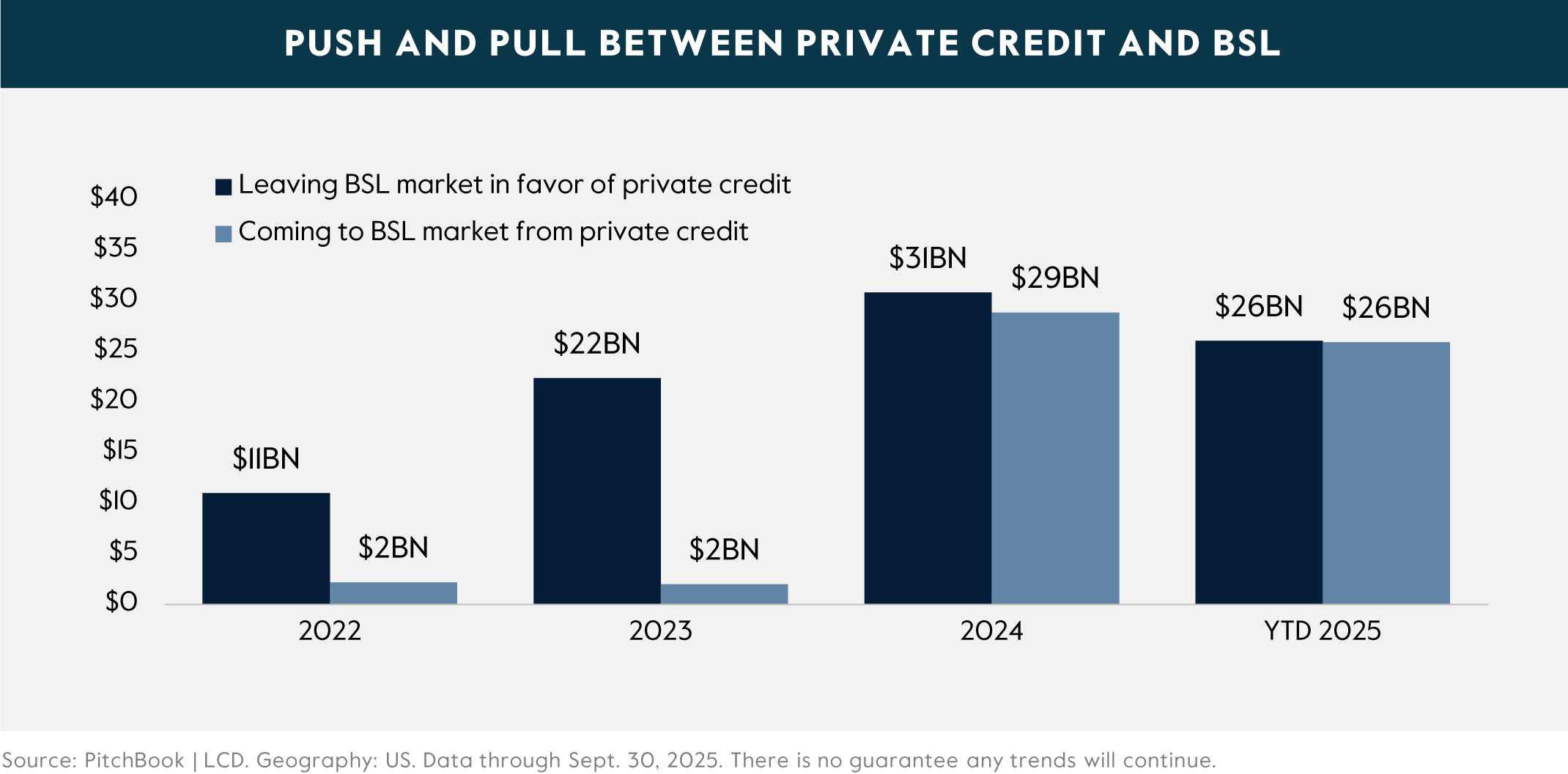
The enhanced competitive spirit of the BSL market has attracted several borrowers looking to refinance their existing private credit capital structures, with some mixing lower cost refinancings with higher leverage to drive dividends. The fact that the BSL market is accepting dividends for first-time issuers is representative of the strength of the current market and lack of new M&A supply—typically the market pushes back on such transactions. Borrowers continue to move between markets based on their preference for execution, but the BSL market has at least started to attract capital back to the public side.
Increased competition between the BSL market and private credit has accrued to the benefit of leveraged finance borrowers, particularly financial sponsors. The heat in markets at the moment, however, is a derivation of the earlier-mentioned supply-demand imbalance. As M&A activity picks up and supply increases, the froth is expected to come out of the market and likely push spreads wider. Net new supply has ticked up in recent weeks as more new money deals have come to the BSL market from new acquisition financings. As such, the percentage of loans trading at or above par fell from 50% on September 18th to 33% on October 8th[1] while the overall secondary market was effectively flat. Lenders were effectively selling high dollar price loans to buy new supply at a discount!
We don’t intend to sound an alarm bell on the overall leveraged lending market. Any spread widening in the coming months may be offset by reductions in the base rate. Borrowers acting now, however, may seek to capture more of that expected rate reduction (50 bps of cuts priced through year-end and another 75 bps in 2025) to the extent they lock in historically low spreads before the imbalance corrects itself.
1. Source: JP Morgan
Economic and market views and forecasts reflect our judgment as of the date of this presentation and are subject to change without notice. In particular, forecasts are estimated, based on assumptions, and may change materially as economic and market conditions change. The Pacharbor Capital Group has no obligation to provide updates or changes to these forecasts. Certain information contained herein has been obtained from sources prepared by other parties, which in certain cases have not been updated through the date hereof. While such information is believed to be reliable for the purpose used herein, The Pacharbor Capital Group and its affiliates assume no responsibility for the accuracy, completeness or fairness of such information. References to particular portfolio companies are not intended as, and should not be construed as, recommendations for any particular company, investment, or security. The investments described herein were not made by a single investment fund or other product and do not represent all of the investments purchased or sold by any fund or product. This material should not be construed as an offer to sell or the solicitation of an offer to buy any security in any jurisdiction where such an offer or solicitation would be illegal. We are not soliciting any action based on this material. It is for the general information of clients of The Pacharbor Capital Group. It does not constitute a personal recommendation or take into account the particular investment objectives, financial situations, or needs of individual investors.