
How Much Does AI Rhyme with shAle?


It is often said that history doesn't repeat itself, but it does rhyme. Given recent concerns around AI capex budgets—with companies like Oracle and Google spending at or above cash flow—we thought it useful to ask: how much does this AI technological revolution rhyme with the shale revolution of 2010-2020?
The shale boom was arguably the most notorious "growth at all costs" capex cycle in the modern era, where energy industry-wide capex reached 110-120% of cash flow at its peak (see Exhibit 1). On the eve of the 2014 oil price crash, some energy companies were spending north of 200% of cash flow.
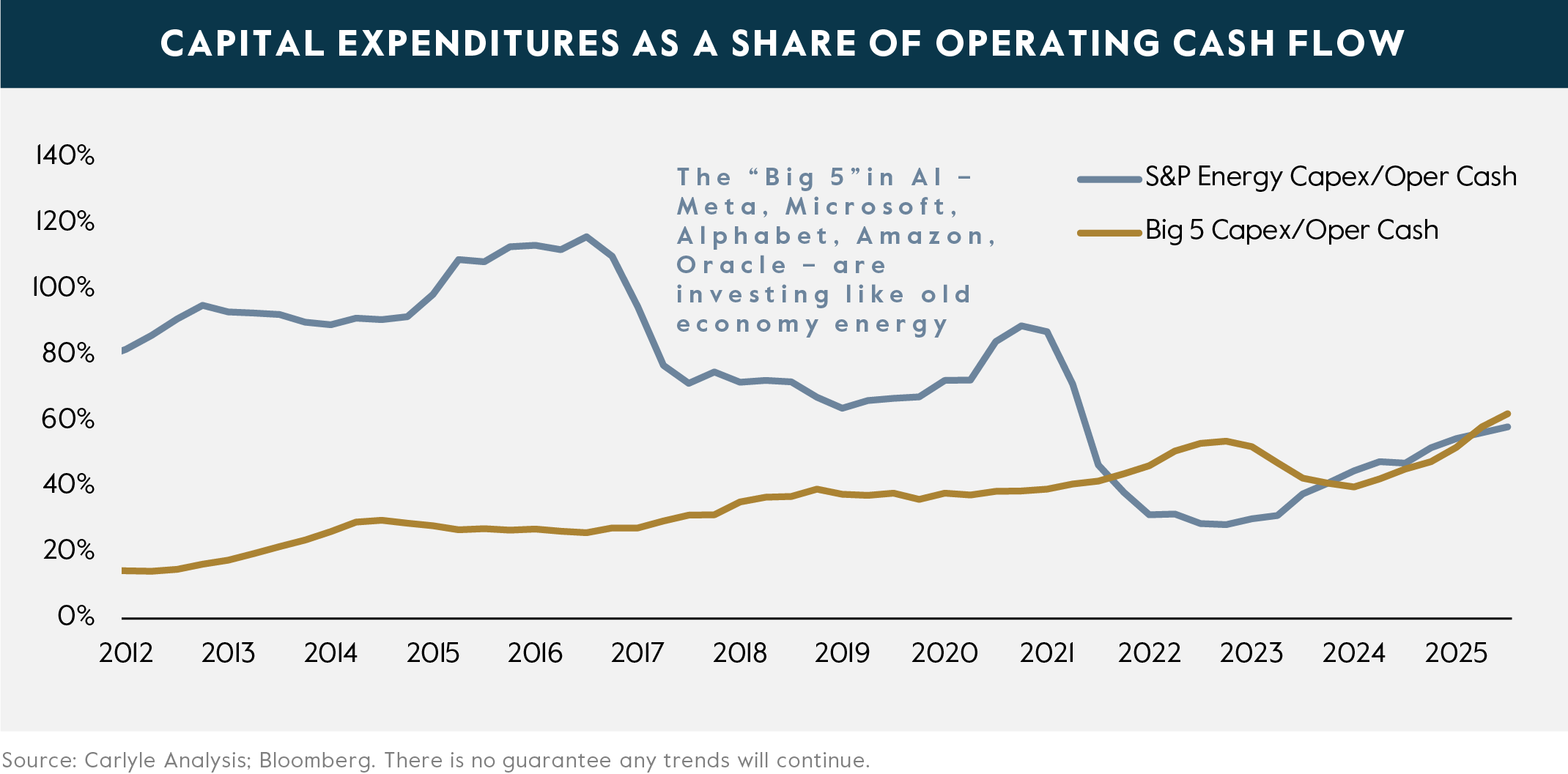
These parallels run deep. In 2014, disdain for the technology sector echoed calls that it was "cheap for a reason," a likely reflection of scarring from the dotcom bust. This mirrors today's disdain for energy, where the 2014-15 crash still haunts the industry. Oddly, there are more fears today around an ‘oil supply glut’ after a decade of reigning in spending than there are fears of a ‘compute supply glut.’
Despite the bullish energy narrative in late 2013 and the bearish concerns around technology, what happened after 2014 through the end of the decade was nothing short of epic. Technology went on to create $9 trillion of wealth while energy destroyed 41 cents on every dollar invested, wiping out $2.6 trillion in equity. While much of the equity was lost, bond holders were made whole in the end. Management teams did extremely well, but the biggest winners of the shale revolution were US citizens and their government.
Energy and technology are arguably the two most important sectors in the economy. If you cannot turn the lights on, nothing can happen and if you don’t innovate you will never progress, rendering important sectors like finance and healthcare useless without the other two. This is why market leadership has rotated between energy and technology for decades. At the end of the 1970s-80s commodity cycle, Exxon was the world's largest company. By 2000, Microsoft held that crown. By 2010, ExxonMobil and PetroChina vied for it. Today, the top three are Nvidia, Apple, and Microsoft—all technology companies.
This energy-technology leadership rotation was historically driven by respective capex cycles that were separate and distinct yet always ended the same way: in a bust given the long lead times in investment. The system would debottleneck energy, which created deflationary pressures and lower interest rates which, in turn, gave technology the room to run until energy resources were depleted again. Historical patterns paint a pretty simple story until now.
If the ‘asset heavy’ super cycles of the 1970s and 2000s were all about physical assets from natural resources (call it ‘atoms’ as in the periodic table), and the ‘asset light’ super cycles of the 1990s and 2010s were all about technology assets from innovation (call it ‘bits’ as in memory bytes), then the 2020s are shaping up to be a decade where the bits converge with the atoms, creating new ‘bit-atom’ commodities like cryptocurrencies and AI compute. Ultimately, Bitcoin is ‘mined’ by burning vast amounts of electricity from coal, gas and other atoms to create a bit-atom commodity we call cryptocurrency. Nowhere else is this convergence between bits and atoms greater than with the hyperscalers that are trying to put steel and copper into the ground as if they were asset-heavy natural resource companies.
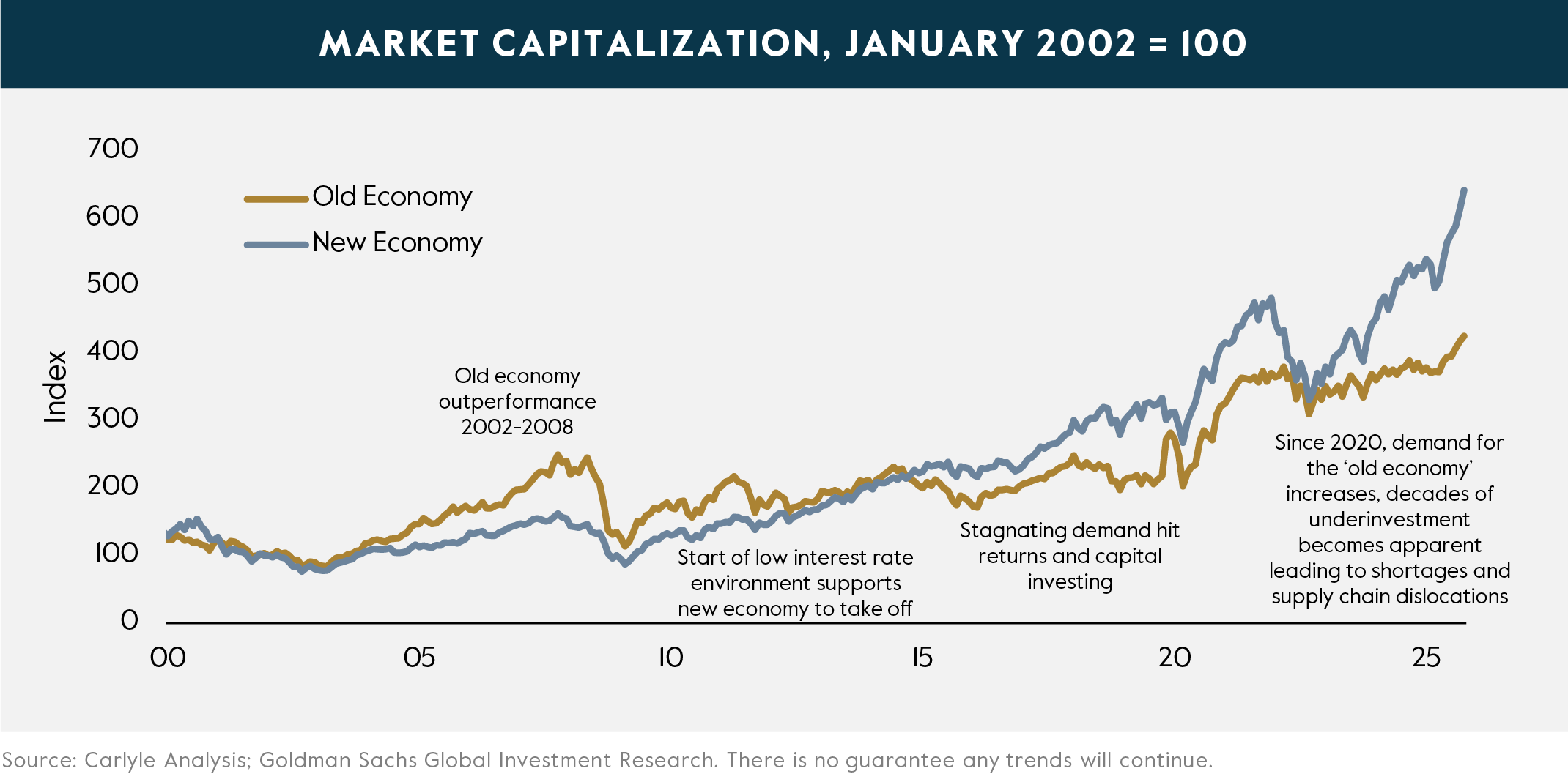
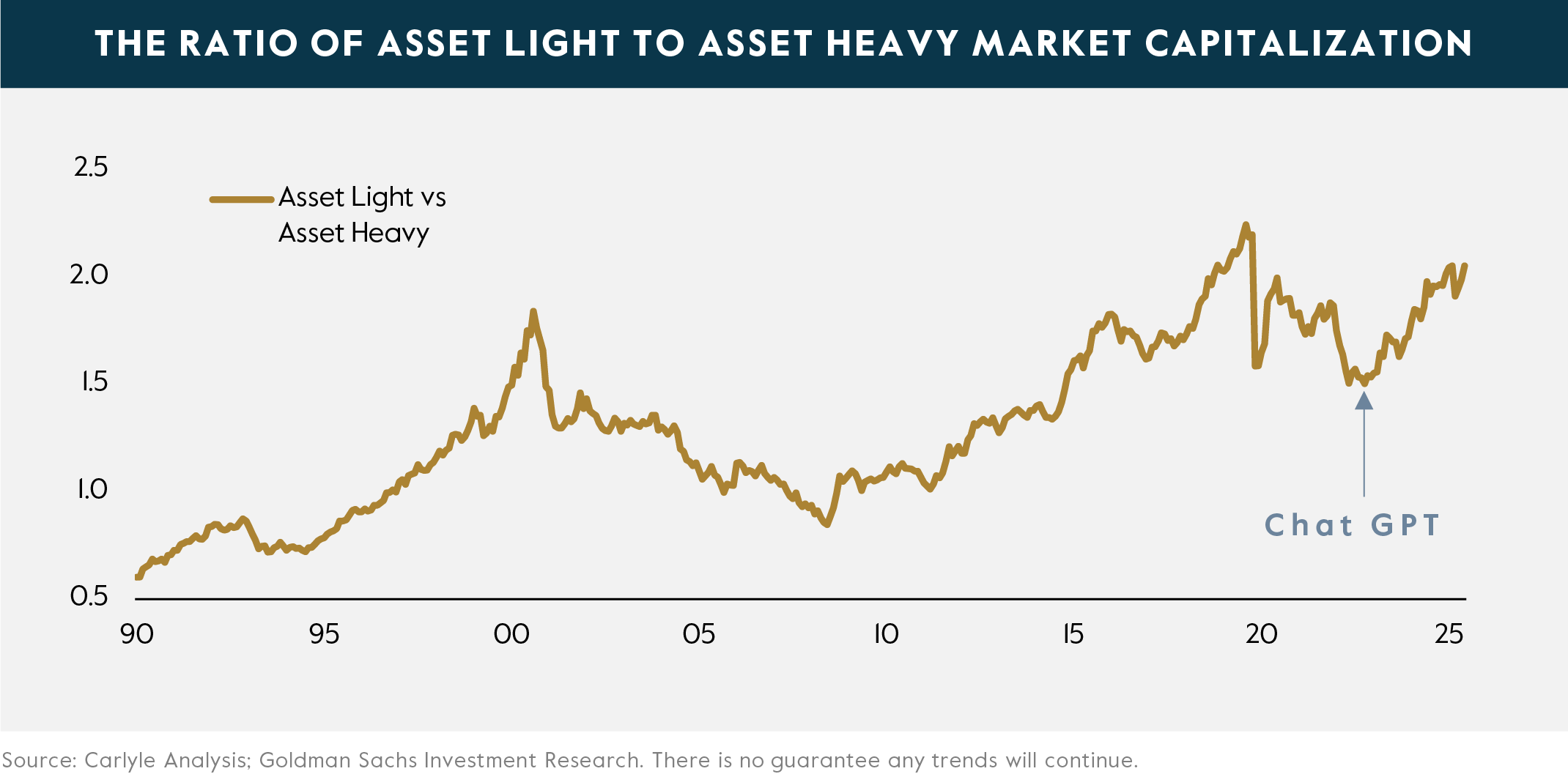
Natural resources, however, are old economy industries where reinvestment runs far higher than technology, so for technology spending to reach energy industry levels should raise a lot of questions. Are they asset-light virtual companies or are they asset-heavy natural resource companies? If they are, the multiple rating is vastly lower for asset-heavy companies (see Exhibit 2). In the end, these technology companies are now producing a commodity called ‘AI compute’ priced in $/hour much like electricity priced in $/MWh or oil in $/bbl.
Assessing the multiple a technology company should receive is one question, but what the price is for their commodity is a separate question. Big Tech AI is now producing a physical commodity with a supply and demand balance just like an energy company. The confidence in forward AI compute prices stabilizing, such as the Silicon Data H100 Index benchmark holding in a $1-$2/hr range, echoes the same confidence that the US shale producers had in $100/bbl oil that drove their spending far above cash flow (see Exhibit 3).
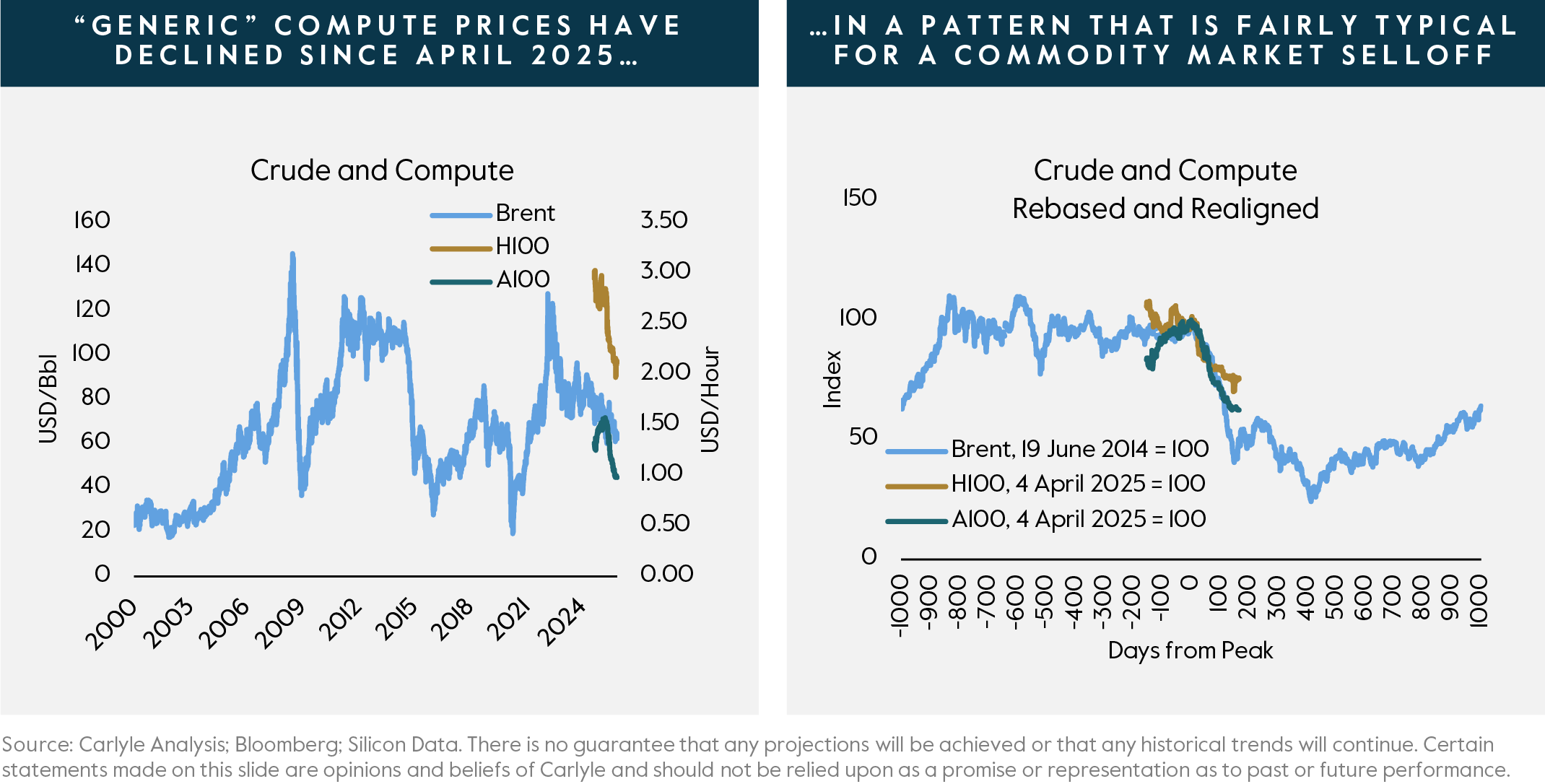
Instead of $100/bbl oil, at the end of 2015 the oil producers received c.$30/bbl oil as they all brought the supply online at the same time and in far greater quantities than anyone expected. This surge in US production, in turn, triggered a price war with the lower cost producer Saudi Arabia for market share. The oil market collapsed not because demand failed to materialize, as many now fear with AI, but because petroleum engineers exceeded expectations by lowering costs and producing substantially more. At the beginning of the 2000s commodity super-cycle, we had a saying: “Don’t bet against an engineer. Give them enough time and money and they will solve the problem.” We knew a bust was coming as one inevitably does, but it came much faster than we ever thought possible.
In the technology industry, this would be the equivalent of compute prices going to $0.30-$0.50/hr despite confidence of it stabilizing above $1/hr. Ironically, the variable costs for AI compute are around 25-35%, comparable to oil in 2015 when it found support around just $30/bbl. If, analogously, we replace low-cost Saudi Arabian oil supplies with low-cost Chinese AI compute technologies combined with cheaper foreign providers then the narrative could look eerily similar. This may already be happening to some degree as recently as early 2024 the industry had “targeted” a floor around $4/hr for H100 rental prices over the next four years, but today they are already at $2.13/hr. The phrase ‘price war’ is already being used.
Much like the tech analysts covering AI compute prices today, few oil analysts were outright bullish on oil prices in late 2013. In fact, we went neutral in October 2012 due to shale, but we saw a cost structure in that $85-$100/bbl range, and we were confident oil prices wouldn’t dip too far below that range. Two things happened. First, the surge in US production in 2014 was nearly 2.5 times expectations. This not only triggered a price war with Saudi Arabia for market share, as we mentioned above, but it also took out all of the higher cost producers such as deepwater drillers that were key to that higher-cost price support.
The industrial organization parallels are also strikingly similar. AI, AWS and Azure are the integrated "deepwater" operators—comprehensive platforms with premium pricing, i.e. BP and Shell. Now we're seeing the "shale" equivalent: specialized compute providers like CoreWeave, Lambda Labs, and even Chinese competitors like DeepSeek offering dramatically lower-cost alternatives. DeepSeek's recent models match GPT-4 performance at a fraction of training cost. This is the shale playbook: achieve comparable output with radically lower input costs, then scale aggressively. Undercutting AI, AWS, and Azure sounds absurd now, but predicting in 2013 what would ultimately unfold for BP and Shell over the following decade would have sounded equally unthinkable at the time. An important distinction, however, is the incumbents like BP and Shell never completely embraced shale like the AI incumbents have. ExxonMobil, by contrast, did via acquisition.
Second, the 2014/15 collapse in oil prices triggered a massive macro repricing in everything from FX, rates, metals, agriculture, equities and credit. In other words, investors had enough of the asset-heavy old economy centered around China and rotated into the asset-light new economy centered in Silicon Valley, a regime the market has been in since 2014 despite a failed attempt to rotate back to asset-heavy in 2022 (see Exhibit 4). The result of this repricing was that an oil project that could earn a roughly 25% IRR in 2013 at $100/bbl oil could now earn a mid-teens IRR in 2016 at $50/bbl oil, provided there were no legacy costs.
For the survivors, the important point was that legacy costs were not locked in from the old regime. The most crippling legacy costs were mainly debt, land leases and midstream contracts. This is the most striking similarity. US oil producers in 2010-2014 would keep only drilling debt on their balance sheets. For everything else, they entered into long-term gathering, processing and transportation take-or-pay contracts with midstream special purpose vehicles (SPVs) and master limited partnerships (MLPs). This allowed them to outsource the remaining capex to the midstream in exchange for high-cost long-term contracts. In turn, the MLPs would then use the same contracts as bankable revenue to raise their own debt and equity.
Big Tech AI appears to be using the exact same playbook that the energy industry used as these arrangements clearly rhyme with today’s AI datacenter SPV arrangements. Finally, we cannot forget about the land grab, or the ‘race for positioning’ as the oil patch called it, which mirrors the AI ‘land rush’. These exorbitant costs were held until expiration at which point they could be renegotiated.
A big difference between AI and shale is that, during the shale revolution, no one would ever have mentioned monopoly in the way that the term is thrown around today in the context of generative AI. The shale revolution was fundamentally about decentralizing the remnants of the industry’s old Rockefeller empire into a network of highly efficient, scrappy producers. Some argue that it makes sense for Big Tech AI to spend more than 100% of cash flow if a single generative AI model can achieve monopolistic profits; however, thus far AI looks more like a basic commodity industry. It’s perfectly fine for AI to be a commodity, of course: just don’t be surprised when industry multiples get priced like one.
Economic and market views and forecasts reflect our judgment as of the date of this presentation and are subject to change without notice. In particular, forecasts are estimated, based on assumptions, and may change materially as economic and market conditions change. The Pacharbor Capital Group has no obligation to provide updates or changes to these forecasts. Certain information contained herein has been obtained from sources prepared by other parties, which in certain cases have not been updated through the date hereof. While such information is believed to be reliable for the purpose used herein, The Pacharbor Capital Group and its affiliates assume no responsibility for the accuracy, completeness or fairness of such information. References to particular portfolio companies are not intended as, and should not be construed as, recommendations for any particular company, investment, or security. The investments described herein were not made by a single investment fund or other product and do not represent all of the investments purchased or sold by any fund or product. This material should not be construed as an offer to sell or the solicitation of an offer to buy any security in any jurisdiction where such an offer or solicitation would be illegal. We are not soliciting any action based on this material. It is for the general information of clients of The Pacharbor Capital Group. It does not constitute a personal recommendation or take into account the particular investment objectives, financial situations, or needs of individual investors.