
Private Equity Explained
What is private equity?
Private equity funds raise capital from investors, which is then invested into portfolio companies. In traditional closed-end private equity funds, the private equity fund acts as the general partner (GP), while the investors are considered limited partners (LPs). Both the GP and LPs hold ownership stakes in the portfolio company. However, the general partners (fund managers) play an active role in guiding the company’s strategy, operations, and growth, while limited partners take a more passive role, primarily providing capital.
The core objective of private equity investing is to actively shape the operations, strategy, and financial health of the company. Through hands-on management, private equity firms aim to create value by streamlining operations, reducing inefficiencies, and implementing strategic growth initiatives. Over time, once the portfolio company improves, private equity investors look to exit the investment for a profit, often to other financial buyers or strategic acquirers. In some cases, companies may be large enough to consider an initial public offering (IPO) though this is less common in smaller and mid-size companies.
Potential portfolio benefits¹
Larger investment pool
Access to small and mid-size companies
Diversification
Potential for higher returns
At-a-glance:
Private equity v. public equity
Private equity and public equity are two different ways to invest in companies, differing mainly in how investments are managed and how easily they can be bought or sold. They also tend to behave differently with markets and generate returns through different mechanisms.
| Private equity | Public equity | |
|---|---|---|
| Market correlation | Generally less sensitive to market fluctuation | Typically, sensitive to market fluctuation |
| Control & active management | GPs and large LP investors typically actively contribute to company value creation plans, including selection of company management | Generally passive approach outside of activist investors |
| Liquidity | Less liquid | More liquid |
| Returns |
|
|
Asset class characteristics are presented for educational purposes only and are summary in nature. They are not intended to reflect past or future performance and should not be relied upon as investment advice or a recommendation.
Perspectives in private equity

History of the secondaries market
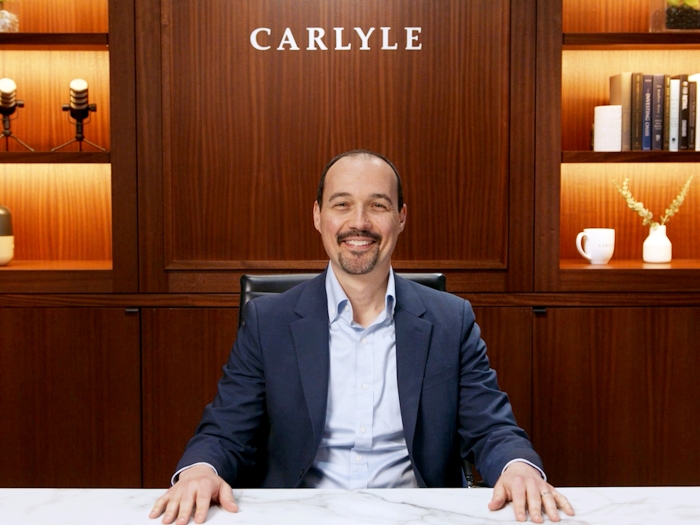
David Rubenstein explores how the secondaries market evolved from a niche liquidity solution into an increasingly important part of private markets, helping investors actively manage portfolios, access liquidity, and support long-term value creation.
Private equity solutions
Private equity firms employ a variety of strategic approaches to managing and enhancing their portfolios: Secondaries, Co-Investments and Primaries. Through investments in private companies and strong alliances with reputable global GPs, private equity firms offer fund structures that seek attractive returns at potentially lower volatility than the public markets.
Each of these strategies offer different risk and return profiles with the potential to contribute different sources of return at different times.
| Investment strategy | Anticipated return timing |
|---|---|
Secondaries Involve the buying and selling of pre-existing private equity fund interests or portfolios, often from other investors seeking liquidity
| Short to Medium-Term
|
Co-Investments
| Medium to Long-Term
|
Primaries
| Medium to Long-Term
|
Asset class characteristics are presented for educational purposes only and are summary in nature. They are not intended to reflect past or future performance and should not be relied upon as investment advice or a recommendation.

The history of private equity

Demystifying the secondary market

Finding value beyond technology concentration
Secondaries in practice

Introduction to the secondaries market

The brief case on the J-curve in private equity




Access the power of private equity
1. There is no assurance that any portfolio construction objectives can be achieved or that any such portfolio will be profitable. Diversification does not eliminate the risk of loss.
2. Source: Pitchbook, February 2025. For illustrative purposes only. There is no assurance that any trends will continue.
3. Source: Pitchbook, accessed 9/30/2024. There is no guarantee trends will continue. Based on comparison of performance of MSCI ACWI and MSCI’s Burgiss Global Private Equity Fund Index from 1990 to 2024. An investor cannot invest directly in an index.
Investing in a fund involves a high degree of risk, including the risk that you may receive little or no return on your investment or that you may lose part or all of your investment. There is no assurance that any portfolio objectives can be achieved or that any such portfolio will be profitable. Diversification does not eliminate the risk of loss. The information provided herein is for educational purposes only. It does not constitute investment advice or recommendations and should not be relied upon as a basis for making an investment decision. It does not constitute a personal recommendation or take into account the particular investment objectives, financial situations, or needs of individual investors. Click here for a copy of the Form CRS for TCG Capital Markets. Click here to check the background of the firm on FINRA’s Broker Check.